

Pope Leo XIV Will Not Be Another Francis
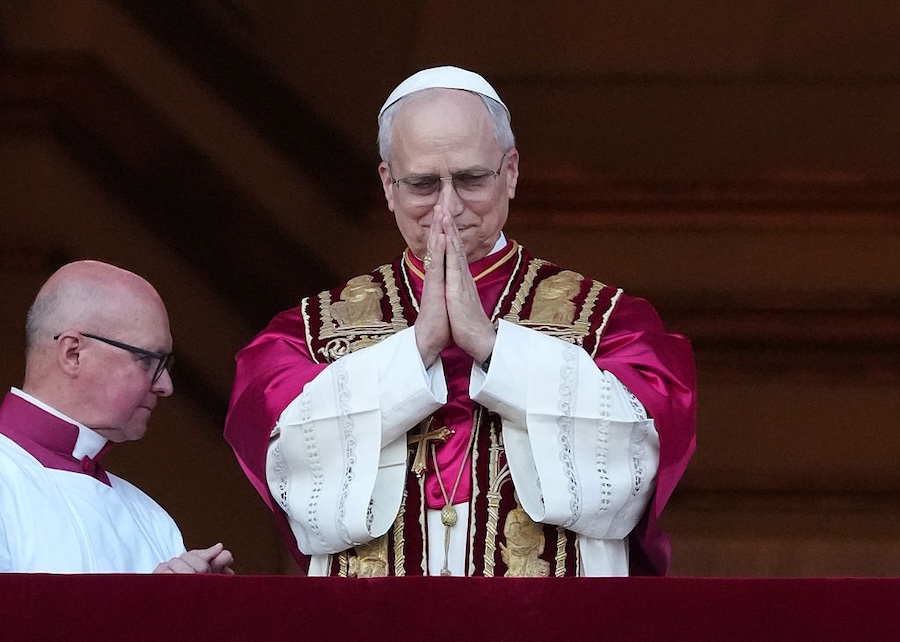
Newly elected Pope Leo XIV is seen for the first time from the Vatican balcony on May 8, 2025 in Vatican City. The Conclave of Cardinals took just two days to elect Cardinal Robert Francis Prevost, who will be known as Pope Leo (Leone) XIV, as the 267th Supreme Pontiff after the death of Pope Francis on Easter Monday. (Photo by Christopher Furlong/Getty Images)
Habemus papam! He is an American cardinal from Chicago named Robert Prevost who was a bishop in Peru, a teacher of the professed, a prefect under the late Pope Francis helping to appoint new bishops, and an Augustinian monk all throughout.
By most accounts, he seems moderate, siding with Francis on some issues, yet opposing abortion and the homosexual lifestyle. He has taken on the name Leo XIV — signaling solidarity with Leo XIII, who worked to modernize Catholicism in the wake of the industrial revolution, or perhaps the original Pope Leo the Great, who stopped bloodthirsty Huns from pillaging Rome.
Although time will tell what kind of pope Leo XIV will be, there has been a loud wailing and gnashing of teeth from conservative and traditionalist Catholics over his selection since last Thursday. Shellshocked from the overt hostility and corruption of Pope Francis, they were evidently hoping for a kind of trad-Trumpist successor to drain the Vatican swamp. Anything less would apparently spell disaster for the Barque of St. Peter.
With all due charity to my fellow Catholics, this kind of thinking is delusional. While traditionalist and conservative Catholic communities are growing and continue to play an outsized role in influencing both religious and secular Western culture, they are far from constituting a majority in the Church. Despite their progress, they largely exist on the margins because they refuse to compromise with secular leftism.
Why We Should Look at This Differently
Moreover, this group has lacked the leadership to become anything close to mainstream. Outside a few unfortunate bishops (i.e. Burke, Strickland, Pell) who stood up to Pope Francis, most bishops hoping to keep their position were forced to become his yes-men. Even supposed champions like Cardinal Robert Sarah looked more like the reform-of-the-reform types like Popes Benedict XVI and John Paul II than the TLM traditionalists or orthodox political conservatives (sometimes known as “Christian nationalists”) of today.
Consequently, the traditionalist and conservative Catholic movements have mainly been led by lay influencers and various online publications. On one hand, these voices have been good at articulating arguments against secular modernism and leftist ideology, and they have increased the overall vitality of Western Catholicism by encouraging family formation, adopting more rigorous spiritual practices, and spreading an authentic Catholic culture.
On the other hand, many in this movement tend to be insulated in self-contained parishes, social circles, and households that prevent them from truly understanding what the contemporary Catholic Church really is. Many of them can’t even fathom how Catholics could mourn the death of Pope Francis, who seemed like nothing more than an out-of-touch bully who hated true Catholics.
And yet most Catholics, the ones who do make up the majority and exist outside these bubbles, thought Francis was a great pope who cared for the poor and seemed down-to-earth. As Catholic writer Jules Gomes recently explained right here at The Stream, “The Francis-hating microchurch consists of a tiny minority of Catholics from the U.S. and Europe. The Francis-loving megachurch is made up of most Catholics who live in Asia, Africa, and Latin America, where Catholicism is thriving. And everyone I talk to in Italy, both Catholics and non-churchgoers, adore him.”
Centrist?
This is why there was simply no way that the latest conclave would elect a Pope Pius XIII, Pope Benedict XVII, or even a Pope John Paul III.
Then again, neither was it reasonable to elect a Pope Francis II. Beyond being very much a product of the Woke Era which has come and is on it way out, Francis was not an effective leader. Even if most people liked him as a person, church attendance and the accompanying finances fell dramatically during his tenure. While he knew how to inspire his fans, he relied heavily on his advisors to run things for him; he didn’t even know how to use the internet. More than anything else, this likely explains his inaction on sexual predators in the priesthood, his blind acceptance of COVID protocols, and his willingness to work with the Chinese Communist Party.
Rather, the new pope will most likely be something in the middle: a squishy moderate with enough charisma and competence to reform the Church while facilitating the areas of growth and dynamism happening both in the developing world as well as the conservative and traditionalist pockets in the modern West.
By this criteria, Cardinal Robert Prevost has a great deal to offer the Church, giving Catholics of all stripes reason to hope in a brighter future. His American and Augustinian background, along with his experience as a bishop and teacher in Latin America, all suggest that he will be practical, personable, and professional. He might not rewind the clock as many centuries as some might want, but neither will he senselessly pick the same quixotic fights that Pope Francis did.
For the most part, he seems ready to get to work, so we Catholics should try to help him anyway we can. As with most things, God doesn’t give us what we want, but what we need. Instead of succumbing to gloom and doom, we should place our trust in Him and His newest servant, Pope Leo XIV.
Auguste Meyrat is the founding editor of The Everyman, a senior contributor to The Federalist, and has written essays for Newsweek, The American Mind, The American Conservative, Religion and Liberty, Crisis Magazine, and elsewhere. Follow him on X and Substack.