

The Messy Legacy of a Woke Pope
There’s a popular quote from Maya Angelou that nearly all educators have encountered in their trainings: “I’ve learned that people will forget what you said, people will forget what you did, but people will never forget how you made them feel.”
This quote is meant to instill the superiority of emotional validation over objective accomplishment. Indeed, no one will care about teachers who work tirelessly — lecturing, grading and disciplining, and consistently producing classes of kids who perform well on assessments and then go on to do great things for their community. Rather, people will celebrate the fun teachers who engaged with their kids, made them feel welcome, and left them with some happy memories of goofing off with their classmates.
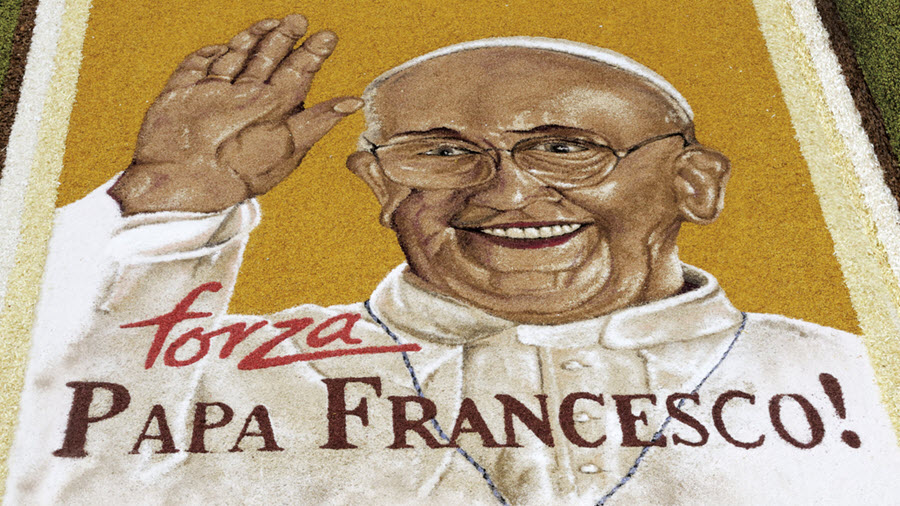
As it is for teachers, so it is for religious leaders. In mourning the death of Pope Francis, many will celebrate his life as one of constant affirmation. He made people, particularly non-Catholic leftists, feel good about themselves and gave them a vague hope in the future.
The Rock Star Pope
To be fair, this was no small matter. When Cardinal Jorge Bergoglio was elected pope in 2013 after the inexplicable resignation of Pope Benedict XVI, he was met with even more fanfare than President Barack Obama in 2008. Like Obama, he embodied the hopes and dreams of millions, a kind of DEI messiah that really would usher in a more diverse, equitable, and inclusive Catholic Church. True to form, he preached about helping the poor, saving the environment, and being humble and down to earth.
More importantly, the contrast with the pontificate of his predecessor, Pope Benedict XVI, couldn’t have been greater. While kind and humble himself, the previous pope was first and foremost a scholar who mostly shunned the spotlight and devoted himself to resolving the major intellectual battles of postmodernity. Unlike Pope John Paul II who came before him or Francis after him, Benedict was never a rock star preaching to record-setting crowds of people.
More significantly, Benedict was far less ecumenical than John Paul and Francis. He didn’t host interreligious prayer rallies, nor go out of his way to wash the feet of Muslim women or be interviewed by atheist journalists. Instead, he explicitly repudiated such moral and religious equivocation and dared to point out the intellectual incoherence of Islam — which was then proven correct when Muslim extremists terrorized churches as a response.
Thus, however much Benedict labored to reform the Church after John Paul’s saintly yet sloppy tenure, and however brilliantly he articulated the profundities of Catholicism, most people simply remembered how he made them feel: guilty, mediocre, and incredibly stupid. For conservative Catholics like myself, this seemed appropriate when we were seeing our beloved religion succumb to hollow ideologies of multiculturalism, relativism, and neopaganism. For everyone else, it was an unpardonable offense.
The Globalist Pope
Naturally, Pope Francis went in the opposite direction, doing his utmost to convert the Church into a leftist NGO. He prioritized the same things as leftist secular governments, had the same soft spots for dictators and communist regimes, and treated moral controversies with unbelievable flippancy. As promised, he “made a mess” by promoting shameless cronies and demoting principled detractors, allowing chronic problems to fester, and stomping on the few instances of growth in the Church. Catholic writers John Zmirak and Jules Gomes both have done a fine job of detailing Francis’s many failures at The Stream.
And yet this was as much a consequence of the surrounding culture as Francis’s Peronist sensibilities. Francis had parallels all over, leaders who were more symbolic than real and who prioritized generating good feelings over actual accomplishment. Only recently have we come to see this was the Woke Era, a time when elites in every institution fixated on perception and assumed reality would follow even when it never did. As such, Catholic progressives ultimately waited in vain for the “Francis Effect,” a predicted mass revival of religious fervor that would result from his election.
Rather, what resulted from Pope Francis’s leadership was worldwide religious decline and ever worsening moral confusion. Leftist pundits will do their best to airbrush his legacy, but even Francis’s biggest fans cannot deny that the hype-filled hopes surrounding him were largely unfounded and unfulfilled.
This means that whoever inherits the papal throne will have several serious challenges confronting him, which in turn means he will have to dispense with woke foolishness and worldly popularity. Even if Francis appointed a majority of squishy yes-men to the Conclave, they have to realize that another mess-maker of a pope will easily make the Church’s current decline terminal and irreversible.
For the good of everyone, particularly Catholics, something needs to change. And at the heart of this change needs to be a repudiation of Maya Angelou’s rule of remembrance. Put simply, we should get over ourselves and stop caring how people make us feel — not only because this is irrational way to judge people, but because if anything good is to come out of the next pope, it’ll probably feel more painful than otherwise.
Auguste Meyrat is the founding editor of The Everyman, a senior contributor to The Federalist, and has written essays for Newsweek, The American Mind, The American Conservative, Religion and Liberty, Crisis Magazine, and elsewhere. Follow him on X and Substack.