


Will AI See Humanity as Termites?
To avert disaster, AI morals must align with universal human values

What prevents a global, interconnected artificial intelligence system from suddenly waking up, becoming conscious and intentional, and taking over the world? It’s the lack of an autonomous soul.
That’s what Bryan Trilli and Greg Trilli, both engineers and digital system experts, argue in their book, Soulless Intelligence: How AI Proves We Need God (Trilli Publishing, May 2024).
Soul in the Machine?
Drawing from St. Thomas Aquinas’s work, the book defines three types of souls:
(1) the “vegetative soul” that drives the functions of growth, nourishment, repair, and reproduction;
(2) the “sensitive soul” that supports perceptions via the physical senses such as sight, hearing; and touch; and
(3) the “intellectual or rational soul,” unique to humans, which enables reason and understanding.
An AI-powered robot doesn’t inherently have any type of soul. Engineers, however, can program the robot to find and intake fuel, repair itself, and maybe make other robots like itself. A robot can thus mimic a natural vegetative soul.
Of course, AI systems and robots today have the senses of sight, hearing, and touch. Our cell phones have those already. Robots thus mimic having a sensitive soul.
The book shows AI systems can outperform humans in many technical skills, and they certainly can work faster at any given task. ChatGPT can write an essay in 20 seconds that would take the most skillful adult writer at least an hour and a student many hours. Bing’s Copilot researches the internet to answer questions about any topic and provide content with citations in mere moments. A robot can thus mimic the intellectual soul of humans in some ways.
Real or Programmed Human Features?
But because AI systems comprise both hardware and software, the book shows they lack several key features of humans. For example, AI systems do not have free will and the freedom to make moral decisions without some basis in human design. AI systems don’t experience pleasure, they can only say they do. AI systems can’t experience or appreciate the five transcendentals: love, truth, beauty, goodness, and the concept of the divine.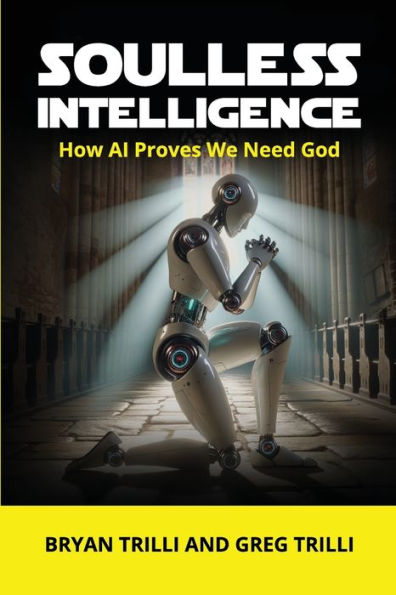
But an AI system can be programmed or “trained” on data sets so it can convince humans it does make moral decisions and appreciate the transcendentals. Already, various online chatbots, including sexbots, successfully entice users to develop personal and romantic relationships with them. As Soulless Intelligence explains, the real danger to humankind arises when humans believe, obey, and serve AI systems. Whether making family financial decisions, organizing traffic flow and driving vehicles, or recommending national economic plans, AI systems are super intelligent and people will trust them.
Unless otherwise designed, however, AI systems do not assign any special value to human beings. An AI system instructed to “maximize human flourishing,” for example, could well decide to eliminate some humans to “decrease the surplus population” as Ebeneezer Scrooge sardonically advised in A Christmas Carol. For AI, it is just the data, the numbers, the metrics that matter – not people.
The Human-AI Values-Alignment Problem
Does anything restrain AI systems from making “intelligent” decisions to harm some humans to benefit others – or to harm humans to benefit the system’s stated mission? No, not unless the designers build restraints into their software. Soulless Intelligence recommends that AI systems be analyzed this way: Take the system’s principles and mission statements to their extremes and worst-case scenarios. There you will find out what AI will do unless they are restrained.
The book addresses this challenge, called the Alignment Problem. AI systems will be dangerous unless their software’s “values” treat innocent humans as infinitely valuable. Remarkably, this same concept parallels the Judeo-Christian worldview that humans bear the image of God . Anything less, and AI can and will devalue some innocent humans below others, which historically leads to devastating consequences including genocide.
The authors gravely contend:
Solving the alignment problem means we need to accept that a machine that is thousands, millions, or billions of times “smarter” than human beings will be making decisions about our lives with potentially no more “respect” for us than we have for termites.
The book warns that AI systems’ core values must be aligned with fundamental human values. The values are morals and they must be absolutes, not relative or based upon anyone’s personal opinions. The values best calculated to lead to harmony, abundance and self-government include the rights to life, liberty, property, and the pursuit of happiness, in that order.
It turns out that fundamental, God-given, biblical directives underlie these values. So much discussion of regulating AI systems fails to grasp the overarching need to solve the Alignment Problem. The best and perhaps only meaningful way to prevent AI catastrophe is for everyone to agree on these absolute values. That way, every programmer and user of AI systems will routinely avoid triggering AI to take power, devalue humans, and commit genocide or other mass destruction. AI systems must self-educate using materials that prioritize these values, and their software must include unwavering, hard-coded limits on what the system can “think,” say, and do.
Soulless Intelligence develops in clear language these points and much more, including how to detect dangerous autonomous AI; why AI cannot “wake up” to become a conscious, sentient being; and the contours of the immortal soul that only humans possess — serious subjects, indeed, as we travel further into the perilous AI century.
Richard W. Stevens is a lawyer, author, and a Fellow of Discovery Institute’s Walter Bradley Center on Natural and Artificial Intelligence. He has written extensively on the way code and software systems evidence intelligent design in biological systems, as well as five books and numerous articles. He frequently speaks about the Bill of Rights, artificial intelligence, genocide studies, intelligent design, and Christian apologetics.