


Victories and Question Marks with Trump’s Meetings in the Middle East
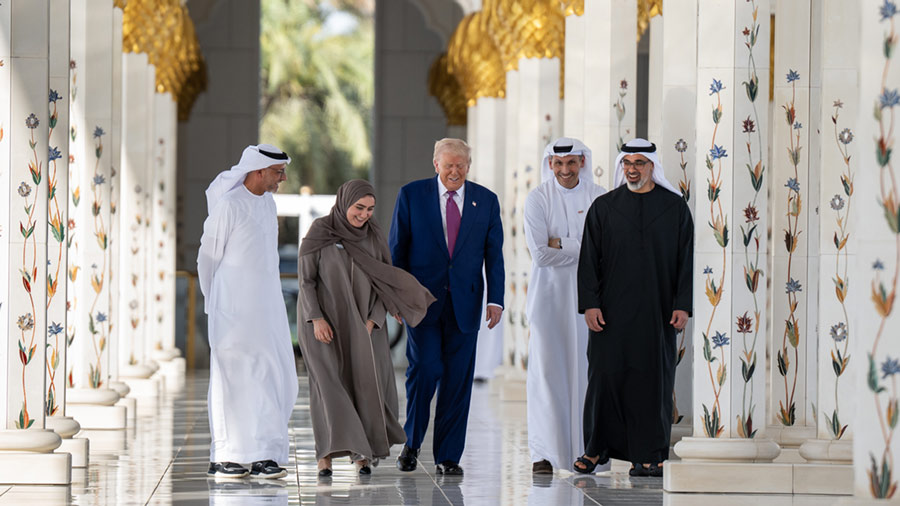
President Donald Trump tours Sheikh Zayed Grand Mosque, Thursday, May 15, 2025, in Abu Dhabi, United Arab Emirates.
The headlines describing Gulf States investing billions here, billions there, billions everywhere came roaring in last week as President Donald Trump embarked on a four-day tour of the Middle East.
Buildings in Riyadh, Doha, and Abu Dhabi were lit up with more American patriotic colors and flags than you’ll find on the Fourth of July in many Leftist American conclaves, as Qatar announced a deal for Boeing jets worth nearly $100 billion and Saudi Arabia committed to investing a whopping $600 billion in the United States.
America’s Dealmaker-in-Chief was in his element as a flurry of arrangements, pacts, and transactions were closed faster than a New York City real estate purchase, infusing a bolus of capital back into Uncle Sam’s workshops.
Goodness knows that America needs this Trump intervention to help her return to macro-economic fundamental practices and stop deepening the national deficit. But there are some concerns in all these deals that should have American Christians tapping the celebration brakes just a smidge – especially regarding Syria.
Kicking It with Terrorists
The trip to Riyadh resulted in two notable actions that are likely connected. The first is Saudi Arabia’s monumental commitment to invest $600 billion in the U.S.
The second was when Trump met with the suit-donning jihadist Abu Muhammed al-Jolani, currently the transitional president of Syria, and emerged with news that he was dropping sanctions that have been in place against that country for decades.
Something about the latter outcome doesn’t sit right. Trump doesn’t give something for nothing.
He framed the rationale for lifting the sanctions around al-Jolani’s leadership capabilities, describing him as a “tough guy [with a] strong past.” I’m not sure who briefed the president, but describing a previously budding star of the infamous Al Qaeda terrorist network as having a “strong past” is like saying convicted sex offender Jeffrey Epstein had “complicated habits.”
Added Trump, “I will be ordering the cessation of sanctions against Syria in order to give them a chance at greatness.” An admirable sentiment, to be sure, but hardline jihadi leaders aren’t exactly known for making any country great.
In fact, the opposite of greatness should be expected from al-Jolani, whose resume is replete with destruction, not construction.
Obviously, Trump knows that he’s rolling the dice by dealing with a consummate jihadi, so what’s really driving the cessation of sanctions?
The likely scenario is that Trump did in fact make a deal – but with the Saudis, not Syria. Riyadh wants a hedge against the Shia mullahs of Iran. Having Al-Jolani, who is a fellow Sunni Muslim, presiding in Damascus ensures Syria’s alignment with the Sunni bloc of the neighborhood’s volatile sectarian tapestry.
That’s why it’s reasonable to assume that lifting the Syrian sanctions was one of Saudi Arabia’s conditions for the $600 billion investment. Removing the sanctions will inject a modicum of financial and thus societal stability into Syria, which underscores what last week’s actions were all about: Stability.
In Syria, stability will help pave the way for al-Jolani to legitimize his leadership. In turn, a Sunni-run Syria helps Saudi Arabia in the balance of regional sectarianism. Finally, the Saudi investment in the U.S. serves to further the Trump administration’s objective of rebuilding macro-economic stability.
At What Cost?
While the Trump administration is serving up an investment feast, the Syrian deal is a gritty bite with a bitter finish.
It would have been easy to tie easing the sanctions if Syria would provide safety and tolerance for its religious minorities, particularly the hundreds of thousands of Christians whose spiritual ancestors were tasked by Christ with healing and baptizing the Apostle Paul.
In fact, their indigenous Christian ancestors inhabited the Middle East for hundreds of years before Islam emerged from the Saudi Arabian desert in the seventh century.
But they are now in the hands al-Jolani, a terrorist of such ill repute that the U.S. had a $10 million bounty on him until just five months ago. What’s more, the West will start to infuse money into the hands of a leader who declared that he will impose Sharia law and that “jihad is obligatory” against anyone who would try to prevent it.
You don’t need to know much about radical Islam to see that a fundamentalist like al-Jolani doesn’t simply loosen his jihadi beliefs overnight, especially when those beliefs put him on the throne in Damascus.
Changing his name, donning a western-style business suit, and leaving the RPG outside the meeting room doesn’t make al-Jolani a reformed and reasonable centrist any more than Bill Clinton stopped being Slick Willie after his grotesque tryst(s) with Monica Lewinski.
The Arab winter that I wrote about in December is indeed descending on the Valley of the Christians.
Joachim Osther is a freelance writer focusing on the intersection of culture and Christianity. He holds a master’s degree in theological studies from Veritas College and Seminary, and two degrees in the life sciences, a field in which he works as a strategist, advisor, and published author. He has been published at American Thinker, and is an occasional contributor to RaymondIbrahim.com.