


Today in History: The Patron Saint of Missouri Punishes Islamic Terrorists
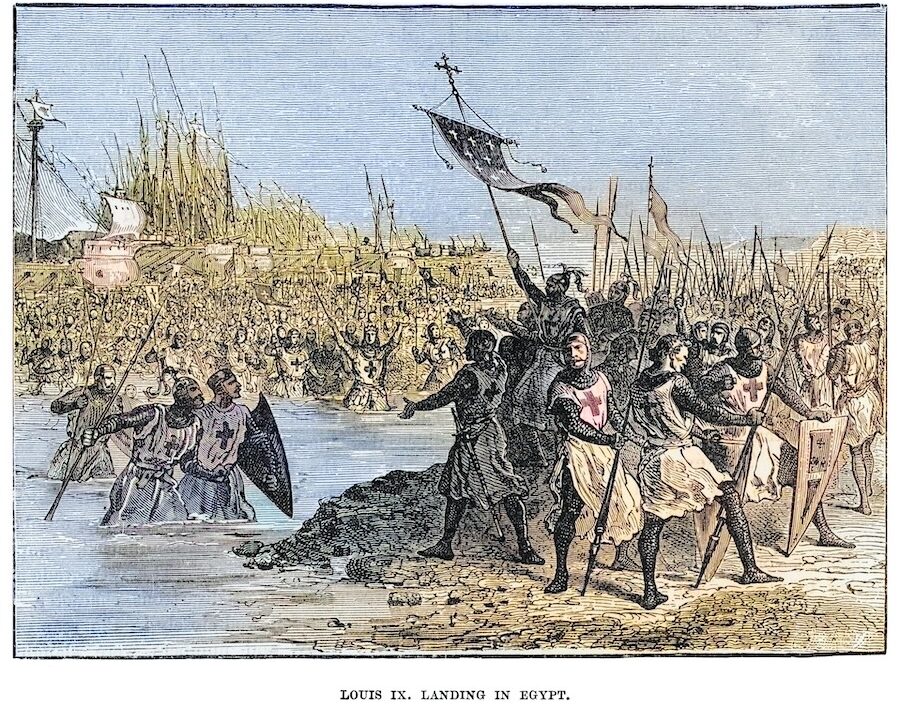
On June 6, 1249, King Louis IX of France — better known to posterity as Saint Louis — scored a dramatic victory against Islam.
It was late May, and the Seventh Crusade had begun to redress what was at that time the worst Muslim atrocities ever committed against the Christians of Jerusalem: According to the chronicle of Eracles, in 1244, a Muslim tribe known as the Khwarazmians, with the aid of the Egyptian sultan, massacred more than 30,000 European Christians — “men, women, and children … for these people took no prisoners, all they wanted to do was kill.”
Louis and his army, which consisted of some 25,000 Crusaders, set sail from Cyprus. Their destination, based on the standard Crusader logic that Egypt had to be neutralized before Jerusalem could be secured, was the Egyptian port of Damietta, also known as the “key to all Egypt.”
Because There Was a Cause
Considering that Damietta was also the focus of the Fifth Crusade (1217-1221), none of this came as a surprise to Egyptian sultan al-Salih Ayyub, the mastermind of the 1244 atrocities. He sent men under Emir Fahreddin to refortify Damietta’s garrison and hold the coast against any Crusader landing. He also sent a message warning Louis to forfend: “No one has ever attacked us without feeling our superiority,” the sultan boasted. “Recollect the conquests we have made from the Christians; we have driven them from the lands they possessed; their strongest towns have fallen under our blows.”
The heart of the Muslim world — from Iraq in the east to Morocco in the west, later Turkey, and for centuries Spain and the Balkans — were originally inhabited by Christians before Muslims conquered them. And Muslims, such as al-Salih Ayyub, enjoyed throwing this fact in their faces.
By June 4, the Christian fleet had anchored on the west bank of the Nile across from Damietta. Between it and the city, legions of Muslims lined the shore and river bank, where they “made a loud and terrible noise with horns and cymbals.”
Louis held a council aboard his ship. Although some said to wait for the rest of the fleet that had been delayed by a storm, Louis was set on taking the shore immediately. “Our men,” wrote Gui, one of the knights present, “seeing the lord King’s steadfastness and unwavering resolve, at his bidding made ready…to occupy the shore by force and go on land.” When his counselors urged him not to join the initial landing, due to the danger it posed, Louis responded, “I am only one individual whose life, when God wills it, will be snuffed out like any other man’s.”
Routing the Enemy
And so, on June 6, 1249, the Crusaders, to a loud battle cry, furiously paddled to shore and “in accordance with the lord King’s strict and most urgent command, hastily leaped into the sea up to their loins.” Clad in heavy iron and slowly plodding toward the coast, they were met by a hail of arrows. “Of all the ships, the lord King’s put in first,” continues Gui. “Louis leapt into the water up to his armpits and waded ashore, shield round neck, helm on head, and sword in hand.”
Jean de Joinville, a close friend of Louis’s who participated in the Crusade, continues: “So soon as they [Muslims] saw us land, they came toward us, hotly spurring. We, when we saw them coming, fixed the points of our shields into the sand and the handles of our lances in the sand with the points set towards them.” Confronted by this massive spike-studded shield wall, and seeing “the lances about to enter into their bellies,” the Muslims “turned about and fled” — all but one, who, thinking his comrades were charging behind him, was instantly “cut down.”
Thereafter, the Crusaders “fell manfully upon the enemies of the Cross like strong athletes of the Lord,” writes Gui: “The armed Saracens, stationed mounted on the shore, disputed the land with us…maintaining a dense fire of javelins and arrows against our men. And yet our men… pushed on and set foot on the land despite the Saracens.” The more the Muslims gave way, the more the Christians advanced onto dry ground. Before long, horses had been ferried over and mounted, leading to heavy, splashy cavalry charges, all under the cover of missile fire from the Christian fleet. Terrified by such daring, the Muslims tucked tail and ran.
Rather than falling back on and holding Damietta, Emir Fahreddin entirely fled the scene. On seeing this ignominious retreat, and not wanting to face what Muslim chroniclers called “the fury of the Christians,” the garrison in Damietta, followed by its entire citizenry, fled the city under the cover of night in great disorder and panic — “barefoot and unclad, hungry and thirsty, in poverty and disarray, women and children” — though not before cutting the throats or “dashing out the brains” of most of their Christian prisoners.
Reconsecrating a Defiled Church
A few escaped captives and slaves intercepted the Crusaders on their march to Damietta, which they were astonished to find completely deserted. On the morning after this spectacular start to his Crusade, Louis and his men went to Damietta’s chief mosque. “Here, three days earlier,” a shocked Gui wrote, “the prisoners categorically assured us, the most filthy Mahomet had been glorified with abominable sacrifices, cries from on high, and the blast of trumpets.”
But because the mosque was formerly a church — “where [Coptic] Christians long ago had been in the habit of celebrating Mass and ringing their bells” — the king had the mosque purified with holy water and, “once it had been utterly purged of the pagans’ filth,” celebrated mass there. In this manner, and as Louis’s mother, Blanche, wrote to Henry III, “the site of the mosque, which some time ago — when the city was previously captured [by Muslims in the seventh century] — was the Church of the Blessed Virgin Mary, was reconciled and thanks were given there to God Most High.”
As these accounts make clear, thirteenth-century Europeans were not oblivious to the fact that all of the Near East and North Africa — not just Jerusalem — were originally part of Christendom. This comes out especially in the Crusaders’ talk concerning Egypt. For example, the foundation charter for the reconsecration of this church-turned-mosque-turned-church again, dated November 1249, makes the following assertions: “after this country [Egypt] is liberated from the hands of the infidels” and “when this land is liberated.” Similarly, Guillaume de Sonnac, the Grand Master of the Templars, wrote about how “the Lord King plans … to return the entire country [of Egypt] to Christian worship.”
Lofty aspirations, to be sure. At any rate, it was an amazing start to what would soon become one of history’s most epic crusades.
This article was excerpted from Chapter 5 of Raymond Ibrahim’s book, Defenders of the West: The Christian Heroes Who Stood Against Islam.