


The Dragon of Rhodes
Are dragons real? Is indirect disobedience to an edict sometimes better for society than minding our Ps and Qs? Raymond Ibrahim delves into both questions.
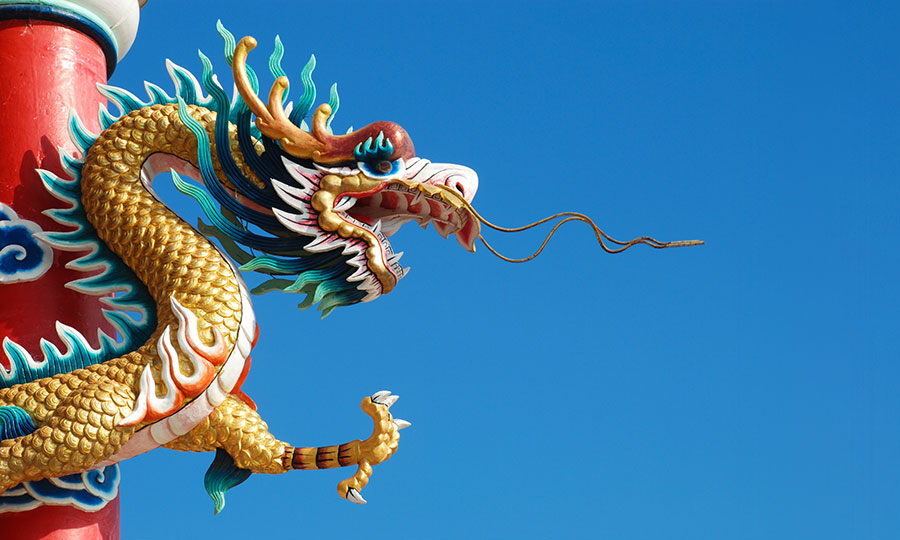
Sometime in the 1330s, what sources describe as a large, scaly dragon — nearly 70 feet long from snout to tail — terrorized the locals from its haunt in the marshes near Mt. St. Stephen, some two miles from Rhodes city. Livestock disappeared, as did shepherds who ventured too close to the beast’s lair.
On learning of this, several of the knights tried to flush it out and slay it, only to be killed and devoured. It reached the point that, on pain of expulsion, Master Hélion forbade them from “attempting anymore an enterprise that seemed above all human strength,” and bade the populace to refrain from going anywhere near the marsh.
One knight, Dieudonne de Gozon, who had on several occasions seen the monster, refused to relent and devised a plan. He took leave to return to his father’s castle in France, where he built a large replica of the dragon. He then trained two large dogs (variously described as bloodhounds or bulldogs) to attack this bestial facsimile whenever they saw him strike it, which he did daily as part of his own training. On returning to Rhodes, he “went down the mountain with his two dogs, advanced straight to the marsh and haunt of the serpent, which, at the noise he made, ran with open mouth and eyes darting fire to devour him.” Vertot continues:
Gozon gave it a stroke with his lance, which the thickness and hardness of its scales made of no effect. He was preparing to redouble his stroke, when his horse, frightened with the hissing and stench of the serpent, refused to advance, retires back and leaps aside, and would have been the occasion of his master’s destruction if he, with great presence of mind, had not thrown himself off. Then taking his sword in hand, and attended by his two faithful dogs, he immediately comes up to the horrible beast, and gives it several strokes in different places; but the hardness of the scales hindered them from entering, and the furious animal, with a stroke of his tail, threw him on the ground, and would infallibly have devoured him if his two dogs, according as they had been taught, had not seized the serpent by the belly, which they tore and mangled with their teeth, though it struggled with all its strength to force them to quit their hold. The knight, by the help of this succour, gets up, and joining his two dogs, thrusts his sword up to the hilt; in a place that was not defended by scales he there makes a large wound, whence a deluge of blood flows out.”
No Good Deed Goes Unpunished
Having thus slain the great worm, all hailed Dieudonne a hero. Carrying him on their shoulders, his brother knights rushed to Master Hélion with the joyous news. He, however, was wroth with the rebellious young knight for disobeying a direct order not to engage the beast (obedience being one of the three requirements of all religious orders).
Immediately this strict observer of discipline, without vouchsafing to hear him, or being moved in the least by the intercessions of the knights, sent him directly to prison. He next convened the council, where he represented, that the order could by no means dispense with inflicting a rigorous punishment on so notorious a disobedience, that was more prejudicial to discipline, than the life of several serpents would have been to the cattle and inhabitants of that quarter of the island… But the council prevailed, that he should only be deprived of the habit of the order; in short, the unfortunate knight was ignominiously degraded, and there was but a short interval between his victory and this kind of punishment, which he found more cruel and severe than death itself.
This draconian response was intentionally designed to impress on all the importance of absolute obedience in an order. As Vertot explains,
The grand master, after having by this chastisement performed the obligations due to the preservation of discipline returned to his natural temper … and was pleased to be pacific, and managed things in such a manner as to make them entreat him to grant a pardon, which he would have solicited himself if he had not been at the head of the order. At the pressing instances made him by the principal commanders, he restored him to the habit and his favour, and loaded him with kindnesses.
While this medieval story of a dragon slaying may be instinctively dismissed as pure myth — Siegfriedian parallels of a fatal sword thrust to the worm’s exposed underbelly are obvious — there are some factors to consider.
Myth or History?
First, the fourteenth century, when this incident is said to have occurred, was not the eighth century, when benighted Europeans were much more consumed by and prone to spread rumors of the fabulous. The Hospital, which recorded this incident in its annals, was an especially serious and rigorous organization that verified information. And whereas most myths center around ahistorical figures, in the case of the dragon of Rhodes, not only are actual historical figures such as Master Hélion of Villeneuve present, but the dragon slayer himself, Dieudonne de Gozon, was so real as to be elected Master of the Knights of Rhodes in 1346. Although he continued leading his men against the forces of Islam, he was, on his death in 1353, best remembered by the words inscribed on his tombstone: Extinctor Draconis, signifying, “Here lies the Dragon Slayer.”
There are also references to the skull of the dragon, which was nailed to one of Rhodes’ castles and witnessed by visitors over the centuries as late as 1837. The French traveler Jean de Thévenot (d. 1667) wrote that he saw the skull when visiting Rhodes, and that “it was much bigger and larger than that of an horse, its mouth reaching from ear to ear, big teeth, large eyes, the holes of the nostrils round, and the skin of a whitish grey, occasioned perhaps by the dust which it gathered in course of time.”
The most compelling evidence, however, is also the remembered. From of old, since well before the ancient Greeks, Rhodes was known as the haunt of large serpentine creatures.
Land of Serpents
Writing in the first century B.C. — that is, 14 centuries before the dragon slaying in question took place — the Greek historian Diodorus Siculus noted that “the land of Rhodes brought forth huge serpents,” and that these “serpents caused the death of many of the natives.” Eventually, the hero, Phorbas, “destroyed the serpents, and after he had freed the island of its fear he made his home in Rhodes.”
The Roman-authored Astronomica, written during Christ’s lifetime, adds that the constellation Ophiuchus, which means “Master of the Serpent” and is represented by a man grappling with a large snake, is based on Phorbas’s battle with the serpentine monsters of Rhodes:
The citizens called their island, overrun by a great number of snakes, Ophiussa [Land of Serpents]. In this multitude of beasts was a snake of immense size, which had killed many of them; and when the deserted land began finally to lack men, Phorbas … when carried there by a storm, killed all the beasts, as well as that huge snake. Since he was especially favored by Apollo, he was put among the constellations, shown killing the snake for the sake of praise and commemoration.
Not only does the author of the Astronomica assert that Rhodes was known as the “Land of Serpents” but one seventeenth-century scholar and linguist says that even before the ancient Greeks, the Phoenicians and other early Semites had referred to Rhodes as gesirath rod, the Isle of Serpents.
In short, it seems fairly safe to say that Dieudonne de Gozon did grapple with and slay a large serpentine or crocodile-like creature, perhaps one of the last descendants of the now-extinct race of worms that anciently infested and plagued the island of Rhodes.
Raymond Ibrahim, author of Defenders of the West and Sword and Scimitar, is the Distinguished Senior Shillman Fellow at the Gatestone Institute and the Judith Rosen Friedman Fellow at the Middle East Forum.