


When Mr. Firebrand Turns to Mr. Doubtfire
Is Jesus really God’s Messiah, or should we look for another?
How do you find the perfect answer to your life-long questions — to the meaning of human existence? How do you find the perfect solution to the world’s greatest problems or find the perfect resolution to the world’s most intractable conflicts?
You do that by finding the Messiah. That’s what the people of Israel will tell you. The job description of God’s Messiah is to set God’s world to rights. But how do you find the Messiah? How do you know what the Messiah looks like?
What if you found Him in the basement of a department store, declared not fit for purpose, despised and rejected, a man of sorrows and acquainted with grief? What if you discovered that He had not answered your life-long questions, solved the world’s greatest problems and resolved the world’s most intractable conflicts? Would you still believe He was God’s Messiah?
What if you found Him posing more questions than answers, more problems than solutions, more conflicts than resolutions? Would you still think He was God’s Messiah? Or would you begin to have doubts? Would you be disappointed, disillusioned, and disenchanted with your quest? Would you ask the question John the Baptist is asking Jesus in Matthew 11:2: “Are you the one who is to come, or should we look for another?”
Sincere Questions
Last week we saw John the Baptist enthusiastically and excitedly pointing others to the Messiah!. That was at the beginning of Matthew’s gospel and beginning of Jesus’s ministry. Now, in the middle of Matthew’s gospel, at the mid-point of Jesus’s ministry, Convinced John has turned into Doubting Thomas. Mr. Firebrand has turned into Mr. Doubtfire. The cocksure crowd-puller is no longer sure Jesus is indeed the Messiah.
Doubting John is sending his disciples to ask Jesus: “Are you the one who is to come, or should we look for another?” We are told that the Baptist still retains disciples of his own. Why has John not asked them to transfer their allegiance to Jesus? In fact, in the Synoptic gospels, we are never told that John’s disciples become Jesus’s disciples.
All this while John has been the Messiah’s media manager. Now he is a skeptic. What has gone wrong?
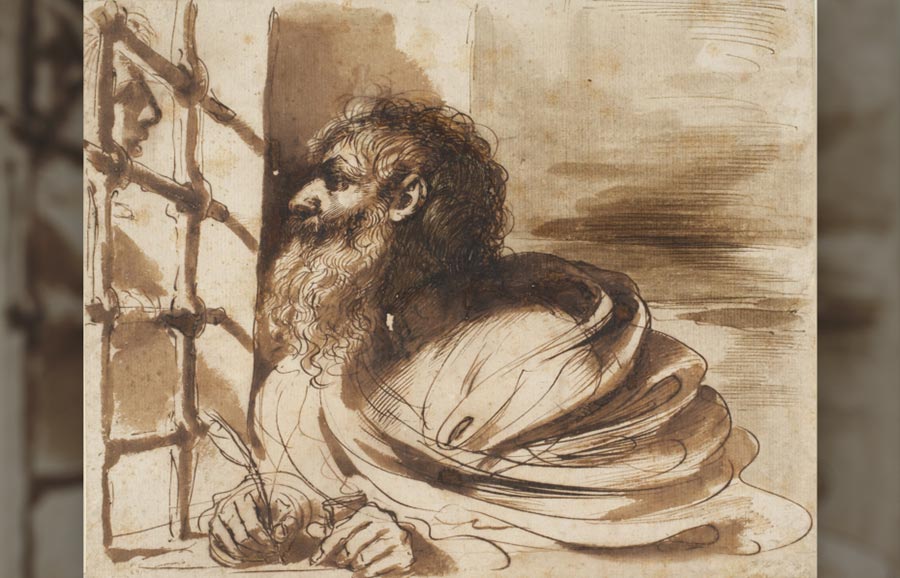
John has been hit by a personal tragedy, that’s what. He is now in jail facing the guillotine. The messianic prophecy of Isaiah promised “liberty to the captives, and release to the prisoners” (61:1). But so far, there hasn’t been a single jailbreak. John is disappointed with Jesus. Perhaps Jesus is not really the Messiah.
John’s credibility is at stake. His fire and brimstone sermons warned of God’s wrath. But now, in prison, John hears of sinners being embraced by the love of God. Like Jonah, he feels he has lost face. Jesus has not taken “an axe” to any tree. He has not burned any “chaff” with “unquenchable fire.” The Messiah has not sparked a cosmic judgment or apocalyptic conflagration. He has not overthrown the Romans.
All Jesus is doing is conducting a ministry of mercy with the marginalized. Hence John’s question, “Are you the one to come, or should we wait for another?” John uses the Greek word heteros rather than the word allos for “another.” Allos refers to “another of the same kind,” while heteros refers to “another of a different kind.” John is asking Jesus: “Are you the Messiah, or are we to look for a different kind of Messiah?” Jesus is not the kind of Messiah John has been expecting.
In response, Jesus sums up all He and His disciples have done so far. “The blind see, the lame walk, the lepers are cleansed, the deaf hear, the dead are raised, and the poor have good news brought to them.” Jesus is quoting a pastiche of texts from Isaiah 35:5-6 (a passage made popular by the recitative in Handel’s Messiah) and Isaiah 61:1-2. The second passage also talks of the Messiah coming with “vengeance” and with “terrible recompense,” but the purpose of the recompense is to “save” and not destroy.
So Scandalous
John’s expectations of God’s Messiah are not totally aligned with his reading of Scripture. We are so much like John. When God does not meet our expectations our faith falters. When He does not answer our prayers the way we expect Him to, we are disillusioned and disappointed. We doubt. We turn our backs on Him. We stop going to church. We look for different solutions to our problems. We forget that God’s ways are not our ways, and God’s thoughts are not our thoughts. We forget that the Bible is much bigger than our skewed and selective readings of it.
We are now less than two weeks from Christmas. By this time, most of us have bought our trees, decorated our houses, sent our Christmas cards, been to at least one party, sung our hearts out at a carol service, and finished our Christmas shopping. When we come to church on Sunday we expect things to move on. We heard from John the Baptist last week. Now it’s time for Mary and Joseph, or the angels or shepherds or something else that will help to get us into the Christmas spirit, isn’t it?
But no! Instead of preparing us for Jesus’s birth, the lectionary editors have jumped ahead some ten chapters and thirty years into the middle of Matthew’s account of Jesus’s ministry. What an odd choice! But is it really? Because as we begin to sing of “peace on earth and goodwill to men,” we will perhaps being to doubt and wonder if all this is really true. Is there really a lot of peace and goodwill around? Has God really delivered on His promises through Jesus the Messiah? Has Jesus really lived up to our expectations? Or should we push Him back into the basement with the Christmas trees and the crib and the decorations after January 1?
John — who, while a somewhat scandalous figure himself, has actually lived a scandal-free life — is scandalized because Jesus has not lived up to his expectations. (Matthew uses the Greek word skandalizo 14 times in his gospel.) Here skandalizo refers to some kind of stumbling in faith. In Matthew’s gospel, several people including the Pharisees and the people of Jesus’s hometown, are scandalized by Him. Just before Jesus’s arrest, His own disciples are scandalized and fall away from their faith.
Jesus responds graciously with a beatitude to John. “Blessed are those who are not scandalized by me.” Jesus gently appeals to John not to fall from faith because He is a different kind of Messiah from the one John has been expecting. “Blessed is he who does not ‘look for another’ because, if he does, he is looking for the fulfilment of his own fantasies rather than of God’s prophecies,” writes biblical scholar John Meier.
What We Can See — and What We Can’t
In December 2007, the Washington Post launched a fascinating experiment by positioning a young violinist, dressed in jeans, T-shirt, and a baseball cap, at a busy Metro entrance in Washington, DC, during the morning rush hour. For 43 minutes, this musician performed six captivating classical pieces. Some 1,100 people hurried past — primarily Beltway insiders and other white-collar professionals.
Yet, as the violinist played, only seven people chose to stop and listen, and even then, only for a fleeting minute. A mere 27 individuals gave money — a total of $32 and change. The other 1,070 rushed by, hardly glancing in the violinist’s direction.
Yet just three days earlier, the same violinist had dazzled a full house at Boston’s Symphony Hall, where similar patrons had paid $100 each for middle-range seats. Two weeks later, the same violinist he would perform at the Music Center at Strathmore to a standing-room-only audience.
Despite this remarkable talent, on that bustling morning, no one recognized Joshua Bell and failed to appreciate that he was playing an original Stradivarius worth an astonishing $3.5 million. Standing in the subway that morning, one of the world’s most famous violinists was just another bum, busking for bucks.
God so loved the world that He gave us His only begotten son. The only stumbling block is that He sent Him to be born as an obscure baby in a basement in a one-horse town called Bethlehem. The only stumbling block is that He sent Him to party with a sleazy bunch of sinners. The only stumbling block is that He ended up in a state of total disrepair, battered and bruised, scarred and scorned, on the cross of Calvary. He didn’t end the brutal Romans’ conquest of the Jews the way the social justice warriors of His day were expecting Him to. To the naked eye, He didn’t fulfill their dreams or aspirations–His ministry ended with His political assassination at Golgotha.
What the naked eye could not see at that time was waiting around the corner.
Are you scandalized? Or do you think you’ve found the Messiah? Is Jesus the one who is to come, or are we to look for another?
Dr. Jules Gomes, (BA, BD, MTh, PhD), has a doctorate in biblical studies from the University of Cambridge. Currently a Vatican-accredited journalist based in Rome, he is the author of five books and several academic articles. Gomes lectured at Catholic and Protestant seminaries and universities and was canon theologian and artistic director at Liverpool Cathedral.