


What’s In Your Thesaurus?
When all is said and done, the Magi are wise men and Herod the Great is a fool. A few musings on the Epiphany.
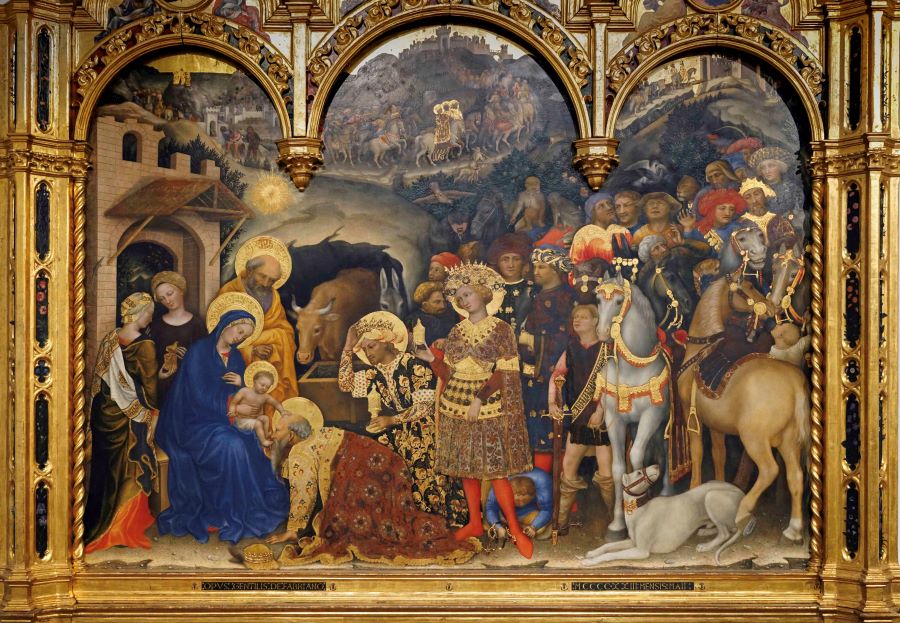
Gentile da Fabriano, Adoration of the Magi, 1423, tempera on panel, 283 x 300 cm (Uffizi Gallery, Florence)
In the movie Father of the Bride II, George Banks is spoiling his daughter’s wedding reception. In Shakespeare’s Macbeth, the murdered Banquo’s ghost spoils the king’s coronation celebration. And in Charles Dickens’s A Christmas Carol, Jacob Marley’s ghost spoils the party for the legendary miser, Ebenezer Scrooge.
In Matthew’s gospel, the three wise men spoil the party for King Herod. All they’d like to do is visit the baby, sip a beaker of Mary’s mulled wine, munch a Mediterranean mince pie, and offer their presents of gold, frankincense, and myrrh.
Instead, the wise men reduce Herod to a nervous wreck.
Herod the Great
Herod was a born leader. At 25, his father appointed him governor of Galilee. In 40 BC he was crowned king of Judea. The Roman Senate then made him “king of the Jews.” Herod founded a dynasty that ultimately ruled Judea for over 140 years.
He launched the grandest building projects of his day: towns, palaces, harbors, irrigation projects, theatres and amphitheatres, hippodromes and fortresses. He brought the quinquennial “Olympic” games to Judea. He rebuilt the Jerusalem temple, making sure that it was bigger than Solomon’s temple. To keep his colonial masters happy, Herod also built a temple in honor of Emperor Caesar Augustus.
On two occasions, he reduced taxes by one-third and one-fourth. Herod possessed an impressive personality, extraordinary intellect, great physical strength, astute political skills, and an indomitable will. He became known as Herod the Great.
Yet, Herod the Great was “troubled” when he heard the news of a little baby (Matthew 2:3) being born. The Latin Vulgate translates “troubled” as turbatus — the same word used to describe the turbulence of a stormy sea. The good news of Jesus’s arrival was bad news to Herod.
What is it about Jesus that makes some people so troubled? From Nero to Nietzsche, from Domitian to Dawkins, Herod has had a string of successors who have been greatly troubled by the babe from Bethlehem.
Wise Men or Wise Guys?
Herod received the first Christmas card in history. He responded by unleashing his dog on the postman. The wise men had spoiled his party.
That’s why I’m reluctant to call them “wise” men. If you visit a country and the king asks you why you’ve come, it would be silly to say, “Hail, king, I’m looking for a child who has just been born who will be the next king of your country so I can honor him.” What a dumb thing to say.
So let’s get away from the sentimentality of our Christmas cribs, where we have “three wise men” or “three kings.” We call them “kings” because the prophet Isaiah speaks of “kings coming to the brightness of your dawn” and bringing with them “gold and frankincense.” Psalm 72 speaks of the kings of Tarshish, Sheba, and Seba bringing gifts. But Matthew simply calls them Magi. He tells us that they came from “the east.”
In those days, the wise men of the West despised the wise men of the East. Roman intellectuals poured scorn upon the “Magi” who came from Iran, Iraq, Syria, and Arabia. The Roman historian Tacitus calls them “absurdities.” The Roman philosopher Seneca laughs at the Magi who predict the emperor Claudius’s death “every year, every month.” The Roman administrator Pliny says he intends to “refute the fraudulent lies of the magi.”
Even the Bible regards the Magi as dubious. In the Old Testament, astrology is forbidden. In the Greek translation of Daniel, King Nebuchadnezzar’s magi fail when asked to interpret the king’s dream. In the book of Acts, Paul calls the magus Bar-Jesus the “son of the devil.” The words “magic” and “magician” are derived from the words Magi and magike. The Magi were generally regarded as magicians rather than “wise men!”
Follow the Star
What, then, led the Magi to follow the star in the East? Astronomers suggest two possible scenarios.
First, the star of Bethlehem might have been Halley’s Comet, which appeared in 12 or 11 BC. Second, it may have been the conjunction of Jupiter and Saturn, which crossed each other three times in 7 BC. Since Jupiter was the “royal” planet and Saturn represented the Jews, the Magi would have concluded that a king of the Jews was to be born. Since the Magi came from Babylon or Persia, they would have learned of the Messianic expectation from the Jews who’d been exiled there.
But why did they go to Jerusalem? Why not to Bethlehem? Perhaps they were not so wise?
Some years ago, a cartoon appeared in the December issue of Punch magazine, depicting the wise men en route to the manger. Suddenly, one of them points toward a light in the sky. He says to his companions, “Just our luck, a one-star hotel!”
Bethlehem was a one-star hotel — an obscure, insignificant city. Even the prophet Micah, who predicted that Jesus would be born in Bethlehem, describes the town as “too little to be among the clans of Judah” (Micah 5:2). But Jerusalem was a five-star hotel — the holy, royal capital city. Surely a king would be born in the capital of his kingdom? And so the “wise” men unwisely take their eyes of the star and go to Jerusalem. Their foolishness alerts Herod to this threat.
The Magi ask Herod, “Where is He who has been born King of the Jews?” Their question is political dynamite. Herod, not Jesus, is the “king of the Jews.” Rome has given him authority. But, in reality, Herod is a usurper of the royal title; the Roman Empire is a sham.
The Crib Points to the Cross
The term “king of the Jews” is used only four times in Matthew’s gospel — once at the crib and three times around the cross. Jesus’s birth becomes a pointer to His death. At Epiphany, the baby Jesus is threatened by Herod. On Good Friday, the adult Jesus will be threatened by Pontius Pilate — the governor appointed by Rome. Pilate will ask Jesus: “Are you the king of the Jews?” The Roman soldiers will mock Him as “king of the Jews.”
At Epiphany, the Magi open their thesaurus (the Greek word for treasure chest) and offer Jesus gold, frankincense, and myrrh. On Good Friday, the soldiers will offer Jesus a wreath of thorns as His crown, a reed for His scepter, and the cross as His throne. Instead of a bright star, there will be pitch darkness (27:45). But as God reveals Himself at Epiphany to the Gentiles — the Magi — in the crib, on Good Friday, He will reveal Himself to another Gentile — a Roman centurion who will make the greatest declaration in history: “Truly, this man was the Son of God!”
Matthew is asking us to listen to the whole story.
- Herod had good press from the historians of his day; the Magi were maligned by the intellectuals of their day.
- Herod was politically astute; the Magi were politically naïve.
- Herod had scripture as his guide; the Magi had nature as their guide.
- Herod stalked the corridors of power; the Magi walked on the margins of society.
- Herod built magnificent structures; the Magi made room for God in their hearts.
- Herod tried to commit suicide and died a frustrated man; the Magi returned home with exceedingly great joy.
Perhaps they were wise men after all. In biblical literature, wisdom is known as the ability to make the right choices: “The fear of the Lord is the beginning of wisdom.” When all is said and done, the Magi are wise men; Herod the Great is a fool.
Listen to the whole story. Walk from the crib to the cross. Keep your eyes on the stars and on the Scriptures. The heavens are telling the glory of God, but the word of God is a lamp to your feet and a light to your path. Be wise. Make the right choices. Decide for yourself who is King of the Jews and who is the King of your life.
The journey may be long and difficult. You will face mad, murderous, and megalomanical Herods along the way. You will make foolish mistakes. But come to Jesus by whatever route you can. Then, when you have reached the manger, bow down before him as your King, open your thesaurus, and offer to him the best gifts you can find. And the best gift you can offer is yourself.
Dr. Jules Gomes, (BA, BD, MTh, PhD), has a doctorate in biblical studies from the University of Cambridge. Currently a Vatican-accredited journalist based in Rome, he is the author of five books and several academic articles. Gomes lectured at Catholic and Protestant seminaries and universities and was canon theologian and artistic director at Liverpool Cathedral.