


What Does Ol’ Man River Have to Do with the Baptism of Jesus?
The Bible tells the story of a New Exodus and a New Creation taking place at the River Jordan
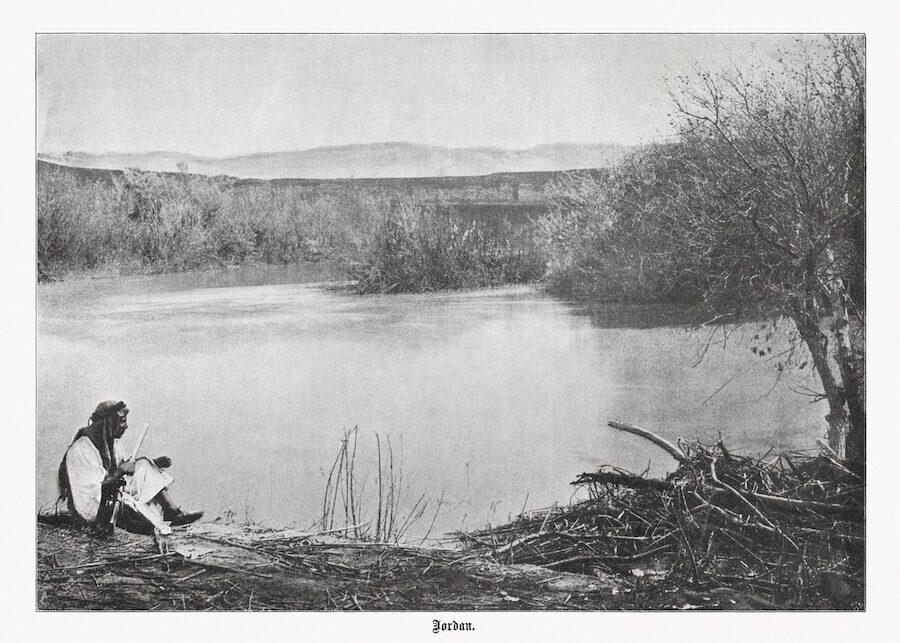
Historical view on the banks of the Jordan River in Israel. Halftone print based on a photograph from the book "Das Neue Testament (The New Testament), published by Hofbuchhändler Heinrich Grund, Berlin in 1899.
Twenty million years ago, a fatal fracture violently ruptured the surface of the earth. Tectonic plates shuddered and shifted, continents heaved and groaned, the crust of the earth suffered a cataclysmic convulsion, and a crack of apocalyptic proportions was created.
Nature dug deep into her bowels to carve the deepest depression in which the world’s most unique river would flow. “There may be something on the surface of another planet to match the Jordan Valley. On the earth there is nothing else like this deep, this colossal ditch,” wrote archaeologist George Adam Smith.
The Jordan is Israel’s most important river. It’s the Bible’s most important river. It’s the Ol’ Man River of the Old Testament.
Ol’ man river,
Dat ol’ man river
He mus’ know sumpin’
But don’t say nuthin,’
He jes’ keeps rollin’
He keeps on rollin’ along.
Dat old man river! He must know something! Archaeologist Nelson Glueck called the Jordan “the earth’s most storied river.” It has a geological story to tell.
It begins at Mount Hermon in Lebanon and wends its way into the Sea of Galilee. From there it descends southward, lower and lower, only to die a tired death in the Dead Sea, in the desolate valley of Sodom and Gomorrah. It runs through the earth’s deepest valley into the Dead Sea, the earth’s deepest point on land at 1,371 feet below sea level.
The Jordan also has a theological story to tell. It is the oldest river in Israel’s historical memory, first mentioned in the dispute between Abraham and Lot (Genesis 13:10). It is referred 165 times in the Old Testament, more than any other river. Of these, 117 references deal with the notion of crossing and boundary.
Crossing the Jordan
The Jordan is the boundary that divides, the border that demarcates, and the barrier that separates. It is the perimeter of the Promised Land. Today, it divides Israel from the Kingdom of Jordan and Syria to the east. Old Testament scholar Walter Brueggemann calls it “the juncture between two histories.” Crossing the Jordan was an imperative if the children of Israel were to enter the Promised Land.
It is at the Jordan, at Jabbok, that Jacob wrestles with God and is named Israel (Genesis 32:10-32). It is at the Jordan that Elijah is whisked away to Heaven in a chariot of fire (2 Kings 2:7–12). It is at the Jordan that Naaman, the Syrian king, is healed of leprosy (2 Kings 5:8–14).
Most significantly, it is at the Jordan that the miracle of the Exodus is repeated over and over again. Elijah parts its waters by striking it with his mantle (2 Kings 2:8). Elisha also parts its waters by striking it with Elijah’s mantle (2 Kings 2:14). But most memorable of all is the story of Joshua at the Jordan.
In an astonishing liturgical act, Joshua instructs the priests to carry the Ark of the Covenant and to step into the waters of the Jordan by faith. When they do, the waters are parted. The entire nation crosses the Jordan and enters Canaan (Joshua 3). The Psalmist captures this in exuberant poetry: “The sea looked and fled; Jordan turned back” (Psalm 114: 3, 5). After 40 years of wandering in the wilderness, Israel enters the Promised Land. The Exodus is reenacted, the waters part, and Israel crosses over from “death to life.”
A New Joshua
But that was centuries ago. By the time we get to the New Testament, history has been reversed. The Promised Land is now occupied territory ruled by the Romans. Israel lives in exile. We need a new Elijah and a new Joshua to reenact a new Exodus for a new people of God.
John the Baptist is the new Elijah. Jesus is the new Joshua.
But why is Jesus is baptized in the Jordan River, and why do Catholic and Protestant churches both celebrate the Feast of the Baptism of Our Lord on the Sunday after Epiphany? Let’s flash back to the Christmas story.
“You are to name him Jesus, for he will save his people from their sins,” the angel tells Joseph in the Christmas story (Matthew 1:21).
“Joshua,” “Yeshua,” and “Jesus” are the same name. Yeshua in Hebrew means “Yahweh saves” or “God is salvation.” Now for the first time since the Christmas story, at the Jordan River, Matthew uses the name “Jesus” or “Yeshua.” Yahweh, the God of Israel, is about to save the world.
As Yeshua steps into the water, the geological and theological story of the Jordan River reaches its climactic resolution. Yeshua plunges into the fatal fracture of the earth’s crust. Yeshua descends into the deepest depression on Planet Earth. As victim, He descends into the watery abyss like Jonah and offers to be thrown into the sea so that the others might be saved. As victor, He descends “into hell” to crush the head of the sea dragon Leviathan/Rahab, who surfaces in the Old Testament.
The Eastern Church merges Jesus’s descent into hell with His descent into the Jordan. Jesus dives into the earth’s most storied river, into the story of your life and my life. The history of Israel and the history of humanity, the story of your life and the story of my life, reach its climactic consummation when God steps into the fault-line that can be traced back to Adam; back to the creation of the world.
New Exodus and New Creation
As Jesus descends into the Jordan, the great breach on earth is healed; the great tear in the earth’s crust is sealed. Now, in a new cosmic convulsion, Heaven, not Earth, is torn apart and God’s voice thunders like the sound of many waters: “This is my Son, the Beloved, in whom I delight.” This is an allusion to the Suffering Servant of Isaiah (42:1). The Jordan River now becomes the birthplace of two new events. There is a New Exodus and a New Creation.
First, there is a New Exodus. Jesus, the embodiment of Israel, undergoes an exodus from Egypt and passes through the waters of the Jordan. But why? Only slaves need an exodus from Egypt. Only sinners need to be set free from the bondage of sin.
Much to John’s horror, the sinless Jesus identifies with them and asks to be baptized. John’s baptism is a “baptism of repentance” (Matthew 3:6,11). It is not a rite of initiation.
But Jesus volunteers to be baptised as a sign of his solidarity with sinners. Jesus steps into the Jordan that we might cross over into the Promised Land. The baptism inaugurates His ministry — a ministry that will culminate on the cross. The cross of Christ will become our bridge over troubled waters. As God steps into the fault line of humanity, our faults are forgiven.
Second, there is a New Creation. The Spirit of God descends like a dove on Jesus when He rises from the waters of the Jordan. This is a flashback to the beginning of creation. In the beginning, when “earth was a soup of nothingness, a bottomless emptiness, an inky blackness, God’s Spirit brooded like a bird above the watery abyss” (Genesis 1:2, The Message). Like a bird incubating her chick, God’s Spirit transforms chaos into cosmos.
The descent of the dove is also a flashback to the Flood: Over 14 days, Noah sends out a dove three times to check if the waters have receded.
Just as Noah and his family were saved through the floodwaters, so we are saved through the waters of baptism, writes Peter (1 Peter 3: 20-21). At the Jordan, the dove signals the ending of the flood and the beginning of a New Creation. At the fault line of the Jordan Rift Valley, the fatal fracture of creation is healed.
When the song Ol’ Man River was first composed, it ended on a note of despair. But as the great baritone Paul Robeson sang over and over again, he altered the words, transforming it from a song of resignation to a song of resistance.
Robeson was the son of a runaway slave and a committed Christian. He changed the lines “I’m tired of livin’ and ‘feared of dyin’” to “I must keep fightin’ until I’m dying.” And then he added this glorious verse to the song drawing together the River Mississippi with the metaphor of the River Jordan:
Let me go ’way from the Mississippi
Let me go ’way from the white man boss
Show me that stream called the River Jordan
That’s the old stream that I long to cross.
That’s the old stream that I long to cross! I hope it is the old stream that you, too, long to cross! Are you willing to take the plunge?
Dr. Jules Gomes, (BA, BD, MTh, PhD), has a doctorate in biblical studies from the University of Cambridge. Currently a Vatican-accredited journalist based in Rome, he is the author of five books and several academic articles. Gomes lectured at Catholic and Protestant seminaries and universities and was canon theologian and artistic director at Liverpool Cathedral.