


We’re Children of the Pulpit!
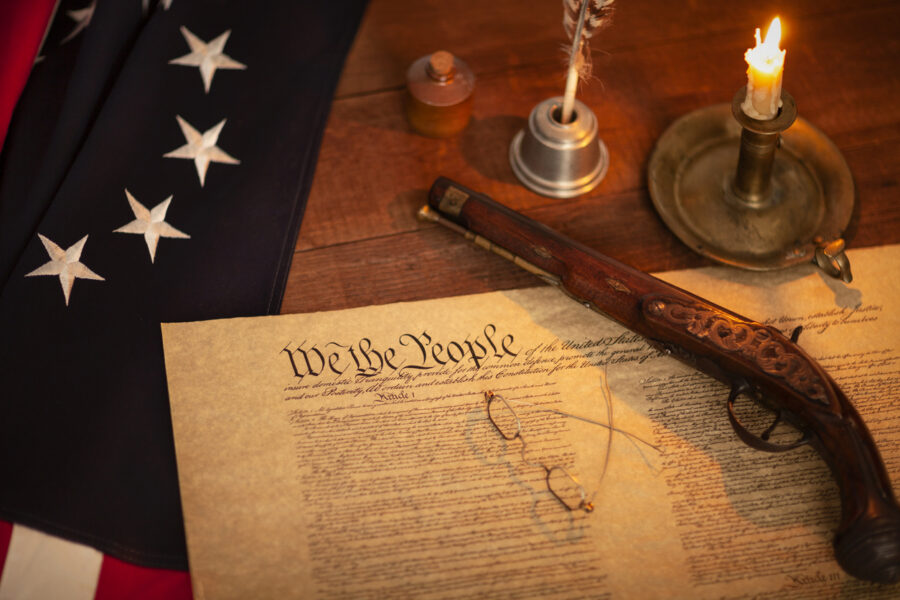
There has never been anything in history like the US Constitution. Signed on September 17, 1787, t is the crown jewel of human advancement and bids freedom not for some but for all. It stands alone, enshrining and paying homage to the core reality of man’s existence – that the dignity and rights of every person come not from the word or works of an impermanent ruler, mob, or government, but from the permanent promise of the Creator.
The Constitution began with a convention and 55 delegates from the newly free Colonies called to modify the Articles of Confederation. It became a convention that would reshape history. Influential members such as James Madison, Alexander Hamilton, and George Washington were convinced that the Confederation needed a stronger national government, and the Convention settled on Madison’s Virginia Plan as a starting document to replace the Articles of Confederation.
That plan itself was the product of the colonial experience with English Common Law and the distilled ideas that flowed through the pulpits of churches for 200 years that foreshadowed both the War for Independence and the Constitution. In the end, the Convention of 1787 produced a document that carried the birthmarks of Holy Scripture in the framework of the ancient covenants of Sinai, arranged by perhaps the most unique and wisest men history has produced at one time, in one place, for one purpose.
Deeply Philosophical Discussion
The discussion in 1787 is the irreducible conflict between liberty and collectivism, free will and authoritarianism, and the origin of individual rights. Should society be assembled largely by self-interested individuals pursuing their own best purposes and living out their faith, or should the sum of any society be defined and controlled by the power of government for the “common good”?
Interestingly, the political and the religious are frequently presented as distinct and separate spheres of interest that can never be commingled in this debate. Yet they were, and are, as close as a tick to a hound dog. The political class can’t scratch an itch without seeking the imprimatur of religious or moral virtuosity. People of genuine faith simply cannot separate themselves from the public affairs of their day lest they cease to be salt and light to the world.
Today, just like political and social conservatives, the orthodox faithful in our churches and synagogues are under withering attack.
The modern church’s institutional weakness and aggressive emasculation make it the perfect target.
In the crumbling Western democracies, the intellectual air is thick with words like fairness, social justice, economic equity, redistribution of wealth, and getting a fair share. This is street slang in the all-out war on free will, religious freedom, free markets, and individual responsibility. This assault on individual liberty is so far along that many conservative politicians and orthodox religious leaders have been browbeaten into either adopting the characterizations of the extreme left or simply ignoring them, leaving the “progressive” agenda uncontested.
Without significant resistance, many mainline Christian churches have revived the centuries-old social justice canard, a trend that tragically includes a growing number of churches in the “evangelical community.” And no small number of the “progressive” churches are promoting repackaged liberation theology – Marxist dictum in drag.
Christianity Shaped the Constitution
So the defense of our most cherished values is reduced to a quiet frustration, and the principles for which over a million Americans died grow increasingly dim – like a fading candle. With two exceptions in five decades, we’ve been led by the weakest of the weak.
But this was not always so. In fact, for much of our history, it has been just the opposite. Godly men and women who were fearless, bold, strong, and savvy have been central to the American experience.
The American Founding specifically was intricately woven into the American story in large measure by the hands of courageous clergy and congregants of the early colonial churches. The battlefields of the Revolutionary War would later drink the sweat and blood of many patriot pastors and their congregations, who were among the first to take up arms when the war did come.
The inspiration and grand proposals of the American Founding and, subsequently, the Constitution, come in no small measure straight from the pens and sermons of our early colonial clergy. The pastors and ministers educated and shaped the worldviews of several generations of colonists, preaching on the powerful connection between biblical truth, the inalienable rights of men, and a just and limited government.
Pastors had a dramatic and consequential place in the American story, starting with the first years of the colonial settlements. In Virginia, prominent ministers were instrumental in creating the House of Burgesses in 1619, the first elected legislative body in North America. In Massachusetts, Pilgrim and later Puritan ministers were at the forefront of establishing elected representative governments. In 1641, the Puritans had a Body of Liberties, a document of individual rights written by the Rev. Nathaniel Ward.
Colonial Christianity
Throughout the 1600s, the new colonies, led or influenced by Christian ministers, established elected governments with defined rights. The English-born Anglican turned Puritan minister, Roger Williams, came to Massachusetts in 1631, only to be officially banished in 1635 by the Massachusetts Bay Company for his belief in “separatism,” or total religious freedom, and for publicly challenging the Company’s right to regulate any religious activity. He and his followers purchased land from the Narragansett Indians and founded Providence, Rhode Island, in 1636 with an elected government “in civil matters only.” They received a charter for Rhode Island in 1643.
In 1638, Williams would start the first Baptist church in North America, becoming a powerful force in the “wall of separation” between the state and religious bodies and the right to worship freely. (Thomas Jefferson would later use his phrase in a famous letter to the Danbury Baptist Association.) Both Jefferson and James Madison credited Williams as the inspiration for the First Amendment.
Also, in 1636, the Rev. Thomas Hooker and other ministers founded Connecticut with an elected government, and Hooker penned the first written Constitution in the Colonies. It would formalize the written documents used in other settlements that shared the biblical perspective of liberty expressed through elected legislatures, define the powers of the government, and establish the first protections of individual civil rights and freedoms.
Pastors Led the Way
Crown-appointed governors in New Hampshire, Virginia, and Georgia who ignored or attempted to disband these elected bodies were met with minister-led opposition and fiery sermons on the civil rights of sovereign citizens. When an attempt was made to abolish the elected bodies in Rhode Island, Connecticut, and Massachusetts and force the Anglican Church on those colonies, ministers and pastors were at the forefront of opposition. In 1687, the Rev. John Wise of Ipswich, Massachusetts, was jailed for leading a protest against taxes imposed without the approval of the legislative body by the crown-appointed governor of the Massachusetts Bay Colony.
Wise was also the author of critically important essays that spread his stature as a leader throughout the colonies, as he powerfully asserted that liberty and the right to elect representative government were God’s plan in both the church and the state and were core biblical principles. He was the first to write that “taxation without representation is tyranny” and that “the consent of the governed is the only legitimate basis for government.”
So profound and deep was the shaping of these ideas that would later be found in the Declaration of Independence and the Constitution that historians could track many of those ideas directly to the writings and sermons of the early American clergy, especially Wise. Whole phrases and sentences ended up in the Declaration of Independence virtually word-for-word.
Thundering Pulpits
In the early twentieth century, historian Alice Baldwin would portray the Constitutional Convention and the written Constitution as “children of the pulpit.”
While the early colonial ministers helped lay the intellectual groundwork for the future nation (along with the Enlightenment thinkers of the century), the Great Awakening – an empowering evangelical revival that swept the colonies in the 1730s and the 1740s – helped establish the character of the coming Revolution.
Beginning with the powerful preaching of the Rev. Jonathan Edwards, who held the first revivals in the early 1730s at his Northampton, Massachusetts church, the Great Awakening emphasized personal salvation by God’s Grace alone, the authority of Scripture, and personal responsibility for moral living. Edwards’s preaching intersected perfectly with the growing democratic spirit in the colonies. It diminished the influence of ritual and established worship while elevating the role of personal faith, prayer, and moral accountability.
The spiritual revival that Edwards ignited became one of the most determining events in American history.
Following Edwards’s first revivals – and to the alarm of many long-established church bodies – other ministers carried his message into the colonies. Most importantly, the already famous Anglican George Whitefield – an accomplished open-air preacher in the English revival –in 1740 traveled by horseback from New England to Charleston, preaching daily to large crowds, frequently numbering in the thousands. Whitefield’s trip concluded at the Boston Commons before 23,000 people at a time when Boston’s population was only 15,000.
The religious leaders’ importance in educating the public and providing intellectual support for the cause of liberty and fighting during the Revolutionary War was not lost on the British, who called the pastors, ministers, and their congregants supporting Independence the “Black Robe Regiment.” The essential place of pastors and ministers in the Revolution was so apparent that John Adams exclaimed, “The pulpits have thundered.”
Many in England considered the war to be the outcome of the nearly two-century-old theological battle between the Presbyterians and Congregationalists and the Church of England. But even that division did not capture the power of the emerging concept in the colonies that resisting tyranny was both biblical and moral. When the war came, this idea had even split the Church of England in the colonies, where up to half the clergy, who had sworn an oath to the Crown upon ordination, left their pulpits, and some Anglican congregations rewrote their Book of Common Prayer to remove its prayers for the king as head of the church. Many of the loyalist Anglican priests returned to England.
We Are Charlie Kirk
With this extraordinary inheritance, you would think that America’s current religious leaders would be on the front lines of the new battle in the twenty-first century for human liberty and the freedom of religion, speech, and association. Instead, with a few exceptions, religious leaders and organizations are irrelevant bystanders in the new America, or all too often, cheerleaders for the devolving culture and the radical left.
But God’s economy doesn’t wait for us. The nation has yet to bury one young man, Charlie Kirk, who, more than any other single individual in a generation, saw the minimal pushback from conservative and orthodox religious leaders and political leaders to the incorporation of cultural Marxism and authoritarian constructs throughout society. Too few voices addressing the slow devaluing of the constitutional systems their predecessors bled for. When he was eighteen years old, Charlie asked God for the vision, talent, and power to confront his times with the self-evident truth.
Charlie set out to do what the nation’s leaders failed to do, wouldn’t do, and couldn’t do. He talked and listened to people. He had discussions and debates with a smile, humility, and a lack of pretension. He raised the great issues of our day with a winsome back-and-forth discussion always arranged on the Reality of God as our birthright, and how the Constitution frames the freedom that so many were so eager to abandon.
He was deeply schooled in God’s Word and understood the battle between good and evil, as well as the evil purposes that uncontrolled governments would pursue without guardrails. He boldly did exactly what our colonial-era pastors did. He took the message of God’s love, purpose, and reality boldly in the marketplace of ideas, and confronted college kids and anyone else he could get in a room with the profound issues of our day. He confronted the education establishment, the attacks on the Bill of Rights, and the willful ignoring of profound issues, such as government-created poverty, hunger, class warfare, and renewed racial incitement.
Most importantly, Charlie addressed directly, without equivocation, the puzzling abandonment of essential doctrines explicit in Scripture and the fad of kowtowing to the lowest common denominator in our culture in sexuality, marriage, and moral responsibility.
Perhaps this one death is what it took to wake up new generations of truth-tellers shaping worldviews and informing, discussing, talking, and educating on the powerful connection between biblical truth, the inalienable rights of men, and a just and limited government.
Perhaps Charlie Kirk was the new thunder in the pulpit that this young century needs.
Michael Giere writes award-winning commentary and essays on the intersection of politics, culture and faith. He is a critically acclaimed novelist (The White River Series) and short-story writer. A former candidate for the U.S. House of Representatives from Texas, he was a senior executive in both the Reagan and the Bush (41) administrations, and in 2016 served on the Trump Transition Team.