


Tyndale Suffered Martyrdom So We Could Have Our English Bibles
Rome burned the Catholic priest and Bible translator at stake but now champions his “heretical” translation
For five centuries, my Catholic ancestors of Portuguese-Goan descent were denied access to the whole Bible in their native language, Konkani; or in Portuguese, the language of their education.
Goa, a Portuguese enclave on India’s West coast, known as the “Rome of the East,” had been a bastion of Catholicism since missionaries led by St. Francis Xavier arrived in 1542, following Goa’s colonization by Portugal in 1510.
The entire Bible was published in Konkani only in 2006. I had just returned to India after completing my doctorate in the Hebrew Bible at the University of Cambridge, and I was overjoyed to be invited to join the team of translation consultants.
Oddly, it was the Protestant Bible Society of India which took much of the initiative in securing a Konkani Bible for Catholic Goa. Previously, Goans had access only to the Konkani New Testament translated from the Latin Vulgate and printed in 1818.
My ancestors read Portuguese, but most of the Bible was translated into Portuguese only in the 17th century by João Ferreira Annes d’Almeida, a minister in the Dutch Reformed Church in the East Indies.
Since the Inquisition burned Almeida’s effigy after bringing it to Goa, one would hardly expect the Goan Catholic hierarchy to authorize a “heretical” Bible translation.
A single-volume Catholic version translated by Fr. António Pereira de Figueiredo was finally printed in 1821, ironically, by the Protestant British and Foreign Bible Society. Figueiredo’s translation was from the Latin Vulgate, not from the original Hebrew and Greek.
The Bible readings at Mass were in Latin so comprehension was limited and the adult men in my family fulfilled their Sunday obligation by puffing cheroots on the church porch.
The Only Bible Translated by a Female Convert
My wife’s ancestors in the neighboring state of Maharashtra, who converted from Hinduism to Anglicanism, were more fortunate. By 1820, the Baptist missionary William Carey had translated the Bible into Marathi from Greek and Hebrew (along with Sanskrit, Bengali, Hindi, Gujarati, Oriya, Punjabi, Assamese, etc.).
Most remarkably, it was Pandita Ramabai, who after converting to Christianity from the highest caste of Hinduism, translated the Bible singlehandedly from Hebrew and Greek into Marathi in 1924. Ramabai got the destitute women from her shelter to build a printing press and print the whole Bible for distribution.
It is the world’s only Bible produced entirely by women. My wife grew up immersed in this exceptional translation. All this explains somewhat why I am passionate about Bible translation, why I have visions of William Tyndale when I read my English Bible, and why I wanted to honor him with this essay on October 6, the day he was cruelly martyred.
My love for this heroic Catholic priest grew when I spent four years a few feet from an original print of Tyndale’s translation while studying at Tyndale House in Cambridge.
Father of Modern English
Tyndale is known as “the Father of the English Bible” for first translating almost the whole Bible into English from Hebrew and Greek. The King James Version, the standard template for most English Bible translations, borrowed nine-tenths from Tyndale’s translation.
Tyndale is also known as the “Father of Modern English.”
“At a time when English was struggling to find a form that was neither Latin nor French, Tyndale gave the nation a Bible language that was English in words, word-order and lilt,” writes David Daniell in Tyndale: A Biography published by Yale University Press.
Working with a language lacking standardization, Tyndale’s translation shaped the syntax, grammar, and vocabulary of English more than Chaucer or Shakespeare during its transition from Middle English to Early Modern English. Tyndale’s English would become the world’s lingua franca.
Tyndale’s lesser-known contribution to liberty and the British and American constitutional order parallels his achievement in democratizing the Bible. Constitutional lawyer Michael Farris, in his book From Tyndale to Madison: How the Death of an English Martyr led to the American Bill of Rights, argues that Tyndale sowed the seeds of this exceptional accomplishment.
Rebutting Half-Truths About Tyndale
Catholic apologetic websites like Catholic Answers perpetuate three half-truths about martyrs like Tyndale. First, they claim “many English versions of the Scriptures existed before Wycliff, and these were authorized and perfectly legal.”
Sure, there was a long tradition of Bible translation into English with Caedmon of Whitby (670), Bishop Aldhelm of Sherborne (ca. 700), the Venerable Bede (673-735), King Alfred the Great (871-901), and the Lindisfarne Gospels. But these were only portions of Scripture translated into Anglo-Saxon from the Vulgate, written in the Latin of the fourth century.
The Council of Toulouse (1229) declared: “We prohibit the permission of the books of the Old and New Testament to laymen,” except perhaps the Psalter, Breviary, or the Hours of the Virgin Mary, “expressly forbidding their having the other parts of the Bible translated into the vulgar tongue.”
While there were exceptions to the norm, laypersons were discouraged from reading the Scriptures and translations, if permitted, were to be made strictly from the Vulgate.
Historian Gigliola Fragnito in her book on Rome’s censorship of the Bible, La Bibbia al rogo: La censura ecclesiastica e i volgarizzamenti della Scrittura (1471-1605), records how an incandescent Pope Paul V “exploded furiously” at the Venetian ambassador Francesco Contarini in 1606, asking: “Do you not know that so much reading of Scripture ruins the Catholic religion?”
Despite the good quality of its translation, the Vulgate had several egregious errors, like Genesis 3:15 which read: “she [Mary] shall crush your head” instead of “he [Jesus] shall crush your head” — an error finally corrected by the Vatican in the Nova Vulgata (1979). Pope Sixtus V’s edition of the Vulgate contained at least two thousand errors.
Secondly, apologists claim that it was secular authorities, not the Church, who burned reformers like Tyndale. The truth is that clergy could not violate the principle of Ecclesia non novit sanguinem (the Church knows not blood), so Pope Lucius III, at the Synod of Verona (1184), decreed that unrepentant heretics were to be transferred to the civil authorities for execution.
Philological and Theological Heresy?
Thirdly, and most comically, apologists insist that Tyndale’s translation was heretical, chiefly because he translated the Greek words ekklēsia as “congregation” instead of “church,” presbyteros as “elder” instead of “priest,” agape as “love” instead of “charity,” and metanoia as “repentance” instead of “[do] penance.”
Tyndale’s translation of these four words was correct both philologically and theologically. However, to render the original Greek accurately, particularly in the case of ekklesia, presbyteros, and metanoia, was to plant a nuclear bomb in the heart of medieval Catholicism’s clerical-sacramental-ecclesiological edifice.
“And I saye also vnto the yt thou arte Peter: and apon this rocke I wyll bylde my congregacion,” is how Tyndale translates Matthew 16:18.
Biblical scholars agree that translating ekklēsia as “church” is anachronistic — it is imposing a later idea on what is essentially an “assembly” — the equivalent of the Hebrew qahal (which consistently denotes the assembly of Israelites in the Old Testament) or edah (synagogue). Ekklēsia is not a religious word.
Several Catholic translations avoid rendering Matthew’s ekklēsia as “church.” The New Jerusalem Bible translates: “You are Peter and on this rock I will build my community.” The Italian Catholic bishops’ Bibbia Interconfessionale renders ekklēsia as comunità.
The Konkani Catholic Bible uses the word sobha (assembly) in Matthew 16:18; Ramabai’s version has the equivalent word mandali in Marathi. The renderings are uncontroversial since Indian languages do not have the equivalent of a word for “church” (Kirche/Kirk).
Priest or Elder?
As for Tyndale’s translation of presbyteros, except for the Douay-Rheims, the subsequent Catholic translation of the Vulgate into English (1609) to combat “heretical” Protestant translations, no Catholic translation would dare to translate the word as “priest.”
The reason is simple: the Greek word for a “sacrificing priest” (hiereus) rendered by the Latin word sacerdotos is never used in the New Testament to refer to church leaders. There is simply no concept or terminology for such an office in the New Testament churches.
Instead, the word hiereus is used for Jewish (or pagan priests) and for all Christians. Jesus has made us all “priests” (Revelation 1:6, cf. 5:10, 20:6). It is also the word used for Jesus, especially in the letter to the Hebrews which contrasts the futile sacrifices made by priests with the efficacious sacrifice offered once for all by Jesus, the High Priest.
Contrastingly, the ministers called to preach, teach, and rule the congregations are the “elders” presbyteroi (not the “priests” hierêes). Astonishingly, the Douay-Rheims maintains its philological and theological mistranslation by rendering presbyteros as “priest” throughout the New Testament.
Catholic Bishops Rehabilitate Tyndale
Tyndale was betrayed by fellow clergy and accused of heresy under the Constitutions of Oxford of 1408, which forbade the translation of any part of Scripture into English by any man on his own authority, under pain of punishment as a heretic.
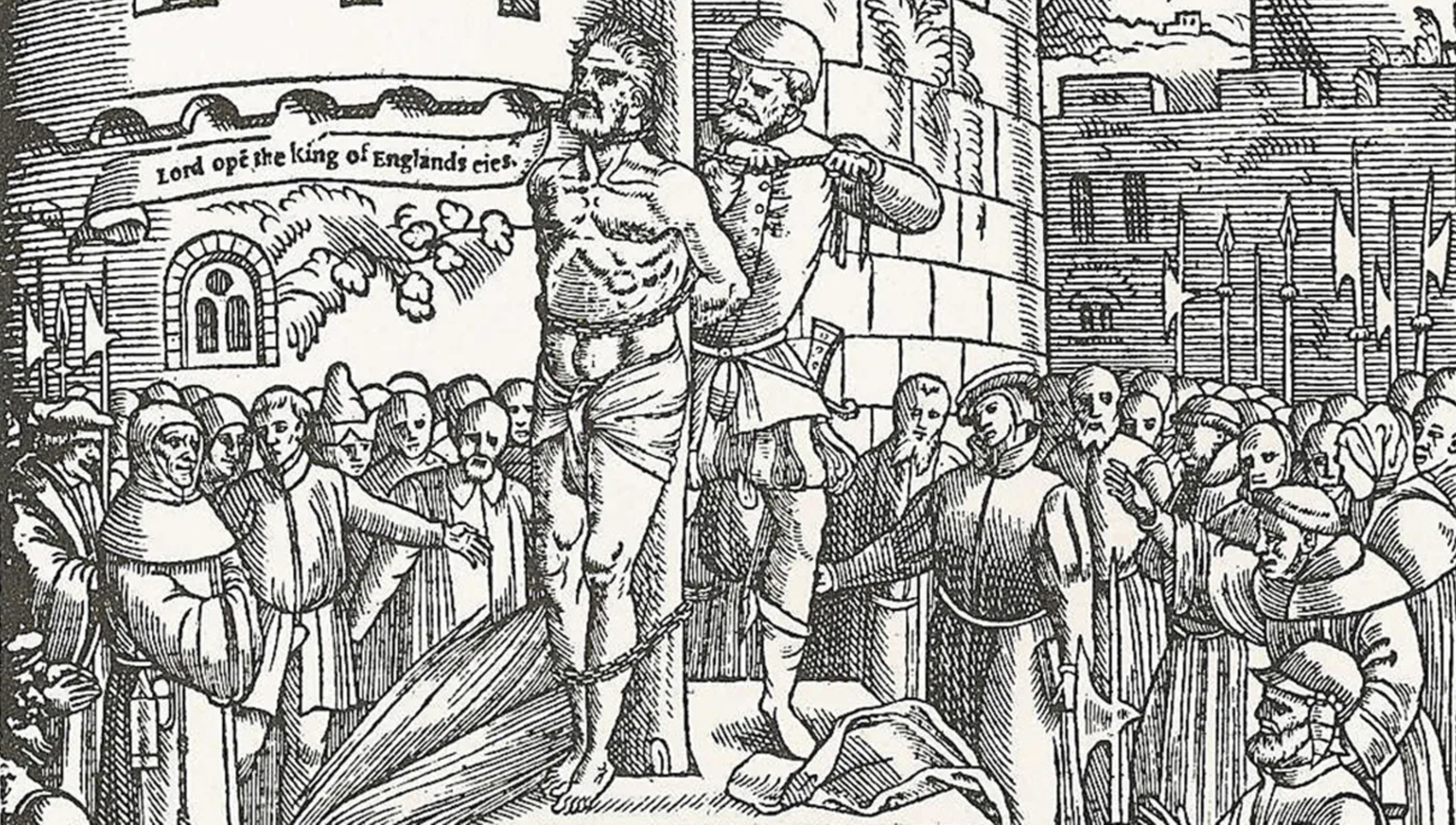
After enduring horrendous conditions in prison for 16 months, Tyndale was formally condemned as a heretic and degraded from the priesthood by scraping his hands with a piece of glass and stripping him of his chasuble and stole. He was then strangled and burned at the stake on October 6, 1536.
Tyndale would greatly rejoice to know that the Bible translation for which he died is now virtually mainstream in anglophone Catholic circles thanks to the visionary Indian Catholic publisher, Nigel Fernandes, and his publishing house, Asian Trading Corporation.
Fernandes’s efforts have resulted in the Catholic bishops of India, England and Wales publishing the lectionary using the Catholic edition of the English Standard Version, an evangelical Bible translation which, the translators acknowledge, owes its origin to the “fountainhead of that stream” — William Tyndale.
Dr. Jules Gomes, (BA, BD, MTh, PhD), has a doctorate in biblical studies from the University of Cambridge. Currently a Vatican-accredited journalist based in Rome, he is the author of five books and several academic articles. Gomes lectured at Catholic and Protestant seminaries and universities and was canon theologian and artistic director at Liverpool Cathedral.