


This Lent, Be Like Socrates
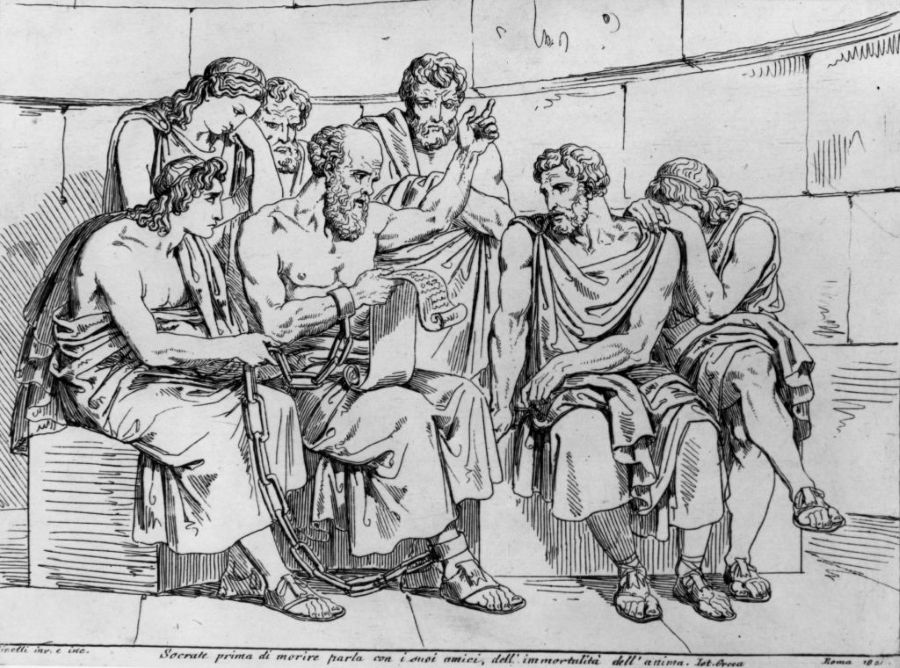
Circa 410 BC, The Greek philosopher Socrates (469 - 399 BC) teaches his doctrines to the young Athenians whilst awaiting his execution. Original Artwork: An engraving after a painting by Pinelli. (Photo by Hulton Archive/Getty Images)
In Plato’s dialog, Gorgias, three orators — Gorgias, Pollus, and Callicles — brag to Socrates that their rhetorical skills give them almost unlimited power. Rhetoricians rule the world by controlling public opinion and the actions of the masses. Through their use of language, they can convince the majority that something is good, true, and beautiful even if it is none of the above. They can free criminals, honor the dishonorable, and dishonor the honorable. Since they control the message, they can do as they please.
Socrates, for good reason, is appalled.
What Gorgias and his friends suggest, says Socrates, is wildly unjust. Socrates, by contrast, argues that it is best never to commit a crime — and second best, if you should commit a crime, you should receive an appropriate punishment. In every way, he wants to live in the truth.
Which is why what he has to say applies to us on Ash Wednesday and throughout Lent.
Life After Life
At the end of The Gorgias, Socrates gives up arguing to relate a myth. (This begins at section 523A if you want to read the whole story.)
Before the god Zeus took over Mt. Olympus, the chief God was Zeus’s father, Cronos. During his reign, the law about human afterlife was forever established:
…that any human being who’d gone through life in a just and pious way would go off when he died to the Isles of the Blessed to live in complete happiness apart from evils, while any who’d lived in an unjust and godless way would go to the prison house of punishment and just penalty which people call Tartarus.
We would expect that. The twist, Socrates explains, is that humans knew the day of their deaths, and their judges were their living peers. So on the day of someone’s death, he or she would arrange to be beautifully attired for the judges and would summon witness after witness attesting to a life well-, justly, and nobly lived. As a result of such shows, the judgments, Socrates tells us, “were decidedly bad.”
Ignorance Balances the Scales
After Cronos was overthrown, Pluto, the god of the underworld, complained to Zeus that the Isle of the Blessed was infested with evil people who didn’t belong and that Tartarus was filled with good people who were unable to put on a good show for the judges.
Zeus outlined a three-part solution. “So first, they’re to be stopped from knowing their death ahead of time.” Without that foreknowledge, humans would have to be prepared for death every day lest death catch them unawares.
Next, Zeus decreed, “they’re to be judged while naked, stripped of all those things, because they need to be judged when they’re dead.” No crown for a king or rags for a beggar, no body — nothing to distract the judges from the state of the soul upon death.
Finally, Zeus appointed as judges three of his mortal children, now dead, who were known for unbiased justice.
Thus, a human would die and the soul — stripped of body, clothes, reputation, wealth, power, position, and even identity — would stand before the sons of Zeus, who would clearly see the condition of that soul and judge in accordance with the truth.
Socrates concludes:
…I look out for the way I might display my soul to the judge in the healthiest possible condition. So saying goodbye to the honors that come from most human beings, I’ll try, by a training in the truth, to be in my very being the best I have the power to be, both to live that way and, when I die, to die that way.
Both Faith and Works Matter
The simple message of Ash Wednesday is memento mori: “remember that you must die.” You don’t have a choice. Implicit in the statement is a question: What condition will your soul be in when you do?
Wait a minute, someone will say, Socrates didn’t know the Gospel. His is just a message of works. Look at Ephesians 2:8-9: “For by grace you have been saved through faith; and this is not your own doing, it is the gift of God — not because of works, lest any man should boast.” It’s not the goodness of our souls, but Christ’s work on the cross that matters.
Which is, of course, true. But consider that while the first half of Paul’s letter to the Ephesians hammers home the free gift of God in Christ, the second half of the letter focuses on behavior and, with behavior, the state of our souls.
The Gospel is not just a get-out-of-jail-free card. Our redemption in Christ enables us to pursue a new way of living, of spiritual and moral purification, of virtue — that is, of holiness. Our behavior and the consequences of it on the state of our souls matters. “For we must all appear before the judgment seat of Christ, so that each one may receive good or evil, according to what he has done in the body” (2 Corinthians 5:10).
Because of the free gift of grace, we, like Socrates, should want our souls to be in the healthiest possible condition, free of things like bitterness, wrath, anger, clamor, slander, and malice, shining with tenderheartedness and a willingness to forgive (see Ephesians 4:31-32).
Lent puts the focus on the state of our souls as we anticipate death. It’s a concentrated period of spiritual effort so that by contrition (hatred of our sin), confession (verbalizing our sins), making emends (praying for others, asking forgiveness, making things right), and forgiving others, we clean up the disorder in our souls.
So as Lent begins this Wednesday, be like Socrates.
James Tonkowich is a freelance writer, speaker, and commentator on spirituality, religion, and public life. He is the author of The Liberty Threat: The Attack on Religious Freedom in America Today and Pears, Grapes, and Dates: A Good Life After Mid-Life. He is Instructor Emeritus at Wyoming Catholic College.