


There’s No Room for Snowflakes in the Kingdom
The phenomenon of university students demanding “safe spaces” on college campuses began in 2016, after Donald Trump’s election. Ivy League colleges created safe spaces where the next generation could color pictures like preschoolers, receive counseling, or engage in therapeutic cuddling with a puppy or a cat.
At Brown University, students found the idea of a debate between a leftist-feminist and a libertarian-feminist so traumatic that the university had to arrange for a safe space stocked with cookies, coloring books, bubbles, Play-Doh, calming music, pillows, blankets, and a video of frolicking puppies.
That was also the year the word “snowflake” became popular in the media to characterize a generation of young adults who have been mollycoddled to such an extent that they cannot deal with views that challenge their own. They demand to live in the artificial world of safe spaces, not recognizing that the real world is actually a very dangerous place. “Snowflake” was one of Collins Dictionary’s 10 words of the year for 2016.
There is a problem with safe spaces. The Bible is impatient to get us out of them, and the church is quick to shoo us out of them. God does not want His people to become snowflakes inhabiting safe spaces. The church does not want us to be Christians wearing safety pins and diapers who remain infantile and refuse to grow up. For this reason, since very early days, both Western and the Eastern churches remember the Martyrdom of St. Stephen the day after Christmas and celebrate the Feast of the Holy Innocents in the octave of Christmas, soon after Christmas Day.
No Safe Spaces for God
In medieval England right up to the 17th century, parents reminded children of the mournfulness of the day by whipping them in bed in the morning. While not recommending this rather unorthodox practice, it would certainly help children to understand that this world is not a safe space for followers of the Lord Jesus.
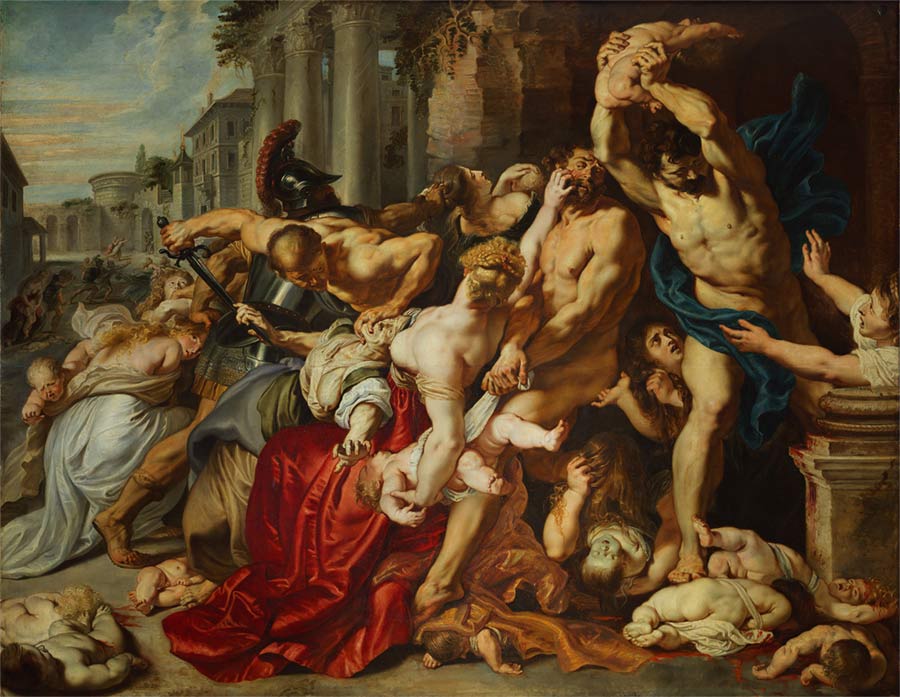
Even God has no safe spaces. God incarnate in the person of Jesus had to flee from an earthly king. God the Father restrained himself from intervening and halting the slaughter of children as Herod turned Bethlehem and its surroundings into a dangerous space for baby boys below the age of two.
There are several Herods in the New Testament. The Herod in the Christmas story is the greatest of them — Herod the Great. The Roman Senate appointed him to be king of Judea. He was a ruler with an impressive personality, extraordinary intellect, great physical strength, astute political skills, and an indomitable will. So why was he “troubled” when he learned of Jesus’s birth?
Herod was a dictator. He was obsessed with power. He could brook no rivals. When he learned of another “king of the Jews,” he felt threatened even though this “king” was a baby. Historically we know that Herod the Great was particularly ruthless regarding the question of who would be king after him.
There was, however, a temporary safe space for Jesus on Earth. An angel appeared to Joseph in a dream and asked him to flee to Egypt with Mary and the child. Why Egypt? In the history of Israel, Egypt functioned as a safe space. In the book of Genesis, we learn that the children of Israel — Jacob and his sons — fled to Egypt when there was a famine in the land of Canaan. But Egypt was only a temporary safe space. When a new king ascended to the throne, he felt threatened by the exponential demographic growth of the Israelites. In the book of Exodus, Pharaoh summoned the midwives and asked them to kill every male Hebrew child by drowning them in the river.
The safe space of Egypt where the children of Israel prospered became a dangerous space where Pharaoh threatened the future of the entire Israelite race.
There are no permanent safe spaces for God’s people.
No Permanent Safe Spaces for the Holy Family
Why did Joseph, Mary, and Jesus flee to Egypt? The borders of Egypt were just 100 miles from Bethlehem. Like Judea, it was a Roman colony. Egypt had a stable government. It had large colonies of Jews, notably in the city of Alexandria. Of its 300,000 people, up to two-fifths were Jews. So Mary and Joseph would have been able to fit in with the community, Joseph would have been able to find work, and they would have been safe from Herod.
More importantly, Egypt had theological significance. Matthew tells us that Jesus’s flight to Egypt was to fulfill Hosea’s prophecy, “Out of Egypt I called my son.” Hosea’s prophecy ties Jesus’s flight to Egypt to the books of Genesis and Exodus where the Israelites flee to Egypt for refuge when there is a famine, but flee out of Egypt when the new Pharaoh threatens to exterminate them.
Just as Egypt in the Old Testament was never going to be a permanent safe space for the Israelites, so also Egypt in the New Testament would not be a permanent safe space for Joseph, Mary, and Jesus. In fact, their sojourn in Egypt lasted only two years. When Herod died in 4 BC, an angel appeared to Joseph and asked him to return to Israel. Nevertheless, when Joseph returned to Israel, he discovered to his horror that even after the death of Herod, it was not a safe space for the family.
Galilee: Not a Safe Space for Jesus
Why? When Herod died, his kingdom split into three. Herod’s sons grabbed a portion of the kingdom for themselves: Archelaus got Judea, Samaria and Idumea. His brother Herod Antipas got Galilee and Perea. Their half-brother Philip got the regions east and north of the Lake of Galilee.
Matthew’s gospel tells us that Joseph returned to Israel from Egypt, but was afraid to go back to Judea because Archelaus was then the ruler in place of his father. Archelaus was a dictator who massacred 3,000 people when he became king. His brutality became so intolerable that his people complained and he was deposed by Rome in AD 6.
Because Archelaus was ruling Judea, Joseph took Jesus and Mary to Galilee. This was a relatively safer space because Herod Antipas was ruling there. Jesus grew up in Nazareth, a small town in Galilee. Matthew tells us this was to fulfill another prophecy that “he would be called a Nazarene.”
So would Galilee under Herod Antipas be a permanent safe space for Jesus of Nazareth? Not really. When Jesus began his ministry, Herod’s son, Herod Antipas, wanted to kill Him. The father wanted to kill the infant Jesus; the son wanted to kill the adult Jesus. There were no permanent safe spaces even for the Son of God.
In Luke’s gospel, some Pharisees said to Jesus, “Get away from here, for Herod wants to kill you.” Herod Antipas killed John the Baptist by beheading him. Finally, just before Jesus was tried before Pontius Pilate, Herod and Pilate plotted together against him. “Now Herod and Pilate became friends with one another that very day; for before they had been at enmity with each other,” Luke’s gospel records. From the time He was born till the time He died on the cross, the Son of God had no permanent safe space.
No Permanent Safe Spaces for Jesus’s Disciples
The story of safe spaces in the Bible does not end with Jesus and Herod Antipas. When you start reading the first half of the book of Acts, you meet a third Herod. His name is Herod Agrippa I. He executes James, the brother of John, and arrests Peter. Herod continues to persecute the church. Now, the followers of Jesus have no safe space under Herod Agrippa I.
When you read the second half of the book of Acts, you meet a fourth Herod. His name is Herod Agrippa II. Just as Herod the Great tried to kill the baby Jesus, and just as Herod Antipas succeeded in killing the adult Jesus, and just as Herod Agrippa I kills the Apostle James, so now the Apostle Paul is imprisoned and brought before Herod Agrippa II.
Just as there were no permanent safe spaces for Joseph, Mary, and Jesus, there are no permanent safe spaces for the followers of Jesus.
Many people join the church thinking it is a safe space. But the church ought to be the most dangerous space on Earth. Because God is not calling us to be crybabies or melting snowflakes or infantilized adults who need diapers and safety pins; God is calling us to grow up, to be mature, and to be transformed by the renewing of our minds.
There is only one safe space for God’s people: the New Jerusalem which God Himself will usher in at the end of history. The book of Revelation very clearly tells us that there will be no room for the “cowardly” — the snowflakes and the infantile — in that new city.
I pray that 2025 will be a year of real spiritual growth, maturity and transformation.
Dr. Jules Gomes, (BA, BD, MTh, PhD), has a doctorate in biblical studies from the University of Cambridge. Currently a Vatican-accredited journalist based in Rome, he is the author of five books and several academic articles. Gomes lectured at Catholic and Protestant seminaries and universities and was canon theologian and artistic director at Liverpool Cathedral.