


The Spiritual vs. the Physical
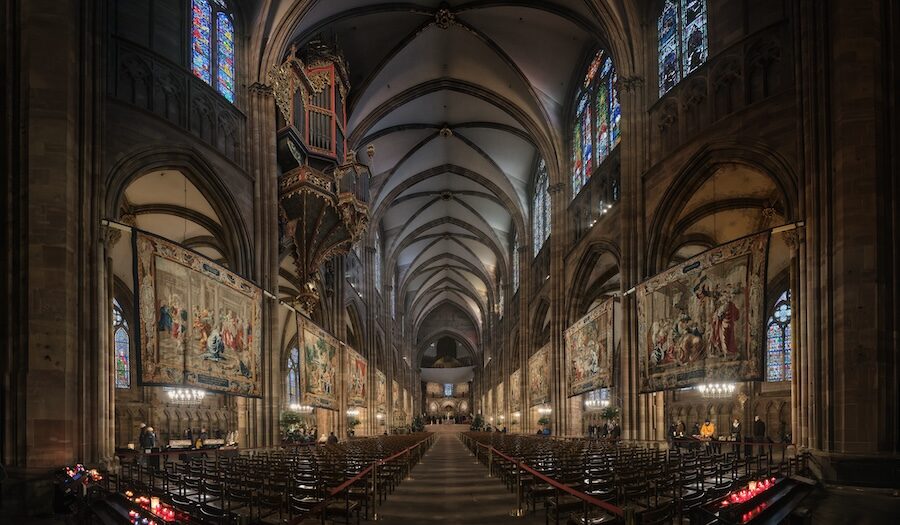
A stunning interior view of France's Strasbourg Cathedral, also known as Notre-Dame de Strasbourg, showcasing its soaring Gothic arches, intricate stained-glass windows, and historic tapestries adorning the nave. The grandeur of the vaulted ceilings and the elaborate pipe organ emphasize the cathedral’s artistic and spiritual significance, making it an iconic landmark of European Gothic architecture.
Last Christmas, I attended several concerts. One of them was held at a Catholic church. The architecture of this church, however, bore no resemblance to any traditional Catholic structure I’d ever seen. It was modern, simple, and utilitarian.
During the intermission, I went upstairs to use the ladies’ room — but afterward, I didn’t know where to dispose of the paper towel I had used to dry my hands. I went back downstairs, still looking, and noticed a receptacle like a trash can near the sanctuary door – so I threw the paper towel into it.
Unfortunately, it was not a trash can. It turned out to be the basin holding the holy water.
I felt terrible, of course! But I also thought it was not entirely my fault. The church should have used a nicer vessel to contain the holy water (not to mention the fact that they really ought to have put a trash can in the ladies’ room). Plus, the overall atmosphere of the church promoted relaxation and lethargy, an environment devoid of the sense of reverence in which a mistake like mine could easily be made.
I don’t know why that Catholic church was designed that way, but its downgrading reminds me of a popular expression among Evangelical Christians: “A church refers to the people, not the physical building.”
The crux of this expression centers around a widely held belief that the work of the Spirit among the believers — the worship experience, the message preached, the fellowship and so forth – takes precedence over all other concerns, and rightly so. However, setting the spiritual against the physical sends a clear message: Only spiritual matters have value, and material things of this world have no relevance in Christian living.
However extreme it sounds, I could not agree more.
What’s More Real Than Reality
When I was growing up as an atheist in communist China, my teachers told us there wasn’t a spiritual sphere around us — only a material world. Nothing existed beyond what we could see, touch, or taste. And I really believed that.
After coming to the U.S., I had a born-again experience at a Pentecostal church, during which the Spirit felt more tangible and real than the material things around me. For an atheist, that was an astonishing experience, shaking the very foundation of my materialistic worldview. As a result, I developed an indifference toward material things, deeming them worthless compared with spiritual matters.
Therefore, I preferred simple buildings for church over ostentatious ones — and even an open church that meets in a park or on a hillside. I thought a church without walls would be the best, welcoming sinners with open arms and allowing the Spirit to freely work in their lives. By comparison, a sumptuous building looks worldly and unapproachable, hindering the work of the Spirit.
I particularly disliked high church buildings, and could not imagine what it would be like to worship in a cathedral with soaring, vaulted ceilings and pointed arches. How could the Spirit work in a place that flaunts worldly beauty that way? How could people contemplate the Spirit when surrounded by intricate interior design? Such an environment undoubtedly could only incite people to ruminate on carnal gratification and worldly achievements, I thought.
However, something challenged my firmly held belief and caused me to reconsider my position.
God Created Beauty
Duke Chapel, Gothic-style cathedral at Duke University in North Carolina, is one of the most beautiful landmarks in the American South. During my studies at the Duke Divinity School, I had no interest in attending services there — but I did go on the last Sunday before finishing the program.
As soon as I walked inside Duke Chapel, I was immediately surrounded by its rich atmosphere of superior beauty, emitting a strong sense of majesty, grandeur, and supremacy. This unexpected encounter overwhelmed me. I could not help but revel in deep reverence for God in that environment.
That turned out to be a moment of reckoning, wakening in me an appreciation for beautiful things and causing me to recognize the fact that beauty originates in God. Surprisingly, the splendid stained-glass windows, the sophisticated interior design, and the heavenward ceilings didn’t entice me to love the world. Rather, it was the opposite: They elevated my desire to worship Him and to contemplate on His majesty. In that moment, I clearly felt the compatibility between the spiritual and the physical.
In the Hebrew Scriptures, the tabernacle and later the Temple had elaborate designs. Who was the architect and the interior designer? What was the purpose for such designs? Didn’t Jesus spend time in the magnificent Temple and call it a house of prayer?
Symmetry and Structure
Last month, I visited the majestic St. Patrick’s Cathedral in New York City, where a young man caught my attention. Crossing himself with holy water and looking heavenward, he made a devout gesture. His face was beaming with gratitude and devotion. I instantly felt close to him, recalling my own experience in my church where there isn’t a high ceiling or stained glass, but where I often feel the same adoration and gratitude during the music on Sundays.
It occurred to me that music and architecture are similar. Someone once said, “Architecture is a type of music, a solidified music.” Music uses pitch, tone, and rhythms to move the listener. A architect, by applying lines, shapes, and space, can create an atmosphere of majesty and glory, evoking a sense of reverence within a structure. I saw a functional similarity between St. Patrick’s Cathedral and the worship songs sung in my church. One is visual, and the other is auditory; both are effective. The expression on the young man’s face clearly confirmed this to me.
Unsurprisingly, a poorly designed building can even incite sacrilegious behavior, as my experience in the modern Catholic church demonstrated.
As twenty-first-century believers, we put a lot of effort into perfecting different ministries, such as music, preaching, and teaching – just to name a few — because we consider them part of the spiritual experience. But we often pay very little attention to the physical structure of a church.
Reflecting on the changes I’ve made over the years, I think my course represents the path of many who have been genuinely touched by the Spirit and have been dramatically transformed. Out of love and devotion to our Savior, we mistakenly rejected the physical dimension of our Christian lives to seek spiritual growth. But like a pendulum, we sometimes swing too far, throwing the baby out along with bathwater.
However, the material world God gives us is intimately connected to our spiritual experience. Instead of setting them up against each other, we should recognize that, because we bear God’s image, we are triune beings – spirits with souls who possess bodies. We cannot separate these things from each other and expect to be healthy; they are inextricably intertwined. Therefore, maybe it would be wise to integrate the physical with the spiritual in our worship experiences.
Would the God who “has made everything beautiful in its time” (Ecclesiastes 3:11) want it any other way?
Chenyuan Snider was raised in Communist China and majored in Chinese language and literature in college. After immigrating to the U.S. and studying at Assemblies of God Theological Seminary and Duke Divinity School, she became a professor at Christian colleges and seminary. She and her husband live in northern California and have two grown children.