


The Rise and Fall of ‘Woke Welby,’ the Arch-Virtue Signaler of Canterbury
Welby should have known that the head that wears a mitre is most vulnerable to the gangrene of power
In the book of Genesis, Esau, the firstborn son of the patriarch Jacob, barters his birthright away to his brother Jacob for a crock of lentil stew.
Esau isn’t just a biblical character; he symbolizes the prototypical opposition to his brother’s spiritual success. Jacob becomes Israel after wrestling with God; Esau’s legacy of shame continues into the New Testament, where he is portrayed as the archetype of the carnal man who exchanges what is eternally precious for transitory gain.
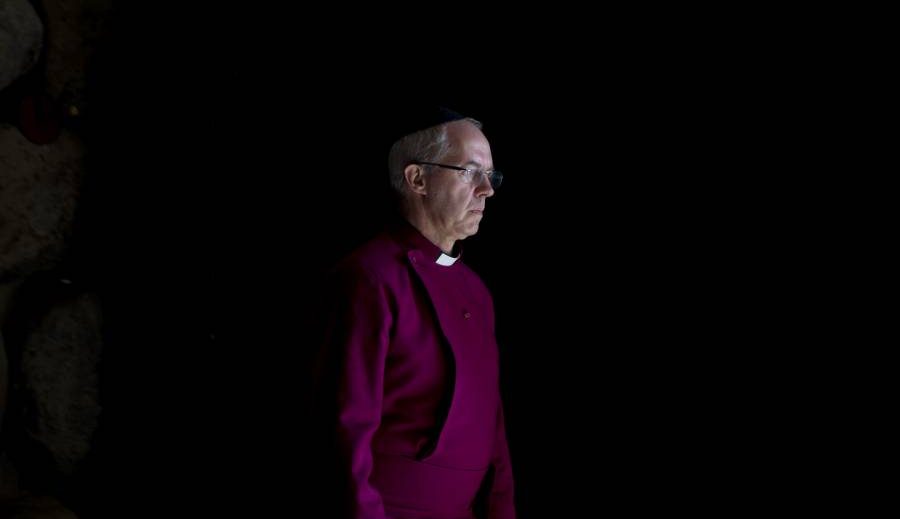
Justin Welby — the now-disgraced Archbishop of Canterbury who just resigned his position — had a glorious birthright as a sinner who experienced the saving grace of Christ after he responded to the Gospel and underwent a genuine conversion experience while a student at Trinity College, Cambridge.
I had heard Welby was an evangelical, committed to the Gospel and to biblical truth. So when he advertised for a canon theologian to serve under him while he was Dean of Liverpool, I applied for the job.
Wise Leadership
Welby made a deep impression on me during my first year at Liverpool Cathedral. I saw him as a wise and compassionate leader with terrific management skills and a heart for serving Christ.
We traveled to Auschwitz together, and I marveled at his fluency in French and the breadth of his ecumenical vision. He had taken me along to meet a smattering of French Catholic leaders.
I was moved by his humility: As dean of what is arguably the world’s largest Anglican cathedral, he saw no problem in popping into my office and asking for exegetical insights into a text he would be preaching that Sunday.
When I decided to cantillate the Eucharistic Prayer to a new setting while celebrating the Eucharist, Welby was irate and shouted, “I despise chanting.” But after hearing it sung, he was humble enough to admit that he actually liked it, and said I should continue to do it.
After I left Liverpool and moved to parish ministry on the Isle of Man, Welby, who had meteorically risen to occupy the See of Canterbury, invited me to join his Task Force on Evangelism. I flew every three months to Lambeth Palace and saw firsthand his passion and strategy for making Jesus known to every soul in England.
I felt almost certain that God had raised His servant to lead the world’s third-largest Christian communion and that Welby would return the Church of England to its past glory. His concern for Africa and his involvement in the war-torn Democratic Republic of Congo and South Sudan were great assets for an archbishop of Canterbury.
Power Corrupts
But “power corrupts, and absolute power corrupts absolutely,” as one of our greatest historians, Lord Acton, put it so memorably. But few know that the context of this maxim is a letter written to Anglican bishop Mandel Creighton, who was defending unlimited papal power. Welby should have known that the head that wears a mitre is most vulnerable to the gangrene of power.
Sadly, even before he was first translated to the prestigious bishopric of Durham, some of us at Liverpool Cathedral had begun to spot blemishes in Dean Welby.
Catherine Pepinster sums it up in a column penned after his fall: “Certainly, when you spoke to him, you sensed he was a CEO who had mentally allocated you five minutes before passing on to the next matter to be dealt with.”
I had this sense of CEO Welby when we flew back from Auschwitz. It had been the most traumatic moment of my life. And Justin was my colleague. We were neighbors. But as soon as we boarded the plane in Warsaw, he snapped open his laptop and began replying to emails. And here I was hoping we’d have a good chat!
I also had a sense of the manipulative Welby when the events manager at the cathedral organized a “club night” in the sanctuary. I was one of the only canons on chapter to protest.
I produced the original consecration service to demonstrate how we would be profaning “sacred space.” I argued from peer-reviewed studies about the negative effects of Electronic Dance Music and the degenerate culture of today’s nightclubs. Welby shouted me down.
That night I witnessed young people getting high on drugs, bingeing on booze, and vomiting in the sanctuary. An inebriated young woman walked right to the main altar and lifted her skirt in an act of profanity; she was sans underwear.
I knocked on Welby’s door and told him what he had unleashed. The next day he stormed into my house and yelled at me right in front of my wife.
Drifting Dean
This was the beginning of a culture of turning cathedrals into venues for rock concerts, raves, mini-golf courses, and other lunatic ventures. And Welby was the pioneer of this new wave of degeneracy.
I noticed how his eyes would suddenly become like those of a frozen cod when I brought up the issue of the Islamization of Europe. I speak Urdu, the language of most Muslim immigrants to Britain, and Muslims would openly tell me their agenda was to turn the country into a caliphate. Welby didn’t want to know, even when I cited the eminent scholar Bat Ye’or on the looming threat of “Eurabia.”
We watched Welby drift from his roots in biblical truth and morality. I will never forget the day a senior Catholic priest came to the cathedral to discuss the project for an “interfaith tent.” Welby asked me to join the conversation and offer my opinion as canon theologian.
I quizzed the Catholic priest on how the uniqueness and definitiveness of Christ was being compromised by this interfaith gig. I wanted to evangelize the lost, not peddle the gospel of motherhood and apple pie. After the meeting, Welby blasted me for my “impudence,” even using the F-word.
I saw Welby flare up again at Lambeth Palace when Rico Tice, an outstanding evangelist on the Task Force, brought up the issue of why the topic of Hell had never featured in our evangelistic strategy. Welby asked him to apologize, if I remember rightly. Tice later quit the Church of England for an orthodox Presbyterian denomination.
Nevertheless, I still believed that God would use my archbishop to usher in the revival for which we had been so desperately praying.
Shattered Dream
What ultimately shattered my wishful thinking was Welby’s defamation of the godly and courageous Bishop of Chichester, George Bell — a great ally of Dietrich Bonhoeffer, the Lutheran pastor who dared to stand up to Hitler and was hanged at the Flossenberg concentration camp in 1945.
I was invited to deliver the keynote address at the Bishop Bell Conference organized by Richard Symonds, who worked unceasingly to restore the name of the good bishop. With very little evidence and against the research of some of Britain’s top historians, Welby had accused Bell of molesting a child.
Long after the allegations were disproved, Welby refused to retract the charges and famously maintained that there was a “cloud” over Bell’s memory. Welby remained intransigent despite a nation in uproar over the blackening of Bell’s reputation.
After a very long time and much acrimony, Welby finally agreed that “we did not manage our response to the original allegation with the consistency, clarity, or accountability that meets the high standards rightly demanded of us.” He apologized.
“Previously I refused to retract that statement, and I was wrong to do so,” he announced. “I took that view because of the importance we rightly place on listening to those who come forward with allegations of abuse, and the duty of care we owe to them.”
It is ironic that someone who claimed to take allegations of abuse so seriously would grossly neglect his responsibility to render justice to 130 minors who were subjected to the savagery of the most prolific abuser in the history of the Church of England, as I have reported in The Stream. For years, Welby refused to even meet with the victims.
To misquote Marc Antony in Shakespeare’s Julius Caesar: “I come neither to bury Welby, nor to praise him. The evil that men do lives after them; The good is oft interred with their bones; So let it be with Welby.”
He could have been England’s Jacob, if only he had not bartered his birthright for a pottage of wokeness (which I will explore in Part 2).
Dr. Jules Gomes, (BA, BD, MTh, PhD), has a doctorate in biblical studies from the University of Cambridge. Currently a Vatican-accredited journalist based in Rome, he is the author of five books and several academic articles. Gomes lectured at Catholic and Protestant seminaries and universities and was canon theologian and artistic director at Liverpool Cathedral.stic director at Liverpool Cathedral.