


The Hill Charlie Died On
Do the rights of an individual come from a fixed, universal Moral Order? Or are they merely whatever a despot, dictator, congress, parliament, corporate oligarchy, or mob says they are at any given time?
This is the second most important question in the human story.
Today, in the United States and Western World, societies born from the womb of the ancient Judeo-Christian ethos find themselves naked in an all-out war over individual freedom. It’s a battle for the core precepts that secure that freedom – the right to worship God and the rights to freed speech, conscience, and peaceful assembly.
Every war finds a rallying cry, a point of focus that frames the cause and its purpose in a few words. For this generation, and this time, that rallying cry must be to Save the Bill of Rights.
If freedom lovers, those who believe in absolute values, conservatives, orthodox Jews, and Christians are to make a difference in our time, then this is the hill we live or die on.
A True Gift
Charlie Kirk did. He dedicated his life to building a movement of young people who understand the origin of rights and the responsibility of moral accountability. He was a walking billboard for free speech.
History demonstrates time and again that freedom is a binary choice. You either believe in a transcendent, unchangeable moral order, or you subscribe to manufactured, human-made disorder, well-meaning though some may be. Kirk understood with absolute clarity that is the only question that matters in the debates of our time.
There is no middle ground. No gray. No in-between.
It seems as though there should be some middle way — some compromise, a “can’t we all just get along” moment – in how we organize ourselves and live together that satisfies everyone.
Many of the best minds in antiquity debated the question, and every generation since has had a bite at the apple. In every age, philosophers and academics have written endless tomes on arranging human affairs just so or building their concept of utopia. And untold hundreds of millions of men and women have been slaughtered along the way, a ghastly tribute to that hubris.
The thinkers and academics of yesteryear are all dead now, and the timeless Moral Order shrugs its indifference to their grand theories and ideas that exclude its existence in the battle between good and evil, freedom or servitude.
Charlie’s amazing ability to transfer the importance of these ideas — and the consequence of ignoring or altering them — to a new generation and connecting them to their personal lives was a true gift. Central to that, he proclaimed that God is in the center, not outside the affairs of men. Many, if not most, of his college audiences grew up in an era when the educational industry deliberately omitted or distorted the history of human freedom and ignored God. He raised the alarm of losing God-ordained liberties to individuals and nations.
His message is for all of us.
Never Forget 2020
At best, parliamentary governments — the tamest version of mob rule — have turned to soft totalitarianism. Since none of these governments is linked to God-ordained rights, their whims are merely the next inevitable step for those unrestrained by moral guardrails. They are all, in varying degrees, attacking free speech, freedom of conscience, freedom of religion, and freedom of association — embracing cultural suicide.
In the United States, Kirk would remind his audience that citizens have only recently discovered the unwritten limits of the most profound constitutional rights. Their rights to speech, association, worship, education, and even their livelihoods were subject to what amounted to the opinion of a handful of unelected medical bureaucrats in something called “public health,” or misinformation boards set up under the direction of the federal government.
Nothing demonstrated this better than the Wuhan coronavirus debacle, which unleashed the worst, not the best, instincts across the globe, but more unexpectedly in the West. Petty bureaucrats, imperious scientists, buffoons, grifters in political office, and think tanks turned on their populations like wolves on a downed elk, tearing at the fabric of freedom with seeming exuberance.
The pandemic led to public discussions in which many world “leaders” and would-be leaders openly promoted ideas reducing freedom to a matter of compliance, not a right. They talked of a new world order that would reflect the ideologies of raw power espoused by Marx, Stalin, Hitler, and Mao, not the God-ordained virtues of human liberty championed by Jefferson, Madison, Adams, and Washington.
Enter the Bill of Rights
The difference between the two seems subtle at first. Totalitarians have always proposed ubiquitous positive “rights” such as security, health care, food, shelter, and education. It’s alluring to many, but since these proposed “rights” are rented in return for individual fidelity, they are transient depending on who has the most power or dominance at any given moment.
But the ancient Biblical Ten Commandments point humanity toward an entirely different predicate for considering and establishing human affairs, which found its way into contemporary times with the American experiment in 1787. It presents “restrictive” rights inherent with individual responsibility and accountability: personal sovereignty.
(Interestingly, the modern radical socialist and Marxist movements still programmatically incorporate the core concepts from Marx’s 1847 Communist Manifesto, which sought to replace the Biblical Ten Commandments with its own new ten “laws” for humanity here.)
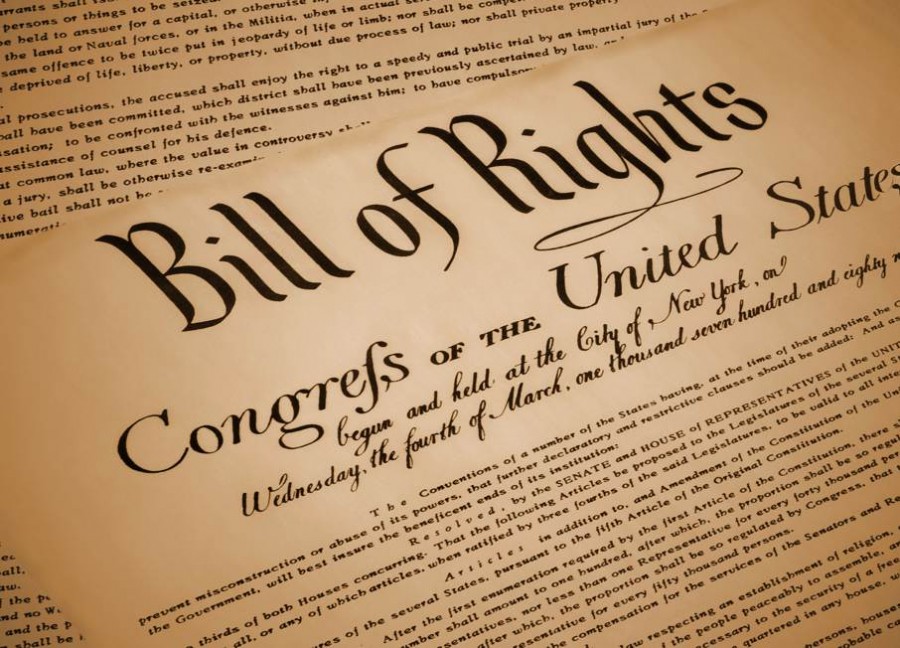
The Bill of Rights, the first 10 amendments to the Constitution, were not part of its ratification, but were a promised addition. The Founders were greatly influenced by the English Bill of Rights from 1689 and primarily drew from Virginia’s Declaration of Rights, drafted by James Madison in 1776. The Bill of Rights became the untouchable cornerstone supporting the rights of liberty for a free people in 1791. Over the centuries, it has significantly influenced the nation’s life in many ways. Perhaps its greatest provision has been to form a communal national understanding that underlies the concepts of liberty, justice, and righteousness.
The preamble to the Bill of Rights states its purpose unambiguously:
in order to prevent misconstruction or abuse of its powers, that further declaratory and restrictive clauses should be added [to the Constitution]: And as extending the ground of public confidence in the Government, will best ensure the beneficent ends of its institution.
So free speech, freedom of religion, association, assembly, and the right to petition for redress of grievances are bedrock rights, not bestowed at the whim of a bureaucracy, a court, or a politician. They are “natural” rights, God-ordained and God-given. The right to self-defense and to bear arms, the right to be free of unreasonable search, to have a speedy trial, due process, and the rights of state governments are not discretionary or elective but part of the sovereign standing of each citizen.
Strict Construction
The “restrictive” nature of the Bill of Rights has been attacked from its inception. First were the arguments that the amendments were codifying rights that the Constitution nowhere gave the federal government to regulate in the first place (Alexander Hamilton in Federalist No. 84). In more recent times, Franklin Roosevelt and Barack Obama also advocated for broad “positive” rights granted by the “government” that would, by their nature, mute the Bill of Rights.
It isn’t what the government can do for you that matters. It’s what it can do to you.
Yet the Bill of Rights stands alone in the world. (It should be America’s number one export!) Personal liberty depends on individual autonomy to fail and succeed on merit and work – to live as free men or women, not as bondslaves to indifferent administrative tyrants. In the U.S. Constitution, these restrictive rights, at least until the coronavirus, are bold pronouncements that self-identify their necessity for liberty’s success. There is no middle way.
The battle is on now. It should be the core message, the common commitment from every candidate for public office, like it was for Charlie Kirk. It should be the rallying cry of every sitting “conservative” member of Congress. It should be the primary focus of every alleged conservative organization and religious body. Save the Bill of Rights. Save liberty.
When all is said and done, as Kirk stated over and over again, this is God’s battle. He will never be mocked, and His Way will prevail with or without us. But it seems we have been placed here for such a time as this.
Michael Giere writes award-winning commentary and essays on the intersection of politics, culture and faith. He is a critically acclaimed novelist (The White River Series) and short-story writer. A former candidate for the U.S. House of Representatives from Texas, he was a senior executive in both the Reagan and the Bush (41) administrations, and in 2016 served on the Trump Transition Team.