


The Gospel of Paul’s Conversion According to Caravaggio
As Protestants and Catholics alike celebrate the Feast of the Conversion of Saint Paul, we ponder the way in which Jesus always turns His fiercest foes into His friendliest allies and then commissions them to suffer for Him
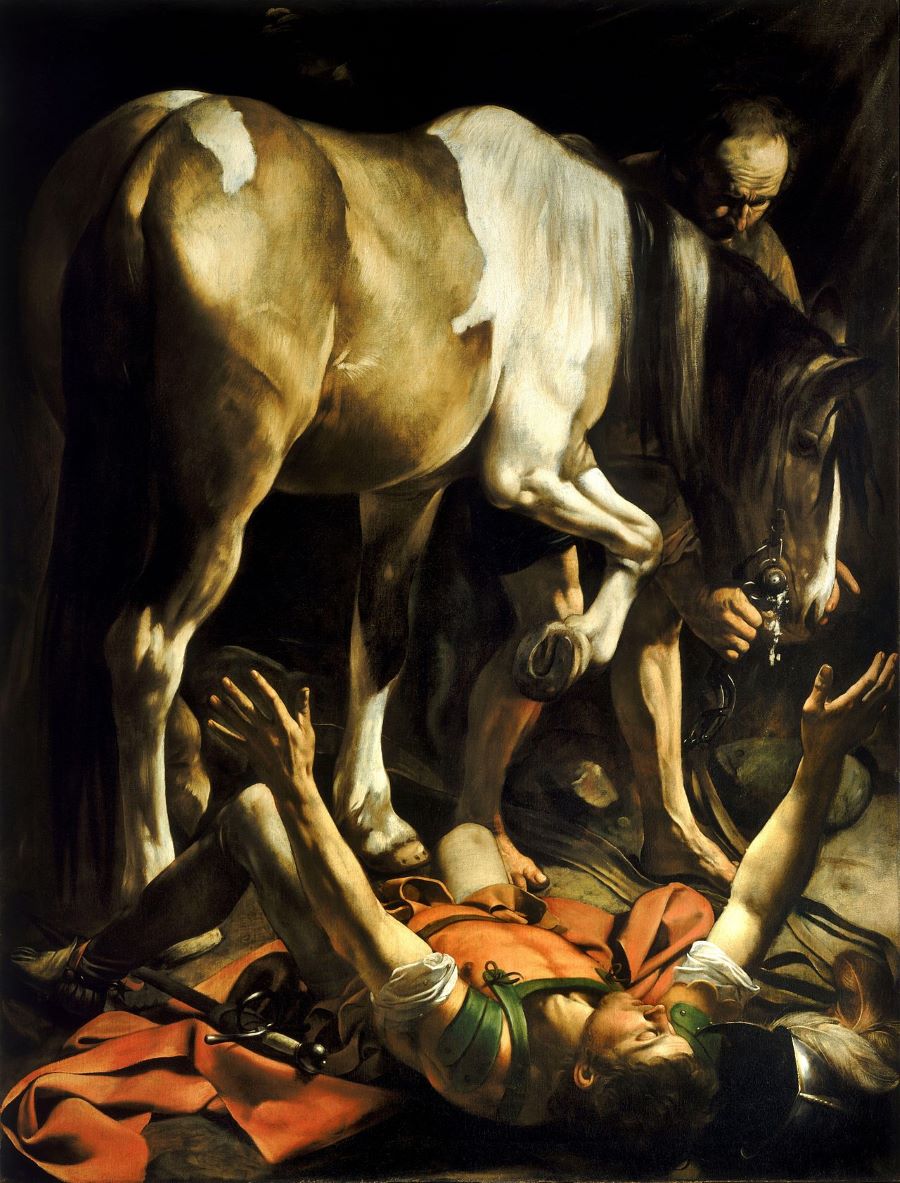
"Conversion on the Way to Damascus" by Caravaggio, oil on canvas, circa 1600.
You are on holiday in Rome, walking along the famous Piazza del Popolo and munching on a yummy piece of pizza. The sun is shining. The tourists are smiling. There’s a magnificent church in the middle of the piazza. “I’ll pop in and say a prayer,” you mutter to yourself.
You duck into the Church of Santa Maria del Popolo, a magnificent basilica with 12 side chapels, and walk straight down the aisle toward the high altar. As you are about to pray, you hear children giggling in the Cerasi Chapel to your left. Distracted, you go to see what’s so funny.
A little boy is pointing to a huge painting and telling his two sisters, “Look, the horse has a big bottom. And he’s sticking it right in your face.” Their mother gives you an embarrassed look while trying to shush her children. You look at the painting, expecting to see something religious — but it seems downright rude.
It is Michelangelo Merisi da Caravaggio’s painting of the Conversion of Saint Paul. You gaze at it. What’s wrong? The horse really is dominating the scene and shoving his posterior right into your face. What is Caravaggio telling you through one of his greatest masterpieces?
A Tale of Two Murderers
Caravaggio, who was literally a murderer, is the bad boy of art. Paul, another murderer, is the bad boy of the Church. In the book of Acts, Luke portrays him as “breathing threats and murder against the disciples of the Lord” (Acts 9:1) and tells us that Saul is the rabble-rouser instigating the lynch mob that has stoned Stephen to death.
Saul then began “ravaging the church, and entering house after house, he dragged off men and women and committed them to prison” (Acts 8:3 ESV). The Greek verb used to describe Saul “ravaging” the church is used in Psalm 80:13 (Greek Old Testament) to describe wild boars devastating a vineyard. Saul’s rampage against the followers of Jesus is like the “panting or snorting of wild beasts,” writes John Stott. Saul is like the horse in Caravaggio’s painting — agitated and stamping its feet.
In the Bible, though, horses symbolize power and pride. Isaiah denounces people who “rely on horses and trust in chariots … but do not look to the Holy One of Israel or consult the Lord” (Isaiah 31:1). The horse is “a false hope for salvation” (Psalm 33:7). This is one reason why Jesus does not ride into Jerusalem on a horse but on a donkey, as Zechariah prophesied.
Saul’s heart is filled with hatred. His mind is poisoned by prejudice. With “raging fury” (26:11 RSV) he is hurrying to Damascus to round up disciples of Jesus who have fled to a large Jewish community there to escape his persecution. The Bible does not tell us if Saul was on horseback. But Damascus is about 150 miles from Jerusalem, and a person of Saul’s rank — a member of the Sanhedrin — would not travel like a commoner on foot. Metaphorically at least, Saul is sitting on his high horse and riding to Damascus.
But as he approaches Damascus, suddenly there is a blinding flash of light. Like Humpty Dumpty, Saul has a great fall. He is dazzled by a “light from heaven, brighter than the sun” (Acts 26:13). It is “around noon” and Saul, as an observant Jew, may well have been saying his midday prayers (Acts 22:6). The fanatic falls to the ground.
He hears a voice: “Saul, Saul, why are you persecuting Me?”
“Who are you, Sir?” he asks.
The voice replies, “I am Jesus, whom you are persecuting” (Acts 9:4-5).
Throwing Saul off his High Horse
You look at Caravaggio’s painting and ask yourself: “Could this fanatical beast, Saul, ever be tamed and harnessed to become God’s greatest apostle?” Your eyes move from the horse to the figure of Saul lying on the ground.
Caravaggio captures Saul’s conversion like no other artist. In the painting, Saul is drenched in light, with eyes closed and feet spread out. His hands are flung outward in sweet surrender. His face registers both shock and serenity. His sword is on the ground away from his body. Once, he rode proud and erect on his horse. Now he lies flat on his back — powerless, helpless, defenseless, weak, and dependent.
His head juts out into our space; he is upside down. Does it look like Saul is caught up in the convulsions of a terrible trauma, or does it look like he is being caught up in the most supreme and sublime ecstasy a human being can experience? Conversion to Christ is both — terrible trauma and supreme ecstasy.
Saul has been mauling the Body of Christ. Now Jesus has conquered him. Jesus has turned His fiercest foe into His friendliest ally.
That is what conversion is. God reconciles His enemies to himself, as the man now namedPaul will later write in his letter to the Romans (5:10). We are not neutral before conversion: We are God’s enemies. We resist His prodding because we do not want to get off our high horse and surrender our lives to Him. We do not want to leave behind our old way of life to take up a new one.
We rely on horses. We are proud and self-sufficient. Conversion is God throwing us off our high horse. Conversion is falling to the ground, blinded by the light of Christ. Conversion is lying helpless on our backs. Conversion is hearing the voice of Jesus call your name, “Cynthia, Jules, Freddie. Why are you fighting Me? You come to church and I prod you through My Word. You go home and I prick your conscience through difficult circumstances. You go to work and I pierce you through problematic situations. Stop fighting Me and surrender.”
Every year, Catholics and Protestants celebrate the Feast of the Conversion of St Paul on January 25. But Paul’s conversion is not from Judaism to Christianity. He remains a Jew to the very end. Paul’s conversion is from Pharisaical Judaism to Messianic Judaism. His conversion is his recognition that Jesus the Jew is God’s Messiah and our Saviour. Conversion is not a change of religion, but a change of heart.
Suffering for Jesus
As you stand in the Cerasi Chapel before Caravaggio’s painting, a hot gush of tears springs to your eyes. You kneel before the altar to surrender your life to Jesus. “What next?” you wonder. “What happens after conversion?”
You know the story. You know how Saul rises from the ground and remains blind for three days. You know he needs to be led by the hand to Damascus. There he will meet Ananias and other followers of Jesus. They will, undoubtedly, be suspicious of him. But God has revealed His plans to Ananias in a vision. Ananias will lay hands on him address him as “Brother Saul.” The scales will fall from Saul’s eyes. He will be filled with the Holy Spirit and begin to preach in the synagogues, and prove to his hearers that Jesus is God’s Messiah (Acts 9:20, 22).
Your eyes move upward to the shadowy figure of the groom in Caravaggio’s painting. Could the groom represent the Church? Cautious at first, but waiting to welcome Saul and introduce him to his new calling? Saul cannot exercise his ministry if he is not part of the Church. Jesus has given Ananias a job description, saying. Saul is to be God’s “chosen instrument to carry my name before the Gentiles and kings and the children of Israel.” His name will be changed to Paul, and he is later to receive a reward for his faithful service to Jesus.
What is his reward? “For I will show him how much he must suffer for the sake of my name” (Acts 9:15-16).
Suddenly your faith is beginning to make sense. You understand why you are so ineffective as a Christian: It’s because you don’t want to suffer for Christ. You think of Christians being tortured and killed in Egypt,Iraq, Syria, Pakistan, Nigeria, and India. You wonder what will happen if you are asked to pay the ultimate price for your faith. And you remember Paul’s words from his letter to the Romans: “If God be for us, who can be against us?” (8:28).
A famous bishop once said: “Wherever Paul went, there were riots. Wherever I go, people serve tea.”
It’s time to leave the Cerasi Chapel. You’ve made up your mind. As you leave the Church of Santa Maria del Popolo, you begin to sing: “Amazing grace, how sweet the sound that saved a wretch like me. I once was lost but now am found, was blind but now I see.”
Dr. Jules Gomes, (BA, BD, MTh, PhD), has a doctorate in biblical studies from the University of Cambridge. Currently a Vatican-accredited journalist based in Rome, he is the author of five books and several academic articles. Gomes lectured at Catholic and Protestant seminaries and universities and was canon theologian and artistic director at Liverpool Cathedral.