


The Faith of Charles Dickens
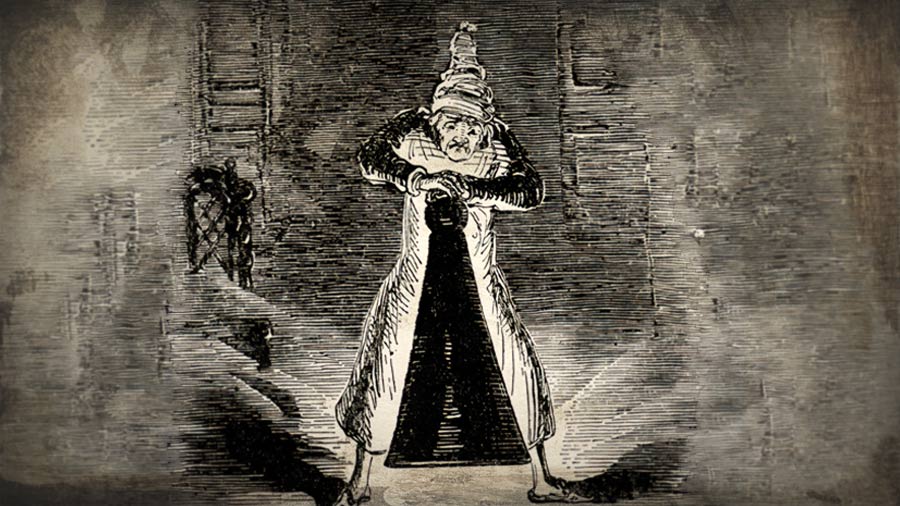
Vintage engraving of a scene from Charles Dickens A Christmas Carol - Ebenezer Scrooge
On Christmas Eve in 1849, a young father sat in his children’s nursery, high above the streets of London, reading aloud to his offspring about the life of Jesus Christ.
This was no ordinary father reading from a well-worn family Bible. Charles Dickens, the literary father of David Copperfield, Oliver Twist, and Tiny Tim, was reading from a manuscript he had begun writing in 1846, titled The Children’s New Testament (later changed to The Life of Our Lord).
The existence of this manuscript — a simple retelling of the four gospels — remained a family secret for more than half a century after the great man’s death. Dickens wanted it that way; he forbade its being published or seen outside of the family. But in 1933, upon the death of the last surviving Dickens son, the family decided the public should at last be allowed to see this little gem. Simon & Schuster published the first American edition in 1934.
The result: Sixty-four years after his death, Dickens became a bestselling author again, with his book becoming one of 1934’s biggest nonfiction works. (This probably infuriated all the writers who actually lived and wrote in 1934, who would have liked to see book reviewers celebrating their tomes, not some dead guy’s book.)
A Message for Children
The Life of Our Lord is a tender retelling of the Gospel message. As his great-great-grandson, Gerald Charles Dickens, explains, the author “wrote The Life of Our Lord for a very special reason. He wanted his children to learn about the life and teachings of Jesus Christ in as plain and simple a way as possible, and he decided the best way to achieve that was to write it himself and give it to his family as a gift.”
The book begins,
My Dear Children, I am very anxious that you should know something about the History of Jesus Christ. For everybody ought to know about Him. No one ever lived who was so good, so kind, so gentle, and so sorry for all people who did wrong, or were in any way ill or miserable, as He was.
Then follows a simple account of Jesus’s life, crucifixion, death, and resurrection.
There are amusing asides, which appear to be intended to keep the wandering attention of Dickens’ 10 children on the story:
You never saw a locust, because they belong to that country near Jerusalem, which is a great way off. So do camels, but I think you have seen a camel. At all events, they are brought over here, sometimes, and if you would like to see one, I will show it to you.
The focus of the book is (as always with Dickens, who endured a difficult childhood) with the poor, the hungry, the hated, and downtrodden. In an afterward, paraphrasing Mark 12, he writes,
Hear what our Lord Jesus Christ taught to his disciples and to us, and what we should remember every day of our lives, to love the Lord our God with all our heart, and with all our mind, and with all our strength; to love our neighbors as ourselves, to do unto other people as we would have them do unto us and to be charitable and gentle to all.
Children from Every Age
But he was determined to share these biblical messages through his novels, and subtly encourage his readers to follow them. In a letter to a friend, Dickens writes:
One of my most constant and most earnest endeavours has been to exhibit in all my good people some faint reflections of the teachings of our great Master, and unostentatiously to lead the reader up to those teachings as the great source of moral goodness. All my strongest illustrations are derived from the New Testament; all my social abuses are shown as departures from its spirit; all my good people are humble, charitable, faithful, and forgiving. Over and over again, I claim them in express words as disciples of the Founder of our religion.
We parents and grandparents should remember how important it is to take the time to explain to children, in simple language, who Jesus is and how we must live if we are to honor Him. Fortunately, today there is a plethora of books designed to help small children understand the teachings of the Scripture, so we do not have to write our own.
Dickens was no theologian, and The Life of Our Lord contains a few errors. For instance, he confuses Herodias and her daughter Salome, and says the Jews celebrated the Sabbath on Sunday. Nevertheless, Dickens does a lovely job of teaching children simple lessons about the character of Christ and of His Father in Heaven, who “makes no difference between those who wear good clothes and those who go barefoot and in rags.”
Charles Dickens, who died in 1870, would be pleased to know that his little book is still influencing his descendants. As Gerald Charles Dickens notes in the introduction to The Life of Our Lord, the book teaches his own modern-day children “about Jesus Christ, and they are as fascinated by the miracles and parables as were their counterparts” 170-odd years ago.
Read The Life of Our Lord on Christmas Eve “as an honorary family member,” Dickens urges, “and draw from it the rich meaning that Charles Dickens intended when he first presented this gift to us.”
Finally — I cannot resist saying this — God bless us, every one!
Anne Morse is a freelance writer living in Maryland amidst towering piles of books. She has never had to endure a Christmas without any presents.