


Rome’s Chief Rabbi Blames Pope Francis for Historic Rupture in Jewish-Catholic Relations
Acrimonious dialogue signals historic breakdown as pope accused of “selective indignation”
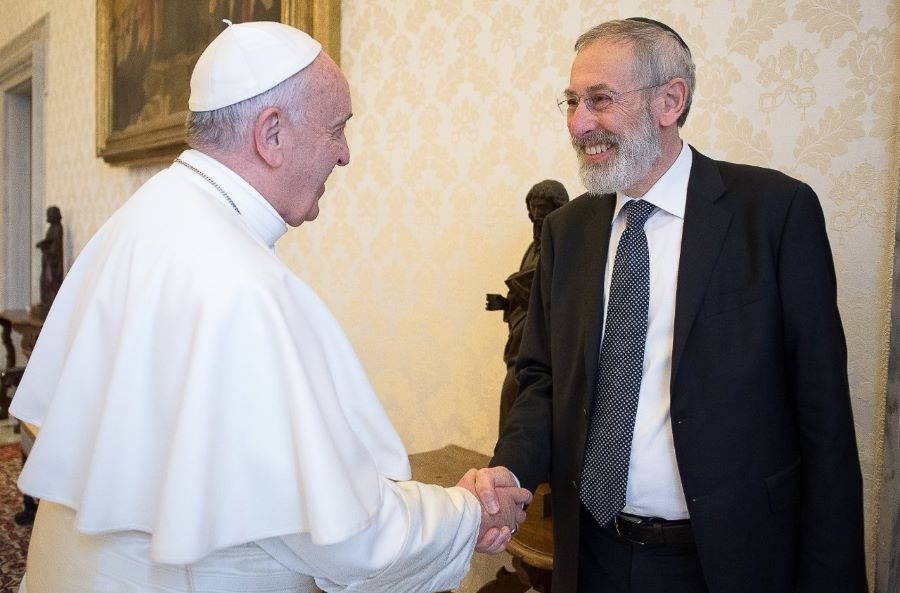
Pope Francis greets Rome's chief rabbi, Riccardo Di Segni.
Jewish-Christian relations are on the brink of a historic breakdown after Rome’s chief rabbi, Dr. Riccardo Di Segni, accused Pope Francis of neglecting persecuted Christians in Islamic countries while directing his “selective indignation” against Israel.
Addressing the 36th Day for Dialogue between Catholics and Jews at the Pontifical Lateran University on January 16, Di Segni warned that the pope’s “omissions, distractions, low-profile, generic citations” against Muslims who persecute Christians “clashes with the systematic and almost daily attention and words of disapproval and condemnation towards Israel.”
Pope Ignores Persecuted Christians
“The number of Christians in the Middle East is dropping precipitously,” Di Segni said, noting that in Iraq alone between 2003 and 2024, the Christian population nosedived from 1.5 million to 250,000. Meanwhile, 400,000 Christians have been killed by Muslims in South Sudan, 400,000 in Yemen, 400,000 in Syria, and at least 300,000 in Tigray (Ethiopia).
Additionally, religious persecution has spawned 13 million international refugees and 24 million refugees within countries, said Di Segni, who is also a radiologist and a philologist.
“We know that the Pope calls the priest in Gaza every day. How many phone calls has he made to Sudan, Syria, Ethiopia, Congo, Yemen, and how many times has he spoken about them?” he asked.
“A Pope cannot divide the world into sons and stepchildren and must therefore denounce the suffering of all. But this is exactly what the Pope does not do. The very noble compassion for the suffering and condemnation of the cruelty of war is suspect when it is one-sided” and “loses its moral force” when it engages in “selective indignation.”
“We are living in a moment when the Church seems once again to be giving in to the temptation to cut ties with Judaism,” he observed. The “concepts and vocabulary accusing Israel, instead of being balanced in an objective view, have been taken up by a part of the Church, from the base to the top, acting as a sounding board and moral endorsement of the condemnation.”
Accusations of Misappropriation
During the opening ceremony of the Holy Door in several churches marking the Vatican’s Jubilee Year, a shofar was blown — sparking a fierce debate on Jewish social media and prompting Di Segni to raise an eyebrow over cultural and religious appropriation and even “substitutionism.”
Di Segni also pointed out that both moderate Catholics and Jews had problems with Christians gathering on Maundy Thursday to recall the Last Supper by reciting the Pesach Haggadah with ritual Seder meals.
Jews also complained that Pope Francis dejudaized Jesus when he was photographed in front of a crib that portrayed a baby Jesus lying on a Palestinian keffiyeh just before Christmas.
“With regard to these protests, I pointed out that on the one hand we protest when you dejudaize Christianity, and on the other hand when you judaize, as you do by playing the shofar, you protest,” he remarked. “The problem is to find the right balance. And it is not easy. It is a question of defining for our sensibilities, but especially for Christian sensibilities, what the boundaries are between the two faiths.”
Slamming accusations of disproportionality against the Israeli Defense Forces, Di Segni argued that “the real disproportion is something else; it is the media attention, the poisoned and lying propaganda that has a hold on people, compared to other much more tragic events.”
A political and rational explanation would not suffice to explain the excessive disproportionality against the Jews, especially for people with a “religious sensibility,” he noted, locating the core of ancient and continuing antisemitism in God’s choice of Israel to be a light to the nations.
For those who believe and look to religion for inspiration and support, there is something or much more than politics, psychology, sociology. It is the special place of Israel in human history and faith, which more often than not leads humanity to express itself towards Israel in the worst possible way, as in these days, but which instead could and should have a virtuous and positive development.
Shamed Catholics Defend Francis
Catholic clergy representatives at the “Pilgrims of Hope” conference were visibly embarrassed by the rabbi’s strong words, but defended Francis’s pro-Palestinian stance — resulting in harsh exchanges between Catholic and Jewish representatives at the meeting.
“I am allergic to any form of antisemitism but I do not believe we can draw such extensive conclusions,” said Monsignor Marco Gnavi, head of the Office for Ecumenism in the diocese of Rome. “Forty thousand victims need to be accounted for. You cannot ask us to suffer with you and not with others.
“The years of dialogue cannot be dismantled. . What has been sown remains. Either we are together or we will not make it.”
Bishop Ambrogio Sprea, Commission for Ecumenism and Dialogue of the Italian Episcopal Conference, agreed.
“We cannot say that we have eliminated eighty years of dialogue, otherwise we would truly go backwards,” he said. “We must work to lower the mountain of hatred that has been created. The pain is the same for everyone.
“Obviously,” he added, “we are very concerned about this rising antisemitism that revives absurd ancient stereotypes that can only do harm.”
Jews Warn of Resurgent Catholic Antisemitism
Ruth Dureghello, former president of the Jewish Community of Rome, noted that Jews “are witnessing distortions of history that have fueled a climate of hatred on social media and in real life” and “interreligious dialogue has also been put to the test.”
She blasted Pope Francis, saying: “When you wink, or when you open doors, or when you look at the suffering of only one side, you make choices that imply responsibilities and that put our future in the balance.”
On January 15, the Italian Rabbinical Assembly (ARI) released a statement noting thatJewish-Catholic dialogue “is experiencing a moment of profound crisis” as the result of “the attitude taken by a significant part of the Catholic world in the last year, after the tragic events of October 7, 2023.”
“What has not been lacking, however, is the participation of Catholic voices, and in this case also of the pope, in the process of demonizing Israel, accused of genocide, of all sorts of crimes, of deliberately killing children, of starving the civilian population,” the ARI stated, warning that the Catholic Church is “underestimating the resurgence of antisemitism and anti-Judaism.”
Nostra Aetate in Danger
Di Segni’s warning that the conflict in Gaza “has had among its victims the Jewish-Christian dialogue” marks an unprecedented nadir in the rapprochement between Catholicism and Judaism since Vatican II, especially as the Vatican prepares to celebrate the 60th anniversary of Nostra Aetate in 2025.
For centuries, Rome officially taught that the Jews are rejected, cursed, and hated by God. In an epochal U-turn, Vatican II’s Nostra Aetate turned the Jew “from enemy to brother,” using the Latin superlative carissimi to describe the Jews as “beloved by God,” as The Stream has previously explained.
Since Hamas’s infamous attack on Israel in October 2023, Jews in Italy have continued to express concern over the rising anti-Israel sentiments expressed by Vatican officials, especially given the Vatican’s historic antipathy toward Jews and Judaism.
Last April, Italian film director Marco Bellocchio’s movie Rapito (Kidnapped), which premiered at the Cannes Film Festival, was released in British cinemas and in Italy.
Bellocchio zooms in on the chilling scene of papal paramilitary police knocking on the door of Momolo and Marianna Mortara in Bologna on the night of June 23, 1858, while the Jewish mother is caring for her seven children.
David Kertzer’s The Popes Against the Jews narrates the chilling stories of papal abduction of Jewish children who were secretly baptized by Catholics:
In the three and a half years from the middle of 1814 through 1818, Church authorities sent the police into the Roman ghetto on twenty-two different occasions, always at night, to extract Jews by force and take them to the House of the Catechumens. In that brief period alone, the police took seventeen married women, three fiancées, and twenty-seven children. The night hours were a time of fear for Rome’s Jews.
In a candid review, the Italian Episcopal Conference newspaper Avvenire acknowledged that Rapito is “unsettling” and “rightly disturbing” with “no polemical aspect in the presentation” but “only the desire for clarity and truth.”
Historians studying the recently opened archives relating the papacy of Pope Pius XII have also noted the pope’s silence in the face of the Nazi deportation of over 1,800 Jews from Rome to Auschwitz, despite heartrending pleas from their families.
Catholic officials intervened only in the cases of Jews who had been baptized as Catholics or had married Catholics.
Dr. Jules Gomes, (BA, BD, MTh, PhD), has a doctorate in biblical studies from the University of Cambridge. Currently a Vatican-accredited journalist based in Rome, he is the author of five books and several academic articles. Gomes lectured at Catholic and Protestant seminaries and universities and was canon theologian and artistic director at Liverpool Cathedral.