


Remembering to Say “Thank You”
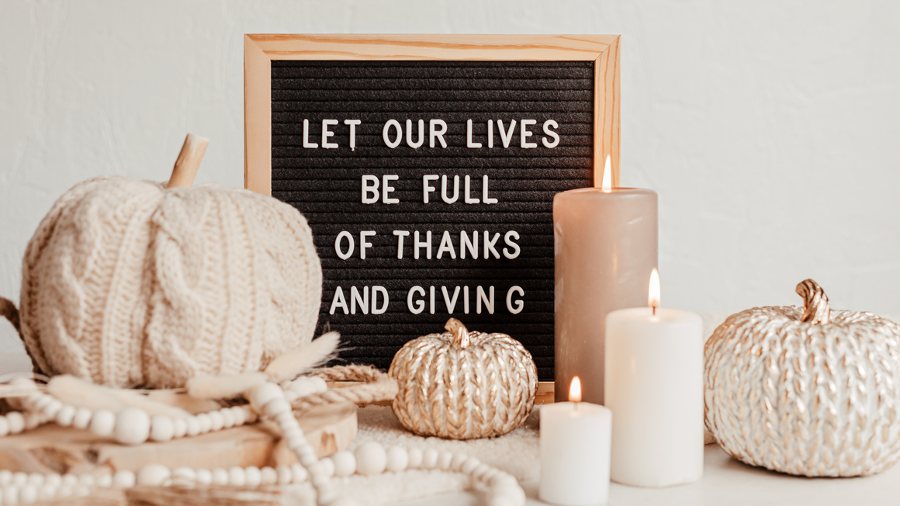
Thanksgiving is here again, and that’s a tough sell in our age of rights and entitlements, particularly as it kicks off the “holiday season,” the season of self-indulgence, “gimme,” “I want,” and “I deserve.” And there’s no getting around it: A lack of gratitude infects almost all of us, despite Scripture and Christian spirituality insisting that it is an ugly and vicious sin.
Just look at the company ingratitude keeps in St. Paul’s thought:
For men will be lovers of self, lovers of money, proud, arrogant, abusive, disobedient to their parents, ungrateful, unholy, inhuman, implacable, slanderers, profligates, fierce, haters of good, treacherous, reckless, swollen with conceit, lovers of pleasure rather than lovers of God, holding the form of religion but denying the power of it.
Then he adds, “Avoid such people.” (2 Timothy 3:2-5). Well, yes, to say the least. Avoid hanging out with such people and, more important, avoid becoming one.
Gratitude Renders Justice
“In the light of the Divine Goodness,” wrote Ignatius of Loyola, “it seems to me, though others may think differently, that ingratitude is the most abominable of sins and that it should be detested in the sight of our Creator and Lord by all of His creatures who are capable of enjoying His divine and everlasting glory.”
Fast forward 500 years to Billy Graham, who said: “Gratitude is one of the greatest Christian virtues; ingratitude, one of the most vicious sins.”
Thanksgiving, you see, is a matter of justice, of giving others what they deserve. The person who holds the door for you deserves a “thank you.” Justice demands it. Parents who brought us into the world and raised us — despite their shortcomings — deserve gratitude. Again, justice demands it. This month, we celebrated Veterans Day. Remembering with thanksgiving those who died while serving our country is a matter of justice.
And, of course, the God who made this world, gave us our gifts and talents, keeps us safe, and redeems us in Christ deserves gratitude to the point of worship. In liturgical churches, when the priest says, “Let us give thanks to the Lord, our God,” the congregation replies, “It is right and just.” The priest then goes on in prayer, “It is truly right and just, our duty and our salvation, always and everywhere to give You thanks….”
The Universal Sin
All that being said, I recently read my friend Jason Baxter’s wonderful new translation of Dante’s Inferno, the first book of The Divine Comedy, and noticed that Dante’s Hell has no circle of the ungrateful, no special torment for those who did not give thanks in life. Why? Because every soul in Hell is there because of ingratitude — from the least of the sinners to the worst.
The first souls Dante encounters on the outskirts of Hell are “the sorrowful souls of those / who lived without infamy but also without praise” (Inferno 3.35-36). They never did anything worthy of Heaven and they never did anything worthy of Hell and so are “despised by God and his enemies alike” (3.63).
Rather than using the gift of life — either for good or ill — they did nothing. They are, Dante tells us, “cursèd souls, who never really lived” (3.64). They merely existed, lacking gratitude even for their humanity, the Medieval equivalent of the modern couch potato.
Lower down in Hell (Canto 7), the spendthrifts and the hoarders war with each other over what each did with his or her money, but they both took the gift of wealth for granted.
Further down, rather than giving thanks for a safe return from the Trojan War, Ulysses tells Dante that “neither the sweetness of my son nor piety / toward my aged father, and not that love / I owed Penelope — I should have made her glad” (26.94-96) could keep him from setting off on another — this time fatal — journey. He lacked gratitude for all his clear and obvious blessings, running off and leading others on a fool’s errand.
The Traitors’ Circle
The lack of gratitude is most clear in the lowest depths of Hell, the circles reserved for traitors. Rather than living in gratitude, these betrayed family, homeland, friends, and, worst of all, benefactors. Instead of justly returning thanks, they returned treachery and murder.
Owing gratitude to Julius Caesar for his kindness and loyalty to them, Brutus and Cassius assassinated him. Owing thanks to Jesus for His friendship and apostolic calling, Judas Iscariot betrayed him for a handful of coins.
These three each suffer in one of the three mouths of the worst, most thankless betrayer, Satan himself, who chews them in bovine idiocy.
Satan is the preeminent example of the godless of whom St. Paul writes, “although they knew God they did not honor him as God or give thanks to him, but they became futile in their thinking and their senseless minds were darkened” (Romans 3:21).
Thanklessness demonstrates that we’ve forgotten graces, benefits, and blessings received, which is why it is status quo in Hell.
The fourth Thursday in November is an annual poke, goading us toward a heavenly way of life — the joyful life of the just, those who have learned to give thanks.
James Tonkowich is a freelance writer, speaker, and commentator on spirituality, religion, and public life. He is the author of The Liberty Threat: The Attack on Religious Freedom in America Today and Pears, Grapes, and Dates: A Good Life After Mid-Life and serves as director of distance learning at Wyoming Catholic College. He also hosts the college’s weekly podcast, The After Dinner Scholar.