


Pride and Prejudice: Seeing Only What We Want to See
What does this have to do with Holy Week? Read on to find out.
It’s Holy Week in our tragically divided world, and as Pope St. John Paul II noted, “It is precisely through the mystery of the Cross that our Lord Jesus Christ overcomes the tragedy of the division between man and God. Indeed, with Easter the mystery of the Father’s infinite mercy penetrates the darkest roots of human iniquity. There a movement of grace begins which, if accepted with free consent, leads us to taste the sweetness of full reconciliation.”
Reconciliation with God necessarily lead to reconciliation with others. Yet divisiveness rather than reconciliation marks our era. Too many of our relationships are poisoned by contempt and distrust. In families, in politics, and even in the Church, divisions seem insurmountable.
While it’s not the only reason, a major problem that leads to division is confirmation bias, the all-too-human “tendency to process information by looking for, or interpreting, information that is consistent with their existing beliefs.” We are certain that some people, groups, and organizations are good and others are bad. Our minds are made up, so please don’t confuse us with facts.
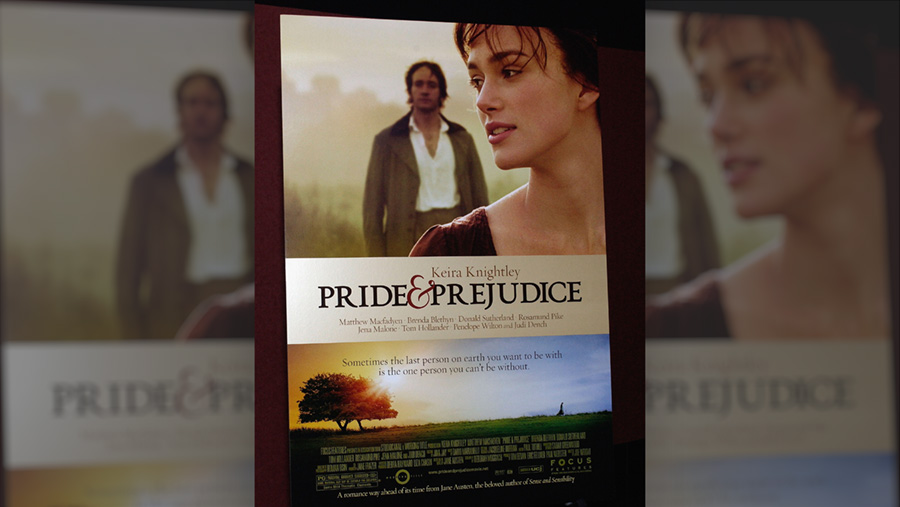
Eighteenth-century novelist Jane Austen wrote an extended meditation on confirmation bias, the thinking that poisons so many relationships. Not having a fancy sociological term for it at the time, she simply called it Pride and Prejudice.
The Dour Darcy
Austen’s book opens as two wealthy gentlemen, Mr. Bingley and Mr. Darcy, move into a country estate near Longbourn, home of Mr. and Mrs. Bennet and their five unmarried daughters.
When the two attend a local dance, Bingley finds the company — particularly that of the eldest Bennet daughter, Jane — thoroughly enjoyable as Darcy stands around looking aloof and dour. Bingley encourages him to join the fun, pointing out Jane’s sister Elizabeth as a possible dance partner.
Elizabeth is seated close enough to overhear Darcy say, “She is tolerable; but not handsome enough to tempt me….” As a result of the evening and the gossip that followed, Darcy gains a reputation not only in Elizabeth’s mind, but among their friends’ as well, for being proud, arrogant, and thoroughly unpleasant — basically a total jerk.
That opinion worsens with the arrival of Mr. Wickham, the son of the Darcy family’s late estate manager; he grew up with Darcy. He also is tall and handsome, but unlike Darcy, he is also cheerful, gregarious, and pleasant to be around. Soon Elizabeth and the whole town love him.
The Opposite
Early in their acquaintance, Wickham informs Elizabeth that he wanted to be a minister, but, alas, Darcy prevented it — presumably out of spite, reducing him to a near poverty.
Elizabeth’s confirmation bias immediately kicks in. “I had not thought Mr. Darcy so bad as this,” she says, “though I have never liked him, I had not thought so very ill of him….” But now she does.
At a party months later, Darcy asks Elizabeth to dance. She reflexively says yes, but quickly regrets it. “I dare say you will find him very agreeable,” says her friend, Charlotte.
“Heaven forbid!” she replies, “That would be the greatest misfortune of all! To find a man agreeable whom one is determined to hate! Do not wish me such an evil.”
“Determined to hate.” There’s the nub of it. In her mind, Darcy can do no good while Wickham can do no bad. She calls Wickham “the most agreeable man I ever saw,” adding, “Oh, that abominable Mr. Darcy.”
Seeing the Truth
Later in the novel, Darcy proposes to a bewildered Elizabeth. He is awkward and clumsy, but brutally honest regarding her dysfunctional family. With equally brutal honesty, she refuses him, condemning “your conceit, and your selfish disdain for the feelings of others” pointing out in particular his mistreatment of Wickham.
After Darcy leaves, he feels compelled to answer her accusations regarding Wickham in a letter, telling his side of the story: Wickham is a scoundrel who was treated better than he deserved. Lest she doubt him, he adds, ask Colonel Fitzwilliam — a person Elizabeth knows, likes, and trusts.
At first, she dismisses Darcy’s story, but upon reflection, realizes that she has constructed her ideas about him and about Wickham not with facts, but with pride and prejudice—that is, confirmation bias. Her opinions of both were two houses of cards.
“She grew absolutely ashamed of herself. Of neither Darcy nor Wickham could she think, without feeling that she had been blind, partial, prejudiced, absurd.” The spell, once broken, results in pain and humiliation, two things we all do our best to avoid and yet two things that can bring us face-to-face with truth when we are in the wrong. “How humiliating is this discovery!” Elizabeth thinks, “Yet how just a humiliation!… Till this moment, I never knew myself.”
In the novel, pride and prejudice are not just Elizabeth’s problem. Confirmation bias is everywhere. Elizabeth and Darcy manage to overcome it, and their reconciliation leads to marriage. But other characters in the novel remain stuck.
During this penitential week, don’t remain stuck. As we follow Jesus to the cross, let’s examine our own relationships — particularly the bad ones. How much does confirmation bias prevent us from seeing the truth and paving the way to reconciliation with family, church members, old friends, neighbors, and those with different religious or political ideas — those we are “determined to hate,” or at least dislike a great deal?
The Cross breaks the spell of our confirmation bias. Which is not to say that we should lose all convictions of right and wrong. Jesus didn’t, and we shouldn’t.
Rather, the cross “leads us to taste the sweetness of full reconciliation” and, having tasted, to become “ministers of reconciliation” (2 Corinthians 5:18). What better week can we find to begin?
James Tonkowich is a freelance writer, speaker, and commentator on spirituality, religion, and public life. He is the author of The Liberty Threat: The Attack on Religious Freedom in America Today and Pears, Grapes, and Dates: A Good Life After Mid-Life. He is Instructor Emeritus at Wyoming Catholic College.