


Pope Leo XIV Links Abortion to Death Penalty, Endorsing “Consistent Ethic of Life”
Pontiff approvingly cites moral theory posited by Chicago cardinals, demonstrating continuity with Pope Francis
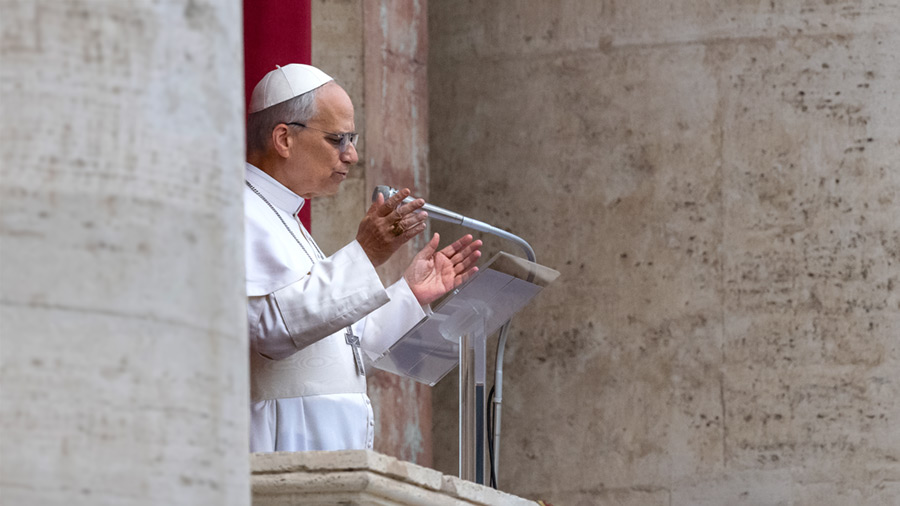
Pope Leo XIV gives his first Regina Caeli prayer in St. Peter's Square on May 11, 2025, after his election.
Pope Leo XIV has affirmed an “interconnectedness” between abortion and the death penalty in a powerful endorsement of the “seamless garment” ethic of life propounded by Cardinal Joseph Bernadin, the former archbishop of Chicago.
Statements Leo made upon receiving an honorary doctorate in October 2023 from the Universidad Católica Santo Toribio de Mogrovejo in Chiclayo, Peru, where he was presiding as Bishop Robert Prevost, surfaced late Wednesday.
“A Catholic cannot truly claim to be ‘pro-life’ by maintaining a stance against abortion while simultaneously advocating in favor of the death penalty,” he declared. “Such a position would lack coherence with Catholic social teaching.”
Citing Bernadin, he observed that issues from “genetic research, abortion, capital punishment, [and] modern warfare to the care of the terminally ill” are “fundamentally rooted in one essential Catholic principle: the loss of even a single human life is a profoundly significant event.”
Prevost continued, “Seen in this context, abortion, war, poverty, euthanasia, and capital punishment share a common identity: each one is rooted in a denial of the right to life. We could add other contemporary issues to this list, such as the implications of artificial intelligence, human trafficking, and the rights of immigrants, among many others.
“Bernardin’s vision suggested understanding the Church’s moral teachings as responding holistically to the many challenges affecting human life, as if they were threads woven into a single garment,” he added, explaining the origin of the “seamless garment” theory.
“One of our greatest challenges today, particularly within this Catholic university and indeed across all Catholic universities, is to discover the best way to teach and promote precisely this kind of thinking.”
Prevost urged his audience to build upon “Bernardin’s foundation,” and quoted Cardinal Blaise Cupich of Chicago as having “recently suggested reclaiming and further developing the concept of the consistent ethic of life, expanding it into what he calls a new, integral ethic of solidarity.”
Cupich’s Defense of Bernardin’s “Seamless Garment”
A week before Leo’s address on the “seamless garment” in Chiclayo, Cupich delivered a lecture on Bernadin’s “consistent ethic of life” at the Jesuit-run Fordham University in New York City in September 2023. Leo quoted Cupich extensively in his address.
Cupich’s address, which was printed in the Vatican’s official newspaper L’Osservatore Romano, recalled Bernadin’s “landmark speech” at the same university 40 years ago, in which he [Bernadin] set out a “consistent ethic of life.”
Cupich elaborated:
Cardinal Bernardin rooted these diverse issues in a single principle of Catholic faith: that the loss of even one human life is a momentous event. Seen in this context, abortion, nuclear war, poverty, euthanasia, and capital punishment all share a common identity in their denial of the right to life. That commonality calls for consistency.
Cupich, who was elevated to the College of Cardinals by Pope Francis in 2016, praised the late pontiff for adopting Bernadin’s proposal.
“In so many ways, Pope Francis inherits, represents, and adapts the ideas at the heart of the Consistent Ethic of Life,” Cupich observed. “Pope Francis has advanced Catholic teaching against the death penalty, to the degree that he has included its prohibition in the Catechism.”
Last April, Francis categorically reiterated that the death penalty should be abolished in his “Declaration ‘Dignitas Infinita’ on Human Dignity,” confirming that it was now official magisterial teaching and not merely a “prudential judgment,” as some Catholics had argued.
The archbishop of Chicago acknowledged that Bernadin’s “effort was not well received in all quarters of the Church” and his 1983 lecture, “intended as a point of unity, had instead united critics against him, including even bishops.”
“Some critics worried that the Consistent Ethic would water down Catholic teaching against abortion and provide cover for Catholics who want to vote for pro-choice candidates,” Cupich noted, conceding that the lecture had “engaged public policy leaders, activists and parishioners” but had “also encountered significant opposition.”
Equating Abortion with the Death Penalty?
Cupich noted that Bernardin had nuanced his position in a 1986 lecture at Seattle University, in which he underscored the “relative moral importance” of each of these issues and “forcefully argued for their distinctiveness, each requiring its own system of analysis, while emphasizing the reality of the interrelatedness of all threats to human life.”
Prevost reiterated Cupich’s clarification, explaining how Bernardin “did not claim that all life issues were morally equivalent” but “emphasized clearly that each issue has its distinct moral character.”
Bernadin “stressed the unique character of each challenge or dilemma — each requiring its own criteria for analysis — while simultaneously underscoring the interconnectedness of all threats to human dignity,” he reasoned.
“Any effort to conflate these issues, without properly understanding their relative moral importance, would diverge from Catholic teaching,” Prevost said. “I propose that we again embrace Cardinal Bernardin’s proposal — perhaps now more urgently than ever.”
Leo Rejects the Death Penalty as Vengeance
Pope Leo rejected the death penalty for a pedophile who savagely raped a three-year-old girl when he was bishop in Peru, aligning himself with Pope Francis’s magisterial repudiation of capital punishment even in the face of heinous crimes, The Stream reported last week.
Despite Peru having the highest rate of female child rape in South America, the-then bishop of Chiclayo told La República that “the death penalty is inadmissible even in a case as tragic as this one” since “we must always be in favor of life at all times.”
The prelate was interviewed on television after a 48-year-old taxi driver, Juan Antonio Enríquez García, kidnapped a three-year-old girl identified in the press only as Damaris on April 12, 2022, in the José Leonardo Ortiz district of Chiclayo.
Protestors expressed outrage that Garcia had been sentenced to nine months of preventive detention instead of receiving a more severe punishment. Peru abolished capital punishment in 1979. Prevost also rejected chemical castration as a penalty or therapy for the pedophile.
Prevost denounced the death penalty as an act of revenge rather than just punishment. “Seeking blood for blood, well, this is not an answer,” he said in a televised interview, where he is seen wearing a black face mask.
The then-bishop of Chiclayo warned that society should not “respond with something that satisfies the desire for revenge” and “that does not take us to the height of what is the human being,” but “rather makes us descend lower each time revenge [is taken].”
A month later, García was found dead in the Challapalca Penitentiary. Prison guards found him tied by the neck with a white cloth attached to one end of his cell bars on May 24, 2022. He had previously requested special protection because other inmates had threatened to kill him.
Death Penalty Supported by Bible and Magisterium
Catholics who support the death penalty and refuse to link it to abortion argue that the Bible, Sacred Tradition, and the Church’s magisterium have consistently upheld capital punishment as a just penalty for heinous crimes, while condemning abortion as “intrinsically evil.”
Catholic philosopher Edward Feser explains how abolishing the death penalty could be the Humpty Dumpty of the Catholic Church’s claim to magisterial continuity:
If capital punishment is wrong in principle, then the Church has for two millennia consistently taught grave moral error and badly misinterpreted scripture. And if the Church has been so wrong for so long about something so serious, then there is no teaching that might not be reversed, with the reversal justified by the stipulation that it be called a “development” rather than a contradiction.
Feser, who has explored the topic in his book By Man Shall His Blood Be Shed: A Catholic Defense of Capital Punishment, warns “that, if pushed through, [it] could sunder Catholic doctrine from its past — and thus give the lie to the claim that the Church has preserved the Deposit of Faith whole and undefiled.”
Biblical scholars argue that the death penalty is so intrinsic to the sanctity of life that capital punishment for premeditated murder is the only law repeated in all five books of the Torah. The Old Testament specifies at least 36 capital offenses calling for execution.
In his letter to the Romans, Paul notes that the state bears “the sword” as “the servant of God, an avenger who carries out God’s wrath on the wrongdoer,” (Romans 13:4), a clear reference to the death penalty.
“The reversal of a doctrine as well established, as the legitimacy of capital punishment would raise serious problems regarding the credibility of the magisterium,” Cardinal Avery Dulles wrote in 2001. “If the tradition on capital punishment had been reversed, serious questions would be raised regarding other doctrines.”
Dr. Jules Gomes (BA, BD, MTh, PhD) has a doctorate in biblical studies from the University of Cambridge. Currently a Vatican-accredited journalist based in Rome, he is the author of five books and several academic articles. Gomes lectured at Catholic and Protestant seminaries and universities and was canon theologian and artistic director at Liverpool Cathedral.