


Pope Leo XIV Builds Bridges with Anabaptists, Historically Persecuted by Catholics
Pontiff reiterates call to “purification of memories” from Vatican’s 2003 Catholic-Mennonite dialogue
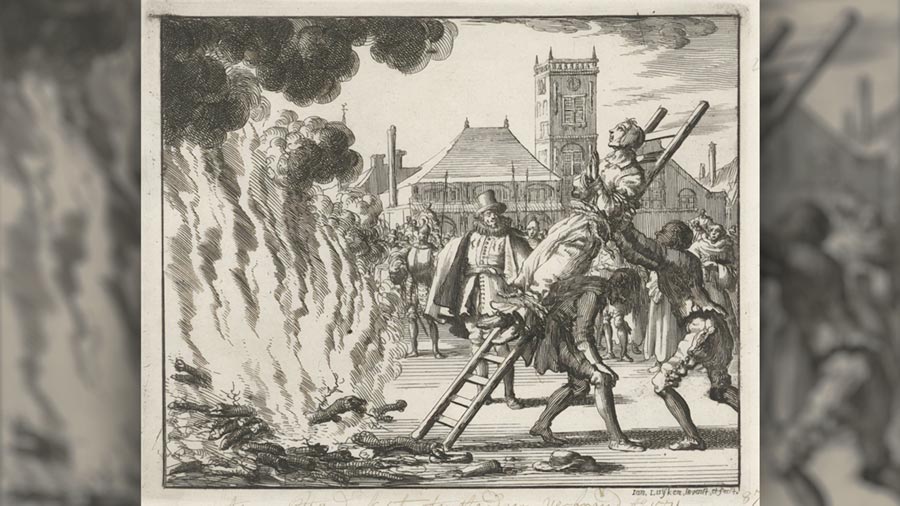
Meister Drucke's (1571-1685) illustration of Anneken Heyndricks being burned at stake.
In 1571, Catholic authorities in Amsterdam convicted Anneken Heyndricks of being baptized as an adult, refusing to go to confession, belonging to a group of Anabaptists, and marrying an Anabaptist.
Heyndricks was extensively tortured, asked to betray her fellow believers, and to recant her faith.
The 53-year-old responded to her persecutors by thanking Jesus that she was counted worthy to suffer for His name. The bailiff ordered her mouth to be filled with gunpowder, her hands bound together, and her feet and torso tied to a ladder.3
Her tormentors kindled a fire and raised the ladder with Anneken still fixed to it. They pushed the ladder into the fire while the gunpowder was still in her mouth. As the authorities watched the ladder being raised, she cupped her hands in prayer and looked to Heaven.
Heyndricks is one of the thousands of martyrs from the 16th-century Anabaptist movement, best known today for its commitment to pacifism.
Pope Leo Commends Anabaptists’ Charisms
Last Thursday, Pope Leo XIV acknowledged to Heyndricks’s successors that there was a need for “honesty and kindness in reflecting on our common history, which includes painful wounds and narratives that affect Catholic-Mennonite relationships and perceptions up to the present day.”
Leo went the extra mile to build bridges with the historically persecuted Anabaptists as they celebrated the 500th anniversary of their founding in Zurich. The pontiff highlighted the special charisms that groups like the Mennonites, Hutterites, and the Brethren had brought to the Church.
“By receiving the Lord’s peace and accepting His call, which includes being open to the gifts of the Holy Spirit, all the followers of Jesus can immerse themselves in the radical newness of Christian faith and life. Indeed, such a desire for renewal characterizes the Anabaptist movement
itself,” Leo said, reiterating his call for the united witness of all Christian churches.
The pontiff specifically restated the challenge of the Catholic-Mennonite dialogue hosted by the Vatican’s Dicastery for Christian Unity in 2003, calling for the “purification of memories and common re-reading of history that can enable us to heal past wounds and build a new future through the ‘courage to love.’”
Why Were the Anabaptists So Fiercely Persecuted?
Often referred to as the “Reformation of the Reformation,” the Anabaptists believed that only adults should be baptized and that clergy should not monopolize the interpretation of Scripture.
The belief in adult baptism threatened the Catholic Church because the state registered babies at the time of their baptism, thus inextricably tying taxation and conscription with infant baptism. Moreover, adult baptism made participation in Christendom a choice rather than a responsibility.
“Anabaptists suffered an outsized share of persecution in Europe’s post-Reformation century” by “exceeding the combined numbers of Catholic martyrs executed in Protestant realms and Lutheran or Calvinist martyrs executed in Catholic realms,” writes David L. Weaver-Zercher in Martyrs Mirror: A Social History — a scholarly history of Anabaptist martyrdom.
While Anabaptists were uniquely persecuted by both Catholics and Protestants (Lutherans and Calvinists), 85% of their executions “were carried out by Catholic authorities, particularly the Austrian Habsburgs, the dukes of Bavaria and the Swabian League,” writes James M. Stayer in the Brill Companion to Anabaptism and Spiritualism, 1521-1700.
“Only Catholic governments carried out the cruel execution by fire, and only they executed Anabaptists who had recanted,” Stayer notes. Most Anabaptists were severely tortured before being burned alive. Protestants beheaded or drowned them, including
Felix Manz, the first of thousands of Anabaptist martyrs over the next two centuries. Catholics burned Michael Sattler, author of the first Anabaptist confession of faith.
According to a mandate published by the Catholic King Ferdinand I of Austria in April 1528, anyone had the right to kill any person suspected of Anabaptism without a trial.
Anabaptists Develop a High Theology of Martyrdom
As a result of the powerful preaching of its charismatic leaders, Anabaptism spread through Zurich, Basel, Augsburg, and Strasbourg. The Reformation that first reached the Catholic-controlled Netherlands was Anabaptism.
“Nowhere had Anabaptism been so widely accepted as in the Netherlands. And nowhere was the persecution as fierce: up to 2,500 people were martyred in the Netherlands. Most of the victims, including women, were burned at the stake,” writes Margot Kottelin-Longley.
“One reason for torturing and killing them was their belief that warfare was contrary to the Gospel injunction. Their pacifism proscribed participation in the all-too-frequent military campaigns of the sixteenth century.”
The Mennonite Encyclopedia observes that in the fifteenth century, Roman Law was assimilated into German Law. This gave the Catholic Church exclusive authority to punish the crime of re-baptism with death.
As a result of the persecution, Anabaptists developed a high theology of martyrdom. They had been re-baptized, and baptism in the New Testament is analogous to dying with Christ. Similarly, Anabaptist hymns reveal a passion for martyrdom with the fullness of firsthand experience.
In their theology of history, Anabaptists came to affirm that the true church of God has always been a suffering church [Märtyrergemeinde]. “All of the Holy Scriptures seem to be nothing else but a book of martyrdom,” states the Martyrs’ Mirror, the classic Anabaptist martyrology.
Christ Himself is the “captain of the hosts of the martyrs” who “had to suffer much to enter into His glory” and thus becomes the archetype of all those who are persecuted for the Kingdom, the Anabaptists believed.
Persecution forced Anabaptists to eventually flee to the Americas in search of religious freedom.
Rome’s Epochal U-Turns On “Heretics” and the Death Penalty
Rome’s delegation leading the 2003 Catholic-Mennonite dialogue said Catholics “can express a penitential spirit, asking forgiveness for any sins which were committed against Mennonites, asking God’s mercy for that, and God’s blessing for a new relationship with Mennonites today.”
“We all have black sheep in the family. We all have ancestors that we aren’t proud of,” said Joseph Martino, who led the Vatican delegation.
Pope Leo has resoundingly reaffirmed Martino’s sentiments. In 1520, Leo XIV’s ancestor, Leo X, published the bull Exsurge Domine, declaring that it was the will of the Holy Spirit to burn heretics.
Five hundred years later, Leo XIV is not only building bridges with those his ancestor deemed heretics, but in an epochal U-turn of the magisterium, has agreed with Pope Francis that the death penalty itself is inadmissible and incompatible with a “consistent ethic of life.”
Christians of all churches will applaud the new pontiff’s passion for Christian unity in response to Jesus’s High Priestly prayer, “that they may all be one … so that the world may believe that You have sent Me.”
Dr. Jules Gomes (BA, BD, MTh, PhD) has a doctorate in biblical studies from the University of Cambridge. Currently a Vatican-accredited journalist based in Rome, he is the author of five books and several academic articles. Gomes lectured at Catholic and Protestant seminaries and universities and was canon theologian and artistic director at Liverpool Cathedral.