


Philos Project Organizes Conference to Combat Alarming Surge in Catholic Antisemitism
Organizer calls out “morally reprehensible” Catholic Jew-haters for defying “authentic Catholic teaching”
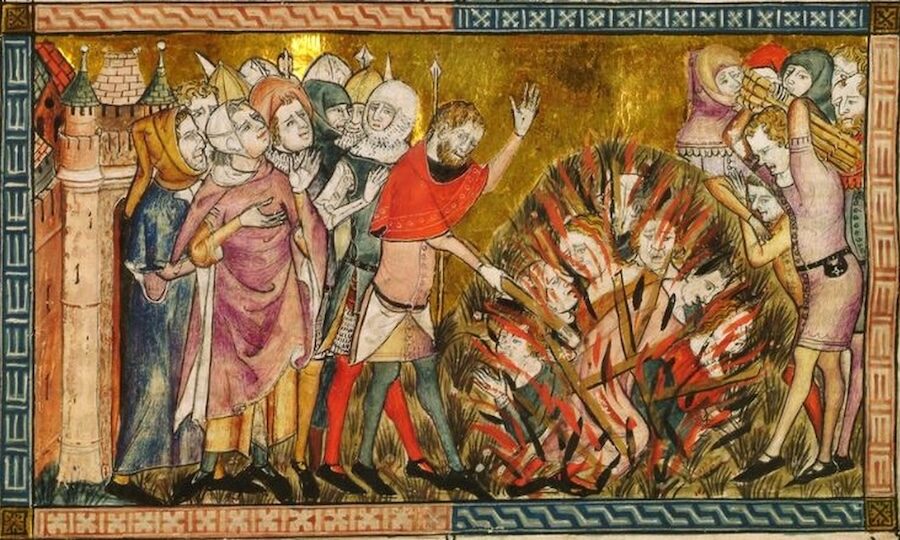
Image of burning of Jews (ca 1353). Jews are blamed for the plague epidemic in Europe and accused of poisoning the wells. Source: Wikimedia Commons. Rights: Public Domain
A conference featuring distinguished Catholic speakers will tackle the alarming surge in Catholic antisemitism while marking the 60th anniversary of Nostra Aetate — the landmark Vatican II declaration that reversed centuries of Catholic teaching against the Jews.
The one-day symposium on “Catholics and Antisemitism — Facing the Past, Shaping the Future” to be held on March 10 will address current Catholic antisemitic discourse as well as “theology and Church teachings — like supersessionism and replacement theology” that play a role in “forming Catholic attitudes toward the Jewish people.”
Pope John Paul II’s biographer George Wiegel, Catholic apologist Trent Horn, holocaust historian Dr. Richard F. Crane, and cultural critic Mary Eberstadt will speak at the event hosted by the Philos Project and the Catholic Information Center in Washington D.C. and online.
The program also features Dr. Jonathan Silver, an acclaimed Jewish scholar and host of the Tikvah Podcast, Dr. Russ Hittinger from the Pontifical Academy of St. Thomas Aquinas, and Fr. Charles Trullols, director of the Catholic Information Center.
Antisemitic Catholics Contradict Vatican II
“The rise in Catholic antisemitism, both before and after October 7, has been deeply concerning, especially in how it manifests in rhetoric and actions within religious and academic spaces,” Simone Rizkallah, director of Philos Catholic, told The Stream. She also hosts the Beyond Rome podcast seeking to reconnect Catholics to their Hebraic roots.
“The obvious contradiction in Catholic antisemitism is that Jesus Himself was a Jew, and the New Testament affirms the enduring nature of God’s covenants with Israel,” she added. The conference “aims to confront contemporary challenges, reaffirm commitments to combating antisemitism, and ensure that the spirit of Nostra Aetate continues to shape the Church’s engagement with the Jewish community today.”
Asked about the rise of online antisemitic Catholic influencers, Rizkallah, a first-generation American of Egyptian-Armenian descent, responded:
“To Candace Owens, Nick Fuentes, E. Michael Jones, and others who claim to represent the “Catholic right” while peddling antisemitism, I would say this: Your rhetoric is not only morally reprehensible but also fundamentally opposed to authentic Catholic teaching. The Church, especially since Nostra Aetate, has made clear that antisemitism has no place in Christian faith — Pope John Paul II even called the Jewish people “’ur elder brothers in the faith of Abraham.’ To embrace Catholicism while attacking Jews is to ignore the very foundations of the faith you claim to defend.”
Backlash
Antisemitic Catholics have begun attacking the conference on social media, with one X user posting: “This event is being pushed by Jews not concerned Catholics. It’s cute how the speakers are Jewish converts.” Speaker Trent Horn, whose father is Jewish, has frequently been targeted by antisemitic Catholics despite his defense of Catholicism as a Catholic apologist.
Another X user posted anti-Jewish quotes from papal and Catholic magisterial teaching in response to a post by Philos Catholic publicizing the conference. The citations from Popes Innocent III, Gregory IX, Pius X, and the Fourth Council of Toledo (633) attempt to encapsulate the Catholic position against Jews before Vatican II.
Pope Innocent III accuses Jews of deicide (a position repudiated by Vatican II), noting that Jews “are to us dangerous as the insect in the apple, as the serpent in the breast” and have “already begun to gnaw like the rat, and to stink like the serpent.” While the Jews are “not to be killed,” he wrote, they “must always be dispersed as wanderers upon the face of the earth.”
In the document posted by Blue Collar Catholic attacking the Philos forum, Canon 58 of the Fourth Council of Toledo commands that “every bishop, priest or layman” who supports the Jews “shall be regarded as profane and blaspheming of God” and “shall be excluded from the Communion of the Catholic Church and be regarded as not belonging to the kingdom of God.”
In a 14-part series, the antisemitic Catholic website Christ the King extensively documents pre-Vatican II Catholic magisterial teaching against the Jews.
The Church’s teachings are classified under headings like “The Catholic Church Teaches The Jews Are The Enemies Of God And The Human Race,” “The Catholic Church Teaches That The Jews Killed Christ And Cursed Themselves,” “The Catholic Church Teaches That Jews Are Faithless And Perfidious,” and “Child Sacrifice Is Part Of The False Religion Of The Jews.”
Church Leaders Failing to Confront Catholic Antisemitism
Asked if the leadership of the Church has failed to address the rise in Catholic antisemitism, Rizkallah said: “While figures like Bishop Barron of Word on Fire and Fr. Dave Pivonka, president of Franciscan University in Steubenville, Ohio, have taken meaningful steps, much of the Church’s leadership remains hesitant to confront the issue head-on.”
She continued: “Many Catholics, including clergy, fail to recognize how modern antisemitism operates, particularly when it masquerades as theological critique or cultural commentary. Additionally, there is a reluctance to challenge influential figures within the Church who are fueling antisemitic narratives. This failure to act decisively allows dangerous ideas to spread unchecked, creating a climate where hostility toward Jews becomes more normalized.”
In a December 2023 article, Bishop Robert Barron revealed how his website’s posting of “a graphic of a Menorah accompanied by a text from St. John Paul II” during Hanukkah were met with a “firestorm of angry protests” even from “some Catholics who gave vent to frankly shocking expressions of anti-Semitism.”
The bishop cited several examples of Jew-hatred directed at his post: “Did they fill your pockets with shekels to say this?” “Judaism is the anti-Christ religion.” “Semites literally steal everything . . . literally worthless thieves.” “Sin-o-gogue of Satan anyone?” “Well, there is the deicide thing.”
“I’ve been on social media for over 20 years, and I’m well acquainted with how vile that space can be, but this outpouring of rage staggered even this grizzled veteran,” remarked the celebrity Catholic prelate who runs the Word on Fire ministry.
In his article titled “Catholics Cannot be Antisemites,” Barron elaborated:
Look, I know there are lots of crazy people on the Internet, but, once again, the sheer volume and intensity of these responses — and I’m giving you only a hint of the hundreds of similar remarks — signals that we have a serious problem on our hands. For Christianity collapses in on itself without constant reference to its Jewish antecedents.
Catholic Antisemitism Sparked by ‘Rupture’ in Magisterial Teaching
The Stream has been documenting a spike in Catholic antisemitism, particularly from Catholics who reject Vatican II. Observers attribute the rise in current Catholic antisemitism as “cognitive dissonance” caused by a “hermeneutic of rupture” between anti-Jewish Catholic teaching over the centuries and pro-Jewish magisterial declarations after Vatican II.
“There is a backlash. It has been going on for 30 years, but now that we have a progressive pope, it’s getting stronger,” Catholic historian Massimo Faggioli observed.
In Jews and Judaism in the Political Theology of Radical Catholic Traditionalists, author Mark Weitzman traces the continuity in recent Catholic Jew-hatred from pro-Nazi radio preacher Fr. Charles Coughlin to elements in the Society of Saint Pius X, including the Holocaust-denying Bishop Richard Williamson — who spewed antisemitism in the SSPX for 18 years.
For centuries, Rome had officially taught that the Jews are rejected, cursed, and hated by God. In an epochal U-turn, Vatican II’s Nostra Aetate turned the Jew “from enemy to brother,” using the Latin superlative carissimi to describe the Jews as “beloved by God.”
Jews in Catholic countries were forced to live in ghettos after Pope Paul IV’s bull Cum nimis absurdum (1555) declared it “absurd and utterly unacceptable that the Jews, who due to their own guilt were condemned by God to eternal slavery,” should be allowed to coexist with Catholics.
In 1858, Pius IX ordered papal carabinieri to kidnap a six-year-old Jewish boy named Edgardo Mortara, because the Jewish child had been illegally baptized in secret by his teenage Catholic maid, who thought he was dying. Mortara became a priest, but his abduction proved to be political suicide for Pius IX and spurred the overthrow of the Papal States by Italian nationalists.
Kidnapping Jewish children and their parents was the rule rather than the exception, historian David Kertzer observes in his bestseller The Popes Against the Jews.
In an 1871 speech, Pius IX said of the Jews: “Of these dogs, there are too many of them at present in Rome, and we hear them howling in the streets, and they are disturbing us in all places.”
Explaining how Catholic antisemitism can be defeated, Barron notes that “a new generation of biblical scholars have emerged who have endeavored to recover the Jewishness of Jesus.” The bishop cites both Protestant and Catholic scholars, including E.P. Sanders, Richard Bauckham, James D.G. Dunn, N.T. Wright, Joseph Ratzinger, Brant Pitre, and Richard Hays.
“Efforts like the Coalition of Catholics Against Antisemitism and the U.S. Catholic Conference of Bishops’ recent glossary are important, but they must be followed by sustained, forceful leadership that makes it clear: antisemitism is not just a sin against the Jewish people, but a betrayal of the Church’s own teachings,” Rizkallah said.
Dr. Jules Gomes, (BA, BD, MTh, PhD), has a doctorate in biblical studies from the University of Cambridge. Currently a Vatican-accredited journalist based in Rome, he is the author of five books and several academic articles. Gomes lectured at Catholic and Protestant seminaries and universities and was canon theologian and artistic director at Liverpool Cathedral.