


Persecution, Exodus, and Hope: Christianity’s Struggle for Survival in the Middle East
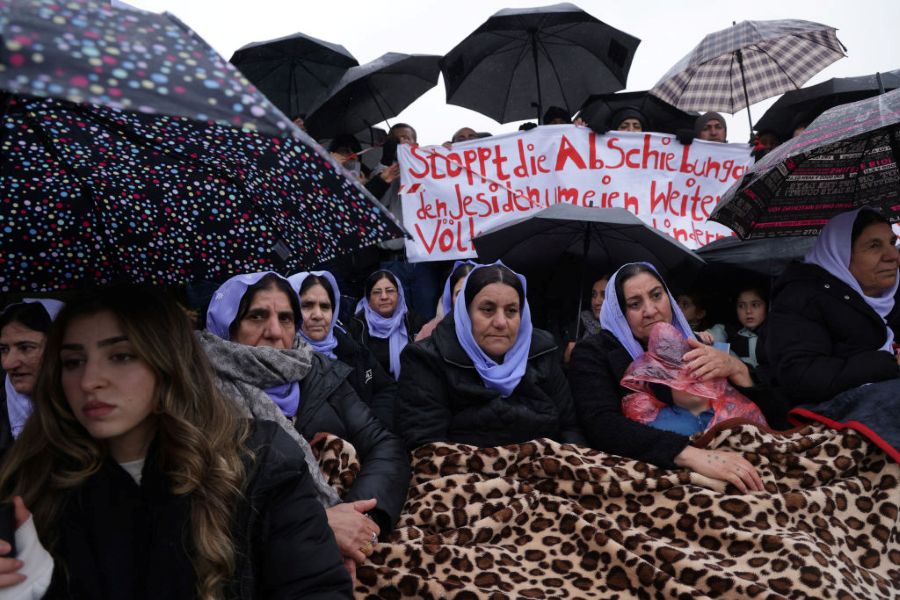
Yazidi women gather outside the Reichstag during a protest against the possible deportation of Yazidis in Germany to Iraq on October 19, 2023 in Berlin, Germany. Over a thousand Yazidis gathered peacefully on the lawn under rain in front of the Reichstag, also to show solidarity with approximately a dozen Yazidis who are into their second week of a hunger strike in tents at the site. A spokesman said they will face forced religious conversion if they are sent back to Iraq. Yazidis are a non-Muslim minority in northwestern Iraq who practice their own religion and faced genocide under the Islamic State. Germany is home to the highest number of Yazidis outside Iraq.
A century ago, Christians made up 20% of the Middle East’s population. Today, they are less than 4%, and in some areas, they are disappearing altogether. The land that birthed Christianity is becoming a graveyard for its followers, and the world watches in silence.
From the brutal reign of ISIS to the calculated oppression of Middle Eastern governments, the region’s Christian population is being systematically erased. This is not a slow decline — it is an extinction taking place in real time.
The rise of Islamist extremism has turned the Middle East into a battlefield for religious minorities. In Iraq and Syria, ISIS waged a campaign of genocide against Christians, executing them, enslaving their women, and burning down centuries-old churches. Though ISIS has been territorially defeated, its ideology lives on, inspiring attacks against Christian communities across the region. The scars left by these jihadist forces remain, and many Christians fear returning to their homes, which have been taken over by hostile elements.
But ISIS was neither the first nor the last extremist group to target Christians. Al-Qaeda, Boko Haram, and other jihadist organizations have long sought to eradicate Christianity from the region. In Nigeria, Boko Haram and ISIS-affiliated groups have killed thousands of Christians, burning villages and kidnapping women and children. Their goal is clear: erase Christianity from any land under their control.
Not Just Terrorists At Fault
Beyond jihadist violence, Christian persecution is enabled by the very governments that claim to support stability. In Iran, Christian converts are treated as criminals, imprisoned, tortured, and sometimes executed. Turkey’s president, Tayyip Erdogan, has turned historic churches into mosques while promoting an Islamist-nationalist agenda that leaves little room for religious minorities. Egypt, home to the largest Christian community in the Arab world, remains a hotbed for mob violence where Coptic Christians are attacked, their churches bombed, and their rights trampled under a government that turns a blind eye.
Saudi Arabia, the U.S.’s long-time ally, has been one of the biggest backers of extremist ideology. Christianity is banned in the kingdom: There are no churches, and any Christian caught practicing their faith faces arrest or worse. The hypocrisy of Saudi Arabia’s relationship with the West cannot be ignored: a country that claims to be modernizing still actively suppresses religious freedom.
Palestinian Christians Ignored
Much of the Western world romanticizes the Palestinian cause, yet it fails to acknowledge the exodus of Palestinian Christians from their own homeland. Bethlehem, the birthplace of Christ, once had a Christian majority. Today, that number has dwindled to a mere fraction as Christians flee growing Islamist influence. Hamas, the governing power in Gaza, enforces strict Islamic laws that make life increasingly difficult for non-Muslims. Palestinian Christians face systemic discrimination, yet their plight remains ignored by those who claim to champion human rights in the region.
Even in the West Bank, which is controlled by the Palestinian Authority, Christians face mounting pressure. Christian-owned businesses are often targeted, and church leaders fear speaking out against the oppression. While Israel has its own challenges regarding religious diversity, it remains the only country in the Middle East where the Christian population is actually growing. Yet the global media narrative continues to paint Israel as the aggressor, ignoring the harsh realities Christians face under Palestinian rule.
In Iraq, the Christian population has plummeted from over 1.5 million in 2003 to fewer than 200,000 today. In Syria, where Christian communities have existed for two millennia, war and persecution have driven them to near extinction. Lebanon, once a Christian-majority nation, is witnessing a mass exodus of its Christian population as economic collapse and sectarian tensions escalate. The numbers tell a grim story: Christianity is disappearing from the very land where it began.
History Lost
The destruction of Christian heritage sites further erases the presence of Christianity in the region. Ancient monasteries, churches, and Christian landmarks have been destroyed by both jihadists and government forces. These sites, some dating back to the time of Christ, are systematically wiped from existence, ensuring that future generations will never know the deep Christian history of the region.
Western governments, despite their rhetoric concerning religious freedom, have failed to act decisively. The Obama administration’s withdrawal from Iraq left a vacuum that allowed ISIS to rise. The Biden administration’s disengagement from Middle Eastern affairs has signaled a lack of commitment to protecting religious minorities. The Trump administration has a unique chance to champion religious minorities in the Middle East, especially Christians, Yazidis, and others by prioritizing religious freedom in its foreign policy. However, with USAID being dismantled for very good reasons, crucial support for these communities could inadvertently be put at risk. Without a strong commitment, the federal government unintentionally might overlook the needs of persecuted groups, raising concerns about Trump’s dedication to their protection. It’s a pivotal moment for him to act decisively and effectively.
The West’s selective outrage is glaring. While there are loud calls for religious tolerance and diversity within the U.S. and Europe, there is little condemnation of the outright persecution of Christians abroad. Western politicians frequently champion the rights of other minority groups but remain silent about the suffering of Middle Eastern Christians. This double standard raises questions about whether Christian persecution is ignored because it does not fit within the dominant political narrative.
The global media often focuses on Middle Eastern conflicts through a political lens, ignoring the religious cleansing happening in real time. The persecution of Christians is not just an unfortunate byproduct of war; it is a deliberate and systematic campaign. From Baghdad to Bethlehem, a faith that has endured for over 2,000 years is being wiped out. And yet, the world remains indifferent. The silence is deafening, and the consequences will be irreversible.
What happens when the last Christian communities in the Middle East vanish? Beyond the religious implications, the extinction of Middle Eastern Christianity would signal a failure of the West’s commitment to religious freedom. The U.S. and Europe must decide whether they will continue to ignore the persecution of Christians or finally acknowledge it as a human rights crisis that demands action.
Western churches and Christian communities have a moral responsibility to highlight this crisis. Evangelical leaders, Catholic organizations, and Christian advocacy groups should exert pressure on policymakers to protect religious minorities in the Middle East. The Christian diaspora from the region, now scattered across the West, also has a role in telling their stories and ensuring their suffering is not forgotten.
The story of Christianity in the Middle East is one of survival against all odds. But without international recognition and action, the remaining Christian communities could vanish within a generation. What was once the cradle of Christianity could soon become a region where Christianity exists only in history books. The world must recognize the gravity of this crisis before it is too late.
Amine Ayoub, a Middle East Forum fellow, is a policy analyst and writer based in Morocco.