


“Our Corn Did Prove Well, and God Be Praised”
Thankfulness is a feeling. Gratitude is an action.
Giving thanks – being thankful for what we have (and sometimes for what we don’t have) – is a mighty powerful thing.
In recent decades, it’s striking in the Western World how that deep sense of thankfulness and its kissin’ cousin, gratitude, diminishes in direct relationship to prosperity and leisure. In a world where an electron sets the speed limit of life, perhaps that’s to be expected. But I think it deprives people of a composite character.
This is especially evident in young people and Millennials. Some lessons can only be learned in defeat or failure. However, culture and social media incessantly present success, money, and popularity – fame – as the pathway to happiness. The message is that only losers fail. But it’s a hollow message.
But being thankful in struggle and loss, however that comes to us – and it will come – and stepping out into deeds of gratitude fills our character and often opens up the window of faith. Because trust only works in the dark.
This is why Thanksgiving remains such a powerful and comparatively uncommercialized event in American culture. It’s a bullhorn declaration that giving thanks for family and harmony can’t be purchased or invented. It has to be lived.
The Miracle of Squanto
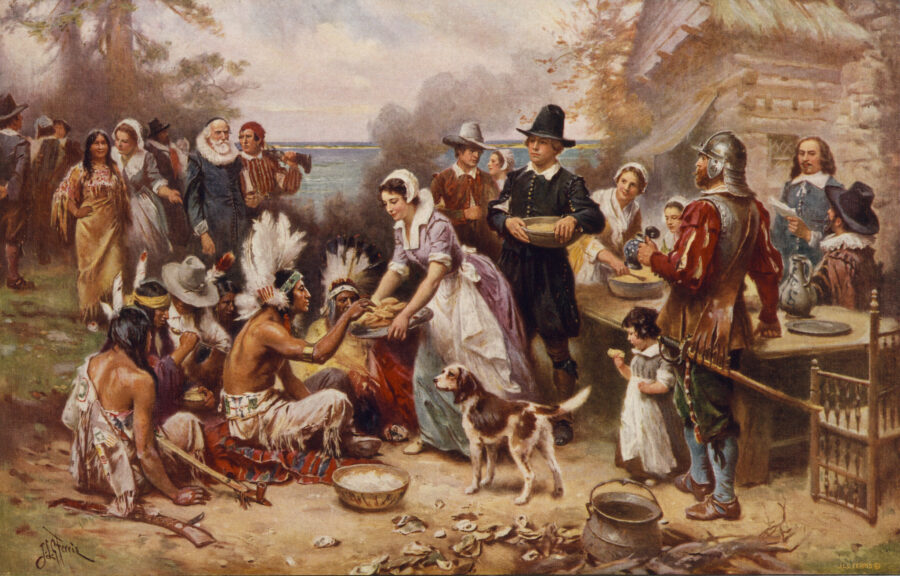
More than 400 years have passed since the first Thanksgiving feast was held by a scraggly band of Puritan Separatists – Calvinist Protestants – who fled the Old World searching for freedom from religious persecution. Of the 102 who landed at Plymouth Rock in the late fall of 1620, only half survived the brutal winter to see the Thanksgiving feast in 1621. They came to understand thanksgiving and gratitude.
We actually know little about the first feast, and it’s perhaps better this way. We rely mainly on a letter written by Edward Winslow and a journal entry by William Bradford.
We do know that in the spring of 1621, the exhausted, sick, and hungry Pilgrims – a name applied to them some two centuries later – were struggling with their failure to grow and harvest in a harsh environment. Of the 53 surviving settlers, at times only a dozen were fit enough to tend to the rest.
The settlement only made it through the harsh winter with the aid of the regional Wampanoag Indian tribe, who befriended them with food. In the spring, the Wampanoag returned with a member of the Patuxet tribe whose English name was Squanto. As a boy, probably in 1614, Squanto had been kidnapped along the New England coast, taken to Europe, and sold in Spain to monks who educated him and introduced him to the Christian faith. Squanto made his way to England, where he learned fluent English, and finally returned to New England in 1619.
The First Thanksgiving
It was Squanto who taught the Pilgrims the lessons of agriculture for the short New England summer. (Some have suggested that Squanto taught them agricultural lessons he had learned, ironically, in England.) He also showed them how to fish, trap beaver, and track deer.
Governor William Bradford would describe Squanto as “a special instrument sent of God for their good beyond their expectation.”
The idea of a “day of thanks” was keen on the minds of the Puritans, who doubtless imported the concept from their former homeland. The bounty of the fall of 1621 – starkly contrasted with the misery and death from the voyage and the first year of the Plymouth settlement — must have driven the desire for a feast of thanks deep.
Their feast of Thanksgiving was a three-day event, with 90 members of the Wampanoag tribe, including the tribe’s “king,” attending.
Edward Winslow wrote about the feast in a letter;
Our Corn did prove well, and God be praised, we had a good increase of Indian Corn, and our barley indifferent good, but our peas not worth the gathering, for we feared they were too late sown. They came up very well, and blossomed, but the sun parched them in the blossom. Our harvest being gotten in, our governor sent four men on fowling, that so we might after a special manner rejoice together after we had gathered the fruit of our labors. They four in one day killed as much fowl as, with a little help beside, served the company almost a week. At which time, amongst other recreations, we exercised our arms, many of the Indians coming amongst us, and among the rest their greatest king Massasoit, with some ninety men, whom for three days we entertained and feasted, and they went out and killed five deer, which they brought to the plantation and bestowed on our governor, and upon the captain and others. And although it be not always so plentiful as it was at this time with us, yet by the goodness of God, we are so far from want that we often wish you partakers of our plenty.
[Modern English translation credit to https://indigenousnh.com/2017/11/22/the-story-of-the-first-thanksgiving/]
Thankfulness Is a Feeling. Gratitude Is an Action.
The Pilgrims learned that lesson in 1621. “Be joyful always; pray continually; give thanks in all circumstances, for this is God’s will for you in Christ Jesus,” 1 Thessalonians 5:16 exhorts us. That theme of thanks and thanksgiving is used over and over throughout Scripture.
It’s a mystery, really. When we start giving thanks for what we do have, somehow, what we have becomes enough, and more often than not, it turns to plenty. In gratitude for what we do have, we learn that as we are given more, our joy is not in hoarding or burying it away from thieves but using it to incorporate others and to make our families, nation, and world better in as many ways as there are stars in the heavens.
Michael Giere writes award-winning commentary and essays on the intersection of politics, culture, and faith. He is a critically acclaimed novelist (The White River Series) and short-story writer. A former candidate for the US House of Representatives from Texas, he was a senior executive in both the Reagan and the Bush (41) administrations, and in 2016 served on the Trump Transition Team.