


Only Radical Christianity Can Defeat Radical Islam
New book on the Islamization of Britain offers a penetrating analysis and powerful proposals
When Donald Trump named J. D. Vance as his vice presidential pick in July 2024, Vance delivered what historians will consider one of the most prophetic statements of his political career.
“I was talking [with a friend] about what is the first truly Islamist country that will get a nuclear weapon, and we were like, maybe it’s Iran, maybe Pakistan already kind of counts, and then we sort of finally decided maybe it’s actually the UK, since Labor just took over,” Vance told the National Conservatism Conference. The British chattering classes experienced a mass meltdown.
Former UK Home Secretary Suella Braverman echoed Vance’s alarming prediction in January. “I don’t think he was entirely joking,” she warned. “What happens if the UK falls into the hands of Islamic fundamentalism, our legal system gets substituted by Sharia law, and our nuclear capability vests in a regime not dissimilar to that of Iran today?”
This is a question Tim Dieppe tackles in detail in his new book, The Challenge of Islam: Understanding and Responding to Islam’s Increasing Influence in the UK. Dieppe, an evangelical Christian who is one of Britain’s leading Islamic experts and head of policy at Christian Concern, demonstrates how the UK is the prototype for Islam’s calculated takeover of the West.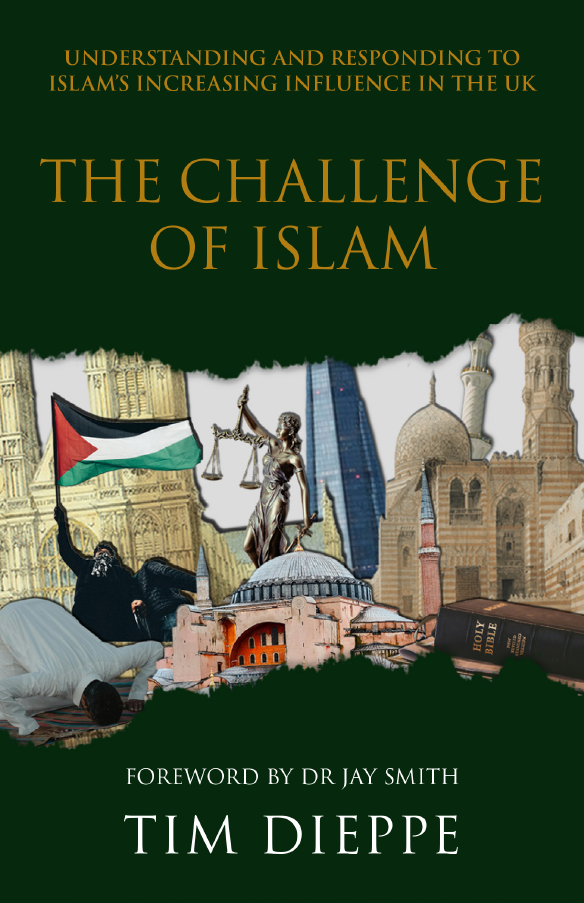
Taking Over the West
Dieppe begins by citing the biblical expositor David Pawson, who prophesied in 2002 that Islam would take over Britain, but pointed out that God would relent of his judgment if His people repented.
The 2001 British census showed the Muslim population at 1.6 million (2.8%) of the population; the 2021 census shows it to be 3.9 million (6.5%). Islam is the fastest-growing religion in Britain, Dieppe warns.
In contrast, Christianity is in steep decline, with only 5% to 7% of the population attending church. Muslims portray Christianity as weak, effeminate, and lacking a solution to Britain’s moral breakdown. By contrast, Muslims promote Islam as a muscular, masculine, and moral panacea to a decadent Britain by offering strong family values and modesty for women while rejecting alcohol.
How Christianity Can Overcome Islam
Islam proselytizes boldly and unapologetically. Conversely, evangelism is nonexistent in most mainline denominations, and evangelical churches are timid in their outreach. “If more of us were radical, bold, and unashamed about our faith, confident in confronting and challenging Islam’s claims, then many more Muslims would turn to Christ,” Dieppe writes.
Because Islam is a spiritual entity, he says, we must recognize that we are engaged in a spiritual battle. Because Islam works against Christianity and the Gospel, prayer is key. Dieppe cautions: “We need to understand that Muslims are redeemable, whereas Islam is not. … Muslims are not our enemies, but Islam is an enemy of Christ.”
Christians need to confront Muslims with the truth of Christianity and expose the intolerant example of Muhammad and the discriminatory ideology of the Koran. While loving Muslims, Christians must also resist Islam’s influence in all areas of law and politics, and use democratic legal rights to protect Christian freedoms.
Dieppe cites examples of a Christian campaign which successfully halted the building of a mega-mosque financed by the radical Islamist Tablighi Jamaat in London, Christian Concern defending street preachers in court, and pockets of Muslims across Britain coming to faith in Christ.
Multiculturalism Is the Breeding Ground for Islam
Christians should challenge multiculturalism because it is “fundamentally opposed to missionary activity and thus opposed to evangelical Christianity.” Further, “state-sponsored multiculturalism is a form of state endorsed religious pluralism or polytheism” Dieppe writes.
In a series of essays, the book explores the roots of Britain’s Islam problem with the fatwa against Salman Rushdie in 1988-89, which raised Britain’s temperature from fatwa to fear. Dieppe urges readers to move back from fear to a robust, Gospel-driven faith.
The author traces the evolution of Britain’s problem of Islam through the epidemic of the largely Pakistani Muslim rape gangs, which operated on an industrial scale in the UK over 40 years, and the death of free speech, which has resulted in a fear of criticizing Islam.
The problem is now critical, Dieppe observes, with the Labor-led government bent on imposing a definition of Islamophobia which would include even legitimate criticism of Islam. Dieppe himself has been one of the most articulate British voices opposing that definition.
Debunking Islamic Selling Points
Using the Koran and Hadith, the book debunks a key plank of Muslim apologetics: the fallacy that the word “Islam” means “peace” and “jihad” implies an inner, spiritual struggle. Rather, Islam is the word for “submission,” and “jihad” is violent warfare intended to force populations to Islam.
Citing Islamic primary sources and statements from modern Muslim scholars and politicians, Dieppe also demonstrates that Islam “as defined by its texts” is intrinsically antisemitic.

Author Tim Dieppe
The book’s most informative essay is on Islamic finance (based on the concept that all forms of interest are prohibited in Islamic law). The mainstream or even alternative media barely touch on the topic, but Dieppe’s own background in finance gives him a handle on it.
In 2014, Britain became the first non-Muslim country to issue an Islamic bond in a bid by the government “to become the western hub of Islamic finance.” Over 20 banks offer Islamic financial services in the UK (compared to 10 in the US). Investments in businesses involving alcohol, pork, pornography, and gambling are banned under Islamic finance.
Islamic Finance Is Fraudulent
Dieppe explains that the ban on interest is a modern, radical interpretation of the Koran and Hadith. Shockingly, even though top Islamic scholar Mahmoud El-Gamal asserts that Islamic finance was conceived in the 1970s, the British government has theologically backed Shariah-compliant finance, stating that “the taking or receiving of interest (Riba) is strictly prohibited.”
“Why [has the government] accepted the modern, strictest possible interpretation? In promoting this understanding of Riba they are promoting radical fundamentalist interpretations of the Koran,” Dieppe writes.
Citing Islamic scholars, the book also unveils the deception of Islamic finance: Muslim banks engage in dishonest practices and levy huge fees on various transactions instead of charging interest. Worse still, Islamic finance is promoted by and linked to Islamic extremists. It aims to destabilize the West by creating a separate, rival financial system.
Ten Proposals
The author offers 10 proposals to prevent a segregated Britain:
- Curb Shariah courts
- Enforce registration of religious marriages
- Ban the face veil
- Tighten up marriage visa rules
- End two-tier policing
- Stop promoting Islamic finance
- Identify Britain as a Christian country
- Defend free speech
- Ban foreign funding of Islam
- Reduce immigration
There are currently 84 shariah courts operating in the UK and nine banks offering shariah-compliant products. Polygamy is a problem, but UK authorities even support polygamous families on the dole. British Muslim men often import their brides from countries like Pakistan. Marriage is one of the top means of getting Muslim (men and women) into the country.
Dieppe’s book is one of the most important contributions from a Christian perspective to the Islamic takeover of Britain. It is bold and factual. It does not engage in hyperbole or sensationalism. It is insightful and informative, and is a much-needed challenge to the church.
A chapter on Christian preachers like Dr. Jay Smith and Muslim convert Hatun Tash, who are reaching out to Muslims, and their strategies for apologetics would enhance this book even further.
It is a must-read for church leaders who are increasingly cozying up to the very monster that threatens to devour them. Dieppe offers a solution: “In the end, the only effective response to radical Islam is radical Christianity.”
Dr. Jules Gomes, (BA, BD, MTh, PhD), has a doctorate in biblical studies from the University of Cambridge. Currently a Vatican-accredited journalist based in Rome, he is the author of five books and several academic articles. Gomes lectured at Catholic and Protestant seminaries and universities and was canon theologian and artistic director at Liverpool Cathedral.