

Macron Plays Popemaker as Conclave Campaigning Reaches Fever Pitch
French president pushes liberal French cardinal and blocks the candidacy of ultraconservative Cardinal Sarah
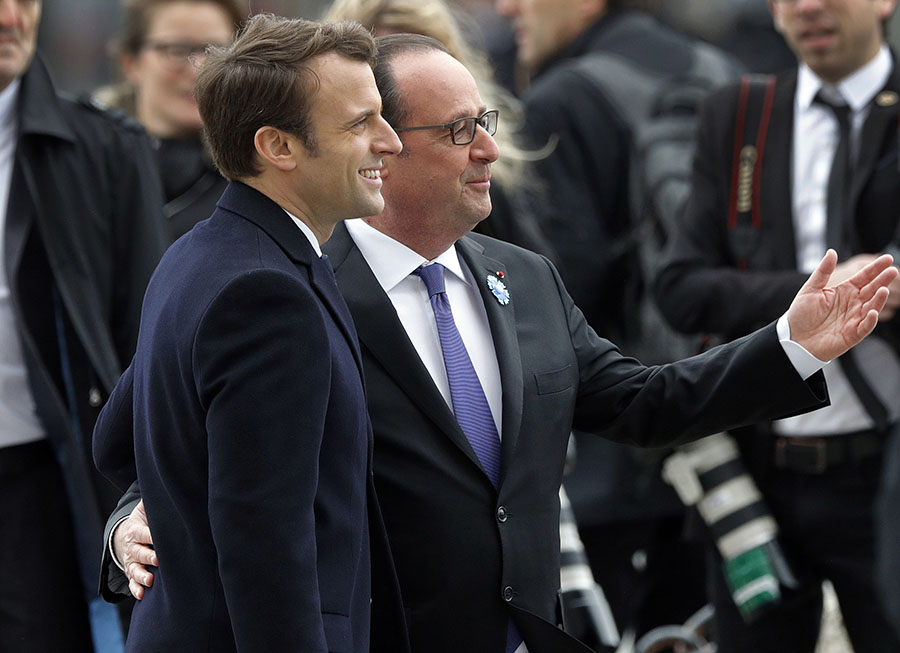
French president Emmanuel Macron, an archglobalist and ally of the late Pope Francis, is being accused of participating in discreet political and ecclesiastical diplomacy reportedly aimed at influencing the choice of the next pope.
Macron dined with four out of five French cardinal electors at the French embassy after Pope Francis’s funeral on April 26 to facilitate conversations about the forthcoming election, the French daily Le Figaro reported.
The president was joined by cardinal electors Jean-Marc Aveline (archbishop of Marseille), François-Xavier Bustillo (bishop of Ajaccio, Corsica), Christophe Pierre (apostolic nuncio to the U.S.), and Philippe Barbarin (archbishop emeritus of Lyon).
All four cardinals are listed as papabile (likely candidates for pope) with Aveline and Bustillo ranked among the top contenders to become the next pope.
Francis’s Favorite French Cardinal
Aveline has been portrayed in the French press as a “man of the Left” and Pope Francis’s “favorite” cardinal to succeed him. He is said to be the most “Bergoglian” of France’s bishops and was elected president of the French Bishops’ Conference (CEF) in April. Macron awarded Aveline the prestigious Légion d’Honneur, France’s highest distinction, in 2022.
The College of Cardinals Report describes Aveline as a “heterodox-leaning prelate with broad appeal who is dedicated to issues of migration and interreligious dialogue.” Bustillo is also considered “a moderate reformist whose vision for the Church largely aligns with that of Pope Francis.”
The orthodox-leaning French cardinal Dominique Mamberti, prefect of the Supreme Tribunal of the Apostolic Signatura (the church’s top court), was absent. He is said to have been attending the internment of Pope Francis’s body at St. Mary Major Basilica.
On the evening before meeting the cardinals, Macron had dinner with Andrea Riccardi, founder of the Community of Sant’Egidio, a Catholic social justice outfit that is pro-immigration. Riccardi, an Italian historian and former government minister, is regarded as the hand behind the elevation of Cardinal Jorge Mario Bergoglio to the pontificate.
French President Woos Italian Popemaker
Riccardi, who received the Légion d’Honneur in 2023, remains highly influential in deciding who will be the next pope.
Veteran Vaticanist Sandro Magister believes that he may be backing Portuguese progressive Cardinal José Tolentino de Mendonça instead of the liberal archbishop of Bologna, Cardinal Matteo Zuppi, who has been a long-term favorite of the Sant’Egidio community.
It has been suggested that Macron’s meeting with Riccardi at the Dal Bolognese restaurant in the Piazza del Popolo was to persuade him to switch his support from de Mendonça to Aveline. Macron’s Interior Minister and Minister for Religious Affairs, Bruno Retailleau, and Minister for Foreign Affairs Jean-Noël Barrot were present.
Italian newspaper Courier e della Sera reported that the meeting between the French president and the papabili cardinals was also designed to block the candidacy of ultraconservative French-speaking Guinean Cardinal Robert Sarah.
Macron’s African Nemesis
A day before Macron’s lunch with the French cardinals, The Spectator ran a story titled “The African cardinal who terrifies Macron.” Sarah has emerged as the leading traditionalist candidate, although at 79 it is unlikely he may win 89 votes from a conclave of 133 electors.
The African cardinal is lionized among conservative and traditionalist Catholics in France and praised for “his uncompromising defence of tradition, his attacks on secularism, and his denunciation of what he calls the West’s moral collapse,” The Spectator reported.
The news magazine explained why a Sarah pontificate would be devastating for Macron:
Nowhere is Sarah’s message more incendiary than in France. With over 10 percent of its population born abroad, deepening tensions over immigration, and a secularism that’s increasingly under strain, France is a tinderbox and Cardinal Sarah’s rhetoric is a match. His warnings about the “self destruction” of Europe echo the anxieties of millions of French voters who feel alienated by Macron’s globalist instincts and tone-deaf moralizing.
“The fact that these views come not from a white nationalist but from a black African cardinal makes them even more dangerous to the progressive narrative,” The Spectator opined, noting that the contrast with Aveline could not be more stark:
Standing opposite Sarah in both tone and theology is Cardinal Jean-Marc Aveline, the Archbishop of Marseille and France’s leading ecclesiastical progressive. Aveline has built his career around interfaith dialogue, migrant outreach, and the kind of pastoral language that glides smoothly through Davos panels and Vatican press releases.
It was Aveline who persuaded Pope Francis to visit Marseille, a hub of migration, in 2023. Pope and cardinal used the visit as a “public celebration of diversity and the Church’s commitment to migrants,” The Spectator added. “Aveline has been described as the ‘French Francis.’”
Political Veto Over the Papacy
Italian media were swift to point out the French president’s machinations. La Verita ran with the headline: “Macron even wants to choose the pope,” Libero, wrote. “Macron even crashes the conclave.” Il Tempo blasted the French leader for his “interventionism worthy of a modern Sun King.”
Riccardi dismissed the rumors, telling Italian newspaper Il Foglio that any alleged conspiracy between Macron and the Sant’Egidio community was “idiocy.” A spokesperson at Sant’Egidio said: “Macron seeks to understand the process, not to influence it.”
France has not had a pope since the 14th century. The last pontiff from the country was Pope Gregory XI, who died in 1378.
However, the three Catholic powers Austria, Spain, and France retained the veto to exercise the “right of exclusivity” by excluding one or more cardinals who could be elected pope during a conclave. The veto was used several times between the 16th century and 1903.
Austrian Emperor Franz Joseph exercised the veto in 1903 to block the election of Cardinal Mariano Rampolla, former Secretary of State.
Following the veto, Cardinal Giuseppe Sarto, the future Pope Pius X, had the matter examined by several experts, resulting in two apostolic constitutions: Commis sum nobis (January 20, 1904) and Vacante sede apostolica (December 25, 1904), which formally prohibit any form of state interference in the papal election.
Meanwhile, yesterday in the Pauline Chapel, all those called to assist in the election of the next pope, whether religious or lay, took an oath of secrecy, marking yet another step towards the conclave which begins on May 7.
Those taking the oath will include the papal masters of ceremonies, the religious in charge of the pontifical sacristy, doctors and nurses, the staff in charge of the elevators in the Apostolic Palace, waiters and Swiss Guard, and the staff responsible for transporting the cardinals between the Casa Santa Marta and the Sistine Chapel.
Dr. Jules Gomes, (BA, BD, MTh, PhD), has a doctorate in biblical studies from the University of Cambridge. Currently a Vatican-accredited journalist based in Rome, he is the author of five books and several academic articles. Gomes lectured at Catholic and Protestant seminaries and universities and was canon theologian and artistic director at Liverpool Cathedral.