


How Muslims Became Moderates Part II
Stealth Bombers vs. Stealth Jihad
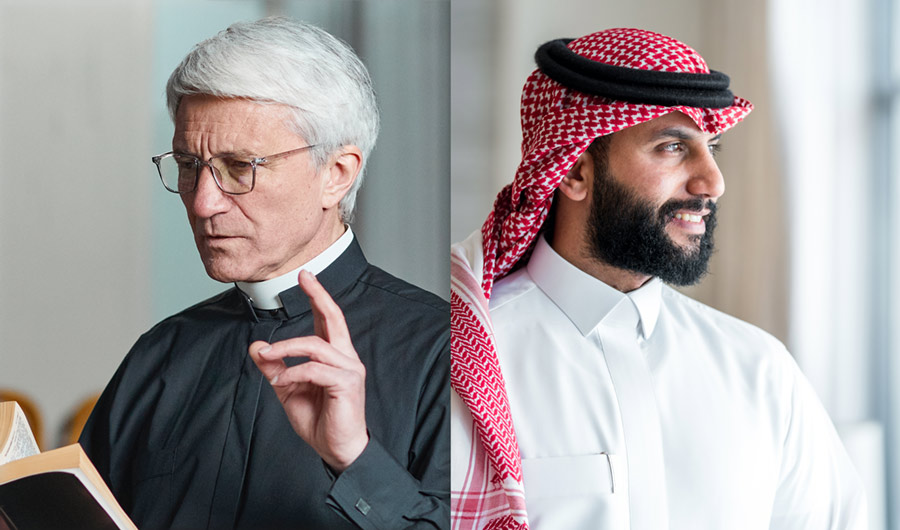
Faithful Muslims believe the whole world must be subjugated to Allah. Can anything that can be done to stop them? Yes — and the first step in this direction has already been taken. Ironically, it took place in Iran—the launching pad for the revolutionary movement that swept through the Muslim world after the fall of the Shah.
On June 21, in a public demonstration of American military might, President Donald Trump ordered a squadron of B-2 stealth bombers to attack three of Iran’s nuclear facilities, to devastating effect, on the heels of Israel’s successful campaigns against Hamas, Hezbollah, and Iran itself.
Significantly, these victories were possible in large part because of superior American weaponry and advanced technology. Only the U.S. possessed the technological know-how to produce the B-2 bomber. The Iranians had plenty of advance knowledge that the bombers were coming, but were unable to stop them or even detect them.
In the wake of that attack, some important changes are already apparent. Many nations in the Mideast are beginning to distance themselves from Iran. The Gulf States were never happy with Iran’s nuclear program. They feared that because of the longstanding hostility between Sunni and Shia Muslims, Iranian nukes could be turned against them.
According to Yossi Kuperwasser, an Israeli security strategist, the “defanging” of Iran has created an opportunity for Middle East peace: “What seemed all but impossible yesterday — full normalization between Israel and its Arab neighbors, including Syria and Lebanon — now appears within reach.”
Don’t Rest Easy, Though
Now, however, is not the time for the West to let down its guard. Iran’s leadership is driven by a fanatical ideology that promises divine intervention for those who keep the faith. Iran is very likely to rebuild its nuclear and ballistic missile programs, and the West should be prepared for that. But it should not be preparing for more negotiations and ceasefire talks. That has been the West’s response to Iranian aggression for the last 45 years, and it has been an abysmal failure. Rather, the U.S. and its allies should be preparing more bombing runs against Iran’s military infrastructure until its fanatical leaders are thoroughly cowed.
In the meantime, it’s important for the West to realize that military strength is not enough. Strength of belief is equally important. We also need to show that our civilization is superior and worthy of emulation.
That won’t be easy. For decades, schoolchildren in the West have been taught to be ashamed of their cultural inheritance. Instead of standing up for it, Western citizens are more likely to apologize for it.
Rebuilding Cultural Confidence
It will be easier to rebuild our military strength than to rebuild cultural confidence. But here are some suggestions for resisting and possibly reversing Islam’s victories in the culture war:
- Sharply reduce Muslim immigration. Muslim immigrants should be carefully vetted, taught about Western values, laws, and culture, and expected to assimilate to our values. Projects like the European Union’s attempt to convince Europeans that they owe their civilization to Islam should be ridiculed and defunded.
- Realize that Islamic expansion in the West is mostly the result of stealth jihad. Since the Muslim Brotherhood is behind many stealth jihad initiatives, they should be banned in the West just as they are banned in numerous Muslim countries. Because stealth jihad often disguises itself as politics as usual, Western citizens need to learn how to spot it. The campaign of Muslim Brotherhood-backed Zohran Mamdani to be the next mayor of New York City is an obvious example of stealth jihad — but apparently it’s not obvious to the many Islam-ignorant New Yorkers who plan to vote for him.
- Stop the whitewashing of Islam in American and European schools. Much of what is taught about Islam is fake history designed to highlight Islam’s achievements while ignoring its history of violent conquests. It’s time to revise the textbooks and fire ideologically driven teachers. Likewise, colleges and universities should stop Islamic-influenced operations. For several decades, American universities have accepted billions in donations from wealthy Arab countries designed to influence the way Islamic history and culture are taught to American students. The money is also used to fund Islamic activist groups on campus such as the Muslim Student Association and Students for Justice in Palestine.
The Church’s Role
Since Islam is a religion as well as an expansionist political movement, Christian churches have a duty to teach the truth about Islam instead of hiding it, as most have done up to now. Here are a few examples of what should be done:
- Speak out about Muslims’ persecution of Christians. The modern-day persecution of Christians far exceeds any historical oppression, yet Christian leaders have been largely silent about the slaughter of Christians in Africa and other parts of the world. Christians need to start pressuring Muslim leaders to stop killing Christians. For instance, in the U.S. Christians could push for sanctions against offending governments — perhaps making foreign aid for certain Islamic nations contingent upon ending Christian persecution. We also should pressure Muslim governments to abolish the blasphemy and apostasy laws designed to keep Christians from proselytizing and Muslims from converting. As Yusuf al-Qaradawi, one of the most respected Sunni Muslims leaders, once admitted, “if [Muslims] had gotten rid of the punishment for apostasy, Islam would not exist today.” In short, Islam would not have survived if Muslims were free to choose another faith. But they’re not free. The usual punishment for leaving Islam is death.
- Inform the flocks. Christians who have been fed a diet of common-ground theology deserve to know that on many critical issues there is no common ground with Islam. What’s the common ground on jihad? On the equality of men and women? On amputation as punishment for theft? On the fate of apostates? On polygamy? On child marriage? On the nature of Heaven? On the Trinity? The Incarnation? The Crucifixion? The Resurrection? Pastors need to lead this conversation.
- Revise the Catholic Catechism to present a fuller and more accurate discussion of Islam. Currently, the 900-page Catechism devotes only one brief paragraph to “the Muslims” who, “together with us … adore the one, merciful God, mankind’s judge on the last day.” This is misleading because there are far more differences than similarities between the God of Christians and the Allah of Islam. For example, Islam teaches that on the “last day” their “merciful God” will condemn to hell any Christian who has failed to convert to Islam.
The fact is that Islam is built on the repudiation of Christian beliefs. The “common-ground” theory is built on lies. They may be well-intentioned lies, but they are lies nevertheless. They serve to cover up the very large gap that divides Islam and Christianity.
Another Clergy Coverup
In the past I’ve compared the Church’s coverup of the dark side of Islam to the Catholic Church’s coverup of the clergy sex abuse scandal. That may seem like an exaggeration, but it’s actually an understatement. The sex abuse scandal caused enormous damage, but the decades-long coverup of the realities of Islam may prove even more damaging. Already millions of Christians have suffered persecution, death, and displacement because they relied on the “shared faith” lies of the common-ground crowd and were unprepared for the hour when their Muslim neighbors turned against them.
All over the world, Catholics accepted the Vatican’s assurance that there was nothing to fear from Islam, and all over the world they found out the hard way that was not so.
Ironically, many of the key figures in the priest abuse coverup are or were key figures in covering up Islam’s aggressive nature. For example, Cardinal Blasé Cupich, who was tasked with squelching the Vatican’s sex-abuse investigation, was the first Catholic cochair of the National Catholic-Muslim Dialogue, which can best be described as an interreligious lovefest. The notorious abuser Cardinal Theodore McCarrick once told a gathering of the Islamic Society of North America, “Who you are and what you believe are very beautiful things,” and urged his audience to tell the world that terrorism is “not what the Quran says, that’s not what the Prophet, peace be upon him, is teaching.”
Of course, the prime example of Catholic Islamophilia was Pope Francis. He pushed for mass migration of Muslims into Europe and praised Islam as a humanitarian and nonviolent religion in documents such as Evangelii Gaudium and the Document on Human Fraternity. In addition to running interference for Islam, Francis is said to have covered up for more than a dozen abusive priests in Argentina and in Italy. On several occasions he gave wayward priests jobs at the Vatican in order to keep them safe from the authorities.
All of which brings up a few questions: Should we trust the people who covered up the sex-abuse scandals to tell the truth about Islam? Can prelates who genuflect to the LGBT agenda be counted on to stand up to Islam? Will bishops who saw no danger in the growth of a homosexual culture within the Church be able to see the danger of portraying Islam as a brother religion?
Clearly, the answer to all three questions is no. And clearly, Church leaders need to reassess their failed approach to Islam. Here’s the key passage from Abraham Lincoln that Catholic leaders ought to take it to heart:
“The dogmas of the quiet past are inadequate to the stormy present. The occasion is piled high with difficulty, and we must rise with the occasion. As our case is new, so we must think anew, and act anew.”
William Kilpatrick is the author of Christianity, Islam, and Atheism: The Struggle for the Soul of the West (Ignatius Press), and a new book, What Catholics Need to Know about Islam (Crisis Publications). His articles have appeared in Crisis, Catholic World Report, The National Catholic Register, First Things, FrontPage and other publications.