


Gospel Goes Viral on Joe Rogan’s Show After Christian Apologist Crushes Atheist in Debate
Millions are watching Canadian biblical scholar Wesley Huff evangelizing the world’s most influential podcaster
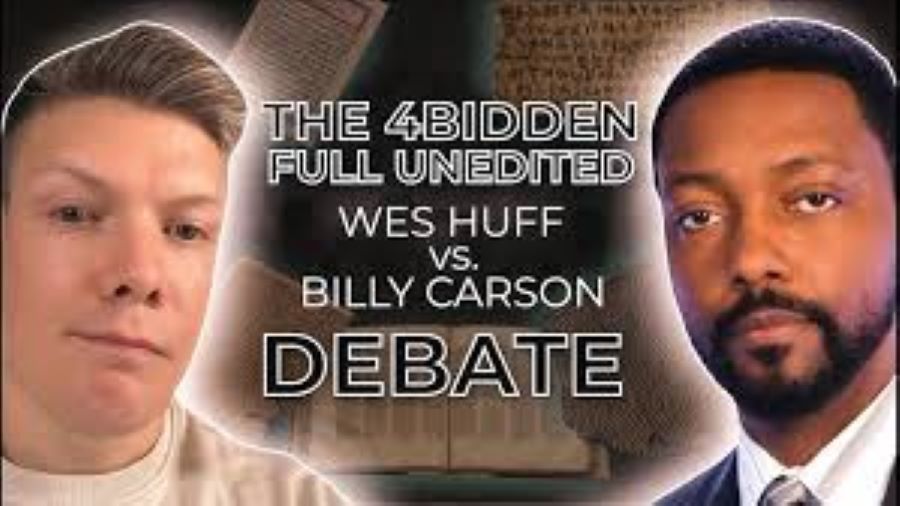
David neutralized Goliath with a slingshot. And recently, Christian apologist Wesley Huff knocked out atheist pseudo-scholar Billy Carson with biblical manuscripts.
I had never heard of Huff or Carson, but a missionary in Rome tipped me off after Joe Rogan found out and got Huff on his show. And now the Gospel is going viral on the world’s most influential podcast.
Here’s a recap: Huff is a 33-year-old biblical scholar and Canadian evangelical apologist who was born in Pakistan and grew up in Amman, Jordan. He specializes in biblical manuscripts, reading Hebrew, Aramaic, Greek, Latin, and exotic languages like Akkadian and Sumerian. The Indiana Jones of biblical history is currently pursuing a doctorate in New Testament at the University of Toronto.
Carson is founder and CEO of 4BiddenKnowledge TV. He encourages individuals to believe in their ideas and refuse to give up no matter what anyone else says. He’s got degrees in Applied Neuroscience from MIT and Ancient Civilization from Harvard. He’s authored The Compendium of the Emerald Tablets and Woke Doesn’t Mean Broke.
In October 18, Huff debated Carson’s widely known critiques on the authenticity of the Bible; the debate aired on December 9. And in it, Huff slaughtered Carson.
Carson tried to suppress the footage, claiming he’d been “ambushed.” His lawyers sent Huff a cease and desist letter. But Huff refused to pull the video, which currently has 1.6 million views.
Spurring Conversions
Rogan, who isn’t a Christian, sniffed out Carson’s epic meltdown. On Wednesday, he quizzed Huff for more than three hours on biblical manuscripts, textual criticism, ancient languages, Ancient Near Eastern parallels to the Genesis stories, and the evidence of Jesus’s resurrection.
As of this writing, Rogan’s podcast with Huff had over 3.1 million views on YouTube (escalating by the minute). Clips shared from both shows are pushing the total number of views to around 10 million. Huff’s subscribers have shot up by 159%and viewership of his many videos defending the Bible on his website has spiked by 584%to 6.2 million. The Gospel is going viral!
Huff’s scholarly response to Carson’s bluff is already triggering conversions. Here are just two of the more than 42,000 comments on the debate:
I have been an atheist that believed many of Billy’s claims for my entire life. … Wes has singlehandedly dismantled my entire worldview on the Abrahamic doctrines. Not only do I realize how incorrect I’ve been my entire life; I’m beginning to believe the Christians may actually be right about everything. I can’t believe I’m saying that, but it’s true. Thanks Wes, for shattering my world view and setting me down on a solid foundation.
I’ve been following Carson and his channel for years. Just watched this and unsubscribed and subscribed to Wes Huff. Gonna get my Bible out and study it for the first time in years. I was a Christian with many questions and not entirely believing. Watching Wes made me realise I’ve been lied to and I’m returning to Christianity and the Lord.
Demolition Man
So how did Huff demolish Carson and his Da Vinci Code conspiracy theories version of the Bible? Watching the debate, I immediately smelled a rat when Carson talked about how the “Sinai Bible” had proved that the Bible is riddled with errors. As a biblical scholar, I had never heard of this document.
Was Carson referring to the Codex Sinaiticus? I had seen the original copy in the British Library. It is the world’s oldest almost complete manuscript of the Bible and dates to the fourth century. “According to the Sinai Bible, Jesus wasn’t crucified,” Carson bluffed.
Huff first clarified whether Carson was indeed referring to the Codex Sinaiticus. He then calmly pulled out a copy of the codex from his shelf. Carson looked like he’d been hit by a bullet train.
Carson referred to the Gospel of Jesus’s Wife, allegedly from the early days of Christianity, in which Jesus refers to Mary Magdalene as “my wife.” The papyrus was “discovered” by Karen King, a feminist scholar at Harvard Divinity School in 2012. But scholars soon debunked it as a forgery and King’s reputation was trashed. In 2016, journalist Ariel Saba told the story of the fiasco in his book Veritas: A Harvard Professor, a Con Man and the Gospel of Jesus’ Wife. Huff chastised Carson for omitting these facts.
Carson then claimed that the creation story in Genesis 1 is a verbatim copy of the Enuma Elish, the ancient Babylonian creation myth. He then trotted out names of ancient Mesopotamian flood accounts like the Gilgamesh Epic and the Atrahasis Epic. (I nearly died laughing. I have studied and taught Genesis in Hebrew as well as all the Ancient Near Eastern parallels.)
Carson’s claim that the biblical authors had plagiarized these stories is hogwash. Huff patiently pointed out that there are similarities between the biblical and non-biblical accounts, but there are also striking differences. The best answer is that the Genesis stories are a polemic against these myths in the context of the Babylonian exile. Huff told him so. Carson had egg on his face.
Carson then went on a tirade, saying he’d visited tribes around the world that have oral histories of aliens, etc. When Huff asked him what scholarly methodology he used to discern the credibility of such oral traditions, Carson delivered a word-salad spiel that would make Kamala Harris blush. He also kept bringing up the old chestnuts about how the Bible justifies slavery and the patriarchy because it always refers to God as male.
Huff corrected him. Carson stomped out.
Convincing Rogan
Viewers may be a bit disappointed by Huff’s subsequent appearance on Rogan’s podcast because the latter isn’t a gladiatorial match. Again, Huff is the model apologist — the quintessential Canadian gentleman who “speaks the truth in love,” following Paul’s exhortation in Ephesians.
I’m not going to spoil the readers’ fun watching Rogan and Huff talk about the evidence for the credibility of the Bible and lots of other topics, including how textual criticism of the Bible works and that the gospels are biographies of Jesus comparable to other ancient Roman biographies. (The Stream will be posting that unedited video later today, so you can decide for yourself what you think of it.)
Huff also discussed the discovery of the Dead Sea Scrolls (1946-1956), which was key to proving the reliability of the text of the Old Testament because the scrolls predate the Hebrew manuscripts of the Masoretic text (that were being used to translate the Hebrew Bible) by almost a thousand years. Rogan listens and responds like a child getting high on an overdose of candy.
The biblical scholar gives Rogan a potted lesson on New Testament manuscripts like P56 and P66 and the Oxyrhynchus collection of papyri which are preserved at Oxford. He also shows him what Sumerian linear Elamite, Akkadian, and paleo Hebrew look like, and explains how the Bible was canonized. Rogan keeps saying, “Wow,” “Whoa!” and “That’s fascinating” to Huff’s explanations.
Evidence for the Resurrection
Finally, the two get to the crux of the Christian faith: the resurrection of Jesus from the dead. “You have a guy who objectively lived. He objectively died, and then individuals close to His inner circle claim that they see Him not dead,” Huff says.
“Well, how do you explain that? How do you explain it going from 11 scared disciples in an upper room, to being willing to go out and die for the proclamation that you believe that Jesus rose from the dead, and you saw him, and you touched him, and you ate with him. And, you know, he wasn’t a ghost, you actually ate fish with the resurrected Jesus.”
After winning Rogan’s confidence, Huff asks the podcaster the greatest question of all: “In all of this, what do you think of Jesus? Like, in terms of your own, like, journeying and trying to find answers to ultimate questions? What do you think of the historical person of Jesus?
“If Jesus is nothing but a moral example, then you can save yourself and you don’t actually need a savior,” Huff says. “If Jesus is a moral example, it actually misses what I think Jesus actually said about what his purpose was, in that you can’t do enough to actually live up to the standard that God holds you to. And so if you keep striving, you’re actually going to wear yourself out and be exhausted.” In other words, the Law points you to the Gospel.
Rogan responds: “You’re right. Like if you do live like a Christian, and you do follow the principles of Christ, you will have a richer, more love-filled life. So it is true. But you have to submit to this concept, that this guy was the child of God who came down to earth, let himself be crucified, came back from the dead, explained a bunch of stuff for people and then said, ‘Alright, see you when I come back.’”
Huff is an evangelist from whom we could learn. He’s not going to rush his interlocutor into deciding for Christ; he uses what the apologist Gregory Koukl in his book Tactics: A Game Plan for Discussing Your Christian Convictions calls the “Columbo tactic” after the TV detective who “goes on the offensive in an inoffensive way by using carefully selected questions to productively advance the conversation.” Just place a pebble in your interlocutor’s shoe, Koukl advises. Huff does just that.
Pastors also have a lot to learn from Huff. If only we preach the Bible faithfully and intelligently, using the best of biblical scholarship and explaining to our congregations how the biblical authors, inspired by the Holy Spirit, engaged their contexts and even used Babylonian creation myths to preserve the faith of Israel, we wouldn’t have Christians who are waylaid by Carson-like charlatans.
What an amazing time to be alive.
Dr. Jules Gomes (BA, BD, MTh, PhD) has a doctorate in biblical studies from the University of Cambridge. Currently a Vatican-accredited journalist based in Rome, he is the author of five books and several academic articles. Gomes lectured at Catholic and Protestant seminaries and universities and was canon theologian and artistic director at Liverpool Cathedral.