


Foreign Policy in the Second Trump Administration: Back to the American Future
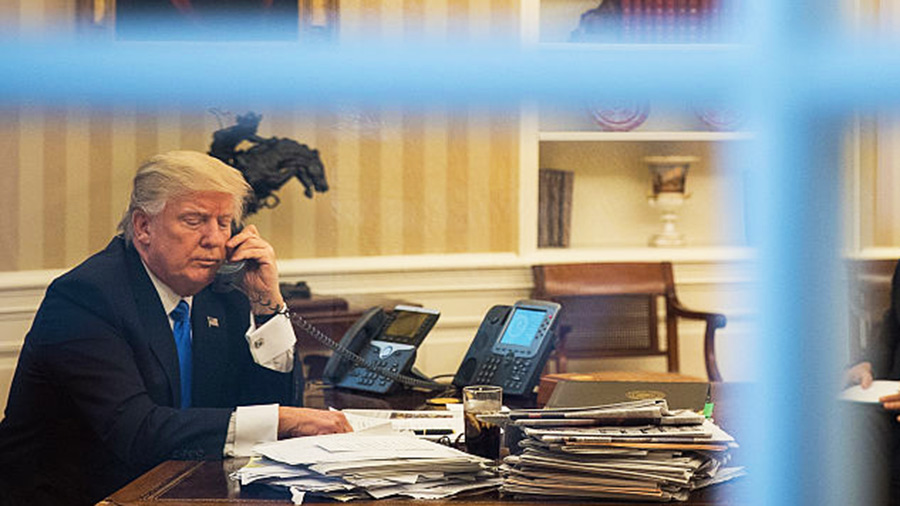
April 30 marked 100 days of President Donald Trump’s second term. While many supporters and critics are analyzing its overall impact, I want to look just at his foreign policy.
Is Trump making American international relations great again? Or is he secretly planning anschluss of Canada and Greenland while cultivating a toothbrush mustache? Perhaps some of both? Let’s examine.
A Look Back at Trump’s First Term in Foreign Policy
First, here’s a brief recap of foreign policy in the first Trump administration.
- Though blighted by the COVID pandemic, it nonetheless had several successes, notably the US-helmed Abraham Accords, in which the United Arab Emirates, Bahrain, and Sudan normalized relations with Israel. Morocco also joined a separate peace with the Jewish state.
- Overall, Trump strengthened ties with Israel and recognized Jerusalem as its capital. He also realigned America’s Muslim world policy toward the Kingdom of Saudi Arabia (making his first overseas trip there), turning away from the Islamic Republic of Iran.
- Trump pulled out of the “Iran Deal” President Barack Obama had set up to restrain Tehran’s nuclear weapons program, but which even the Europeans admit the ayatollahs regularly violate.
- More positive actions in the region included killing both the Islamic State’s self-declared caliph and the head of the Iranian Revolutionary Guards Corps — Tehran’s meddling Middle Eastern mastermind, Qasem Soleimani.
- Elsewhere in the world, 45 met with North Korea’s Kim Jong-un and Vladimir Putin, while also selling Javelin anti-tank missiles to Ukraine.
- In terms of international agreements, Trump badgered NATO countries to meet their promised threshhold of spending 2% of GDP on defense. (When he entered office, only three of the 32 NATO member nations were doing so; by the time he left, 23 were.)
- He also pulled out of the useless Paris Climate Agreement, and the Chinese-front World Health Organization.
- On the global economic front, Trump imposed some tariffs and replaced the Clinton-era North American Free Trade Agreement (NAFTA) with the more US-friendly US-Mexico-Canada Agreement (USMCA) while deep-sixing the proposed Trans-Pacific Partnership, deeming both as economically unfair to this country.
Overall, Trump’s first term epitomized two elements of his thinking: American nationalism and transactionalism — getting something done, business-like, via the “art of the deal,” not just negotiating for its own sake. He may have blustered and stepped on a few wing-tip shoes, but Trump got things done.
Trump’s Second Term Approach: A Lot More of the Same
Now, he is quadrupling down on the same approach, especially on his “America First” conviction.
Regarding geopolitics, 47’s administration might be described as the Monroe Doctrine on steroids. (In 1823, the fifth president basically told the rest of the world that the Western Hemisphere is an American province, writ large.) On international trade, Trump is (Alexander) Hamiltonian.
Predictably, policies stemming from these perspectives are causing palpitations among the usual suspects: the Democrats, world leaders addicted to unbridled American largesse, and of course most of the media.
Let us count the ways Trump is now trashing the globalist consensus that’s reigned for 80 years:
- Withdrew, again (since Biden had reentered them) from the Paris Accords and WHO
- Shutting down the tidal wave of illegal immigration and forcibly deporting legions of criminal aliens
- In Latin America
- Pressured Panama to evict Chinese firms
- Met with Argentina’s like-minded President Javier Milei
- Is strengthening ties with Chile
- Reinstated Cuba as a state sponsor of terrorism
- Listed Mexican and Venezuelan drug cartels as terrorist organizations
- Imposed tariffs, especially on the many nations which already had them on the US and with whom we have massive trade imbalances (and which have been, historically, a staple tool of US foreign policy), resulting in
- Alleviating the US shortage of Rare Earth Elements (REEs)
- Importuning Greenland to become a US territory
- Reimposing sanctions on Iran that Biden had lifted—while also offering to negotiate with Tehran
- Talking to both Ukraine President Volodomyr Zelenskyy and Russian President Vladimir Putin to end their war
- Ramping up US oil production and refilling the Strategic Petroleum Reserve, which Biden had depleted to help his reelection chances
- Slashing USAID funding — much of which had been going to useless, corrupt programs both abroad and here
- Increasing defense spending to $1 trillion
What conclusions can we draw from all of this?
Trump’s grand strategy is, as I noted earlier, firmly rooted in American traditions: those of Hamilton and Monroe, in particular, which Trump’s people are reworking for the modern world. He sees, rightly, that America must put its own house in order instead of trying to fix all the planet’s problems, as has been Washington’s bipartisan bent since 1945. We can no longer afford that, being almost $37 TRILLION in debt. Democrats and Establishment Republicans who think we can just go on operating like it’s 1999 are deluded — and dangerous.
In that sense, 47 is a revolutionary conservative, taking US geopolitics back to the future. Trump is indeed standing athwart current history and telling the liberal Deep State to just “stop.”
But he’s also trying to jumpstart the US going in a new direction, one that would enable this country to survive. We must pray he succeeds. Because if he doesn’t, America’s death spiral will likely become irreversible.
Timothy Furnish has a PhD from Ohio State in Islamic, World & African history. He’s been an Arabic interrogator in the 101st Airborne, a US Special Operations Command analyst, an author and professor. Furnish is the military/security affairs writer for The Stream.