


EU Blows Big Bucks on Stifling Free Speech as UK Forges Ahead to Ban Islamophobia
Vice President J.D. Vance’s warning to Europe’s elite on freedom of expression proved to be accurate
The European Union is splurging millions of taxpayers’ dollars on contractors tasked with providing the transnational behemoth with “technical, content-related and organizational support” for the implementation of draconian restrictions on freedom of speech.
A tender from the European Commission, the EU’s executive arm, offers €4.4 million to companies who will develop a searchable “online knowledge hub” to counter antisemitism, xenophobia, Islamophobia, anti-LGBTQ discourse, misogyny, and other forms of “hate speech.”
In a parallel initiative, the Council of Europe, an institution distinct from but politically allied to the EU, has floated a tender worth €4.5-6 million for consultancy on sexual orientation, gender identity, and gender expression (SOGIE).
The project seeks to combat SOGIE-based hate crime, hate speech, and bullying, and support legal gender recognition and same-sex unions. It also seeks to combat discrimination against “LBQ women, LGBTI asylum seekers and refugees, LGBTI persons deprived of their liberty; LGBTI youth.”
Criminalizing “Hate Speech”
While the EU database emphasizes combating antisemitism it does not even mention hate speech directed at Christians, who comprise the majority religion in the continent.
The EU’s project contractors are required to “conduct a pilot study to map the ‘ecosystems’ of hate speech online” covering at least five EU languages and indicating the “main trends of hate speech, the triggers (political events; socioeconomic factors; role of platform design, etc.) and the platforms most affected.”
The contractors will establish a network of monitoring reporters, including nongovernmental and civil society organizations and reviewers in all 27 member states.
The tender specifies that the goal of creating the online hub is to criminalize “hate speech” under current EU legislation such as the Council Framework Decision on combating racism and xenophobia (2008) which “requires the criminalization of certain forms of hate speech and hate crimes by means of criminal law.”
The tender explains how the EU intends to widen the scope of what it defines as hate speech:
In December 2021, the [European] Commission adopted a Communication inviting the Council of the European Union to include hate speech and hate crime in the list of EU crimes in Article 83(1) TFEU. This would create the legal basis for EU-level criminalization also of other forms of hate speech and hate crime beyond the racist and xenophobic grounds already covered by the Framework Decision.
The hate speech database would also keep records of “action taken by the platforms (removal and non-removal), language of the content, type of content (message, meme or video).”
USA Hits Back at Policing Digital Speech
The European Union designed the Digital Services Act in 2023 to force Google, Facebook, Twitter, Telegram, and other digital platforms to combat what is regarded as disinformation and online extremism.
Addressing the Mobile World Congress in Barcelona in Spain on March 3, Federal Communications Commission Chairman Brendan Carr called out the EU’s DSA as incompatible with America’s free-speech tradition and warned that it risked excessively curbing freedom of expression.
In late February, President Donald Trump signed a memorandum which threatened to impose tariffs on the EU over tech regulations like the Digital Markets Act and the Digital Services Act.
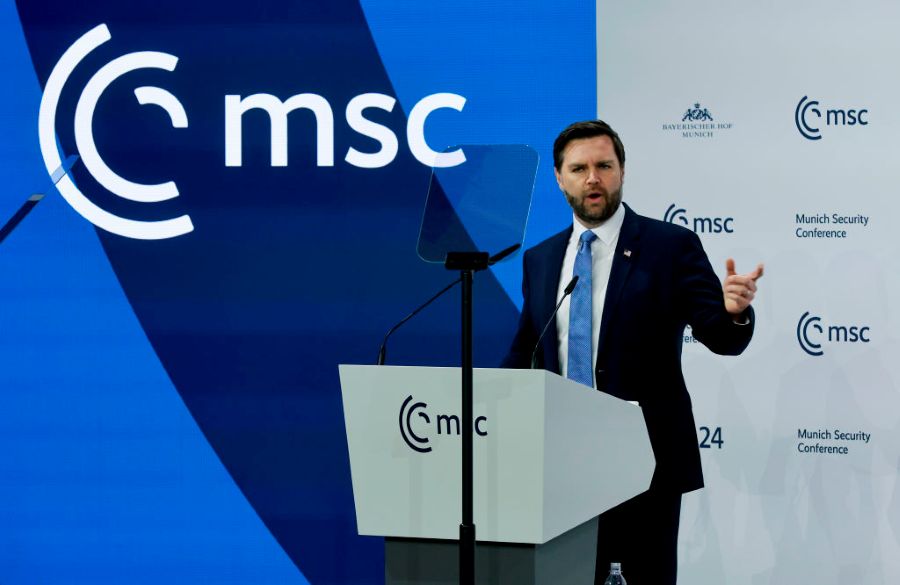
The battle over speech raging between the U.S. and Europe peaked after Vice President J.D. Vance called out the suppression of free speech in Europe and Britain at the Munich Security Conference in mid-February.
“In Britain, and across Europe, free speech, I fear, is in retreat,” Vance said, describing how EU “commissars warn citizens that they intend to shut down social media during times of civil unrest the moment they spot what they’ve judged to be, quote, ‘hateful content.’”
Vance named and shamed Germany for carrying out raids “against citizens suspected of posting anti-feminist comments online as part of, quote, ‘combating misogyny on the internet, a day of action’” and Sweden “where, two weeks ago, the government convicted a Christian activist for participating in Quran burnings that resulted in his friend’s murder.
“And perhaps most concerningly,” he added, “I look to our very dear friends, the United Kingdom, where the backslide away from conscience rights has placed the basic liberties of religious Britons, in particular, in the crosshairs.”
The vice president spoke of the way Britain and Scotland have criminalized Christians merely for praying silently outside abortion facilities or even in their own houses if they were within buffer zones.
“While out of step with Western traditions that respect freedom of speech, the EU’s censorial behavior is becoming more commonplace everywhere,” Vance said.
Britain Marches Toward Blasphemy Law
Meanwhile, Christians and other minorities in the UK have expressed fears over Britain’s rush to criminalize “Islamophobia” after the government launched a new working group on February 28 to provide it with “a working definition of Anti-Muslim Hatred/Islamophobia.”
Critics note that the government will incorporate the controversial definition crafted in 2018 by the All Party Parliamentary Group (APPG) which concluded: “Islamophobia is rooted in racism and is a type of racism targeting expressions of Muslimness or perceived Muslimness.”
By equating Islamophobia with racism, free-speech activists fear that the definition will effectively criminalize all criticism of Islam.
If Deputy Prime Minister Angela Rayner signs it into law, the Labor Party’s definition of Islamophobia would criminalize “anyone who expresses any view that criticizes ‘expressions of Muslimness’ — ex-Muslims who have escaped Islam and want to talk about why — women who criticize the face veil or headscarf,” Benjamin Jones from the Free Speech Union (FSU) tweeted.
In comments to The Stream, Tim Dieppe, head of Public Policy at Christian Concern, said that “there are not many other Christian organizations willing to speak up about the threat to free speech posed by a legal definition of Islamophobia.”
Dieppe, an expert on Islam who has written extensively on the dangers of the proposed legislation, warned that “Christians should be alert to the fact that Islamic blasphemy laws are a key factor in the persecution of Christians in various countries around the world. Christians will be amongst the first targets of any Islamic blasphemy law. They should therefore be the first to speak out against the dangers of bringing in any such law.”
An FSU press statement warned that “any official definition, particularly one derived from the APPG, could have a chilling effect on legitimate public debate” and could create a backdoor blasphemy law in Britain.
“The APPG definition has already been adopted by the Labor Party and numerous public bodies, including 52 local councils. In practice, it has led to individuals facing censure or disciplinary action for lawful statements about Islam or its adherents,” it stated.
Dr. Jules Gomes, (BA, BD, MTh, PhD), has a doctorate in biblical studies from the University of Cambridge. Currently a Vatican-accredited journalist based in Rome, he is the author of five books and several academic articles. Gomes lectured at Catholic and Protestant seminaries and universities and was canon theologian and artistic director at Liverpool Cathedral.