


Do Science Museums Have to Steal Young People’s Faith?
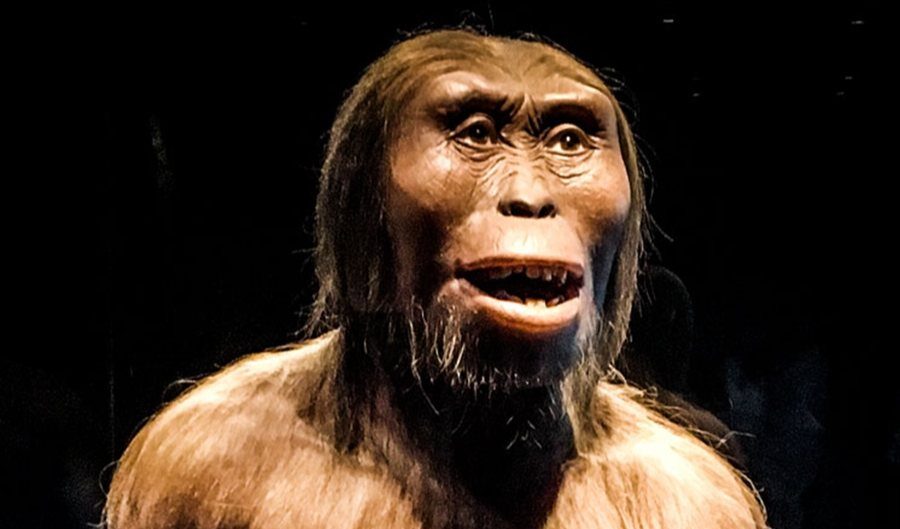
The Lucy exhibit at the National Museum of Anthropology in Mexico, almost identical to the exhibit at the Perot Museum in Dallas.
I’ve written quite a bit lately about the corrosive effect Darwinian materialism has had on people’s faith, and much later on our politics. At the icy, mechanical heart of that worldview is one dogmatic assumption: that everything in the universe can be explained by either blind, immutable laws, or dumb, random chance. That includes all of nature from galaxies to atoms, and all of life from amoeba to people.
This worldview is labeled as the “scientific” one, despite the deep religious faith of some of the most important scientists in history, such as Blaise Pascal, Isaac Newton, Gottfried Leibniz, Gregor Mendel, and Louis Pasteur — and despite the crucial role that Christian culture played in making the Scientific Revolution possible. (For a primer on why experimental science only developed in the Christian West, which posited an orderly universe made comprehensible to our rational minds by a loving God, check out Stephen Meyer’s fascinating video here.)
If you have internalized this dogma, even on a subconscious level, it serves to negate every argument that some action or other is “unnatural” or “immoral.” What do such words even mean in a universe itself barren of meaning, without a Maker, which has no plan? Saying that things like racism or genocide are “wrong” just boils down to asserting that you prefer the world to be a certain way for your own selfish or sentimental reasons. The world itself has no preferences, as it chugs along toward its heat death, and life itself is governed by just one ugly rule: the survival of the fittest.
A Faith Killer
As I suggested here a few weeks back, such a dogma is
a faith-killer. You can’t believe that, even implicitly, and still cling to faith in the God of the Bible. The Jewish and Christian traditions teach us that life is a wondrous, mysterious gift from an all-knowing, all-loving Mind. Since Darwin’s time, every intellectual discipline, from the hard sciences to religious studies, has striven to prove the opposite: Life is just some flotsam that happened to wash up on the beach. Those two views can’t be reconciled, full stop.
So why are we letting our young people get catechized with this worldview? It’s happening not just in public schools but many religious ones, with almost all Christian universities (Catholic and evangelical) handing their biology departments over to card-carrying Darwinists.
This worldview is the one most science museums have packaged winningly for children — from the grand old Museum of Natural History that I used to haunt as a kid in New York City to the shiny, high-tech Perot Museum of Nature and Science right here in Dallas. Exhibits carefully designed by media masters help young people absorb the pointlessness of life through fun, interactive displays and convincing videos — while their church-going, Bible-believing parents walk through the museum, perhaps oblivious to everything they’re seeing.
Does it have to be this way? David Rives says no. He’s the founder of Nashville’s Wonders Center and Science Museum, the largest science museum in Tennessee. At Wonders, young people are introduced to all the basic concepts of science through high-tech, engaging exhibits. But instead of inserting the dogma of materialism at every opportunity, Wonders encourages students to see the ubiquity of order, beauty, and design throughout the universe, from the galactic scale to the microscopic. Visitors will see the occasional Bible verse presented — perhaps some quote from the Psalms or the Book of Job reflecting on God’s grandeur.
What’s more (I was surprised to learn), groups of public school students come through all the time for a refreshing exposure to an alternative point of view.
Let’s Compare Museum Experiences
When I heard that Rives was coming to Dallas, I had an edgy idea: Why not get him to give me a tour of the Perot Museum and tease out the ways the exhibits diffuse Darwinist dogma? He agreed, and we met up at the museum last week. It was an eye-opening experience.
We started out by talking about the impact that being taught, as proven fact, that all life emerged by accident and evolved at random, driven by unlikely genetic mutations then culled by ruthless competition, until after billions of years, amoebas morphed into man, has on young people’s faith. Rives said that science instructors and exhibits that regurgitate Darwinism are
teaching the child on a subconscious level that they are nothing more than accidents of the cosmos. They’re a link in an evolutionary chain that has been extending for billions of years. There’s nothing special about their lives. They have no purpose. They’re not created in God’s image. No, they’re simply ‘star stuff’ living on a ‘pale blue dot.’
We see the impact of training young people this way reflected, darkly, in suicide notes and the manifestos of school shooters. They lay heavy emphasis on the ‘pointlessness’ and ‘meaninglessness’ of life.
Instead of that message, at Wonders the exhibits’ explanatory panels discuss the principles of design and complexity.
“And if [students] continue to look through every exhibit,” Rives said, “they’re also going to find principles that relate back to the Christian worldview and even the Gospel message.”
How would the world be different if more young people shaped their views of life that way?
As we walked through the Life Science exhibits at Perot, Rives pointed to the charts that diagram the evolution of life, from its simplest forms right up through primates and finally humans. The signage that accompanied them laid heavy emphasis on “random” mutations that produced new, higher life forms exclusively through the sorting mechanism of the “survival of the fittest.” He pointed out that 60% of biologists are self-professed atheists — probably the highest percentage in any scientific discipline. I asked him why that might be.
An Anti-Spiritual Discipline
He explained that in order to cling to “faith” in Darwin’s dogma, one must systematically suppress the natural impulse to see Design in every corner of life.
“You have to look at species that coevolved, such as hummingbirds with long beaks and flowers with narrow flowers, neither of which could survive without the other — and deny the obvious inference that they were made for each other,” he said. “You have to pretend that somehow they randomly both emerged at exactly the right time. And you have to do that over and over, through life at every level. You have to actively negate and ignore the logical implication of Design.”
That sounds to me like almost a spiritual discipline — training yourself to avoid the temptation to see God’s fingerprints, even when they’re smudged across everything, simply as interesting circles and swirls.
The Whites of Her Eyes
Perhaps the most egregious example of Darwinist proselytizing at the museum was the “Lucy” exhibit, showing a small ape-like creature that’s often presented as the first ape to walk upright instead of living in trees — and hence likely one of our ancestors in the entirely unplanned and gradual transition from lower primates to humans.
Rives explained that the “Lucy” fossil was found in very partial and shattered form, and that the evidence that she walked upright is thin and inconclusive at best. But the diorama at the Perot Museum was complete and very convincing. It looked almost alive.
What’s more, some subtle touches to the model help make the Darwinist case on a subconscious level. Rives pointed out that Lucy, and all the other putative human ancestors presented, were pictured with whites in their eyes — white corneas like the ones humans have. But apes don’t have white corneas — not even chimpanzees. Certainly no fossil evidence survived to suggest Lucy did. So why would the museum depict all these apes with such inaccurately human-style eyes? Rives offered an answer:
“To make them seem more like us, and make us feel more akin to them.”
A thousand little lessons like that one soaked up by a young person throughout his life … that’s how Darwin’s dogma gets preached. And that’s the source of the stubborn resistance Intelligent Design advocates meet when they try to point out the many impossible claims on which Darwinist materialism rests. They’re bumping up against something very much like a religion that’s been planted in hungry young minds with vivid pictures and plausible stories.
John Zmirak is a senior editor at The Stream and author or coauthor of 14 books, including The Politically Incorrect Guide to Immigration and The Politically Incorrect Guide to Catholicism. His newest book is No Second Amendment, No First.