


Coppola’s Megalopolis: The Highest-Budget Student Film in History
For decades, I told people that the three biggest influences on me were the Catholic Church, J.R.R. Tolkien, and Monty Python, in equal measure. Now Pope Francis is trashing the Church and Amazon’s putting Tolkien through the woodchipper. At least Python reruns are safe for the moment.
But there was another dark star whose gravitational power influenced my orbit. You’ve probably already guessed it: The Addams Family. Not the original cartoons or the movies, but the early 1960s TV series. As I wrote back in 2012:
[W]e humans reside in some very strange premises, which we didn’t build ourselves but blundered into, like those hapless Eisenhower voters who used to visit the Addams family. By the way, I’ve always considered that a deeply Catholic show: Here’s a bunch of aristocratic, history-obsessed homeschoolers who live in a gothic house full of torture devices and actual relics, trapped in an uncomprehending Protestant suburb. Watching the reruns as a kid, I developed a real “thing” for Morticia. She ruined me for any woman whose veins don’t show through her skin.
Indeed I met the woman I love after she read that, and sent me a fan letter “complaining” about her Morticia Addams look. After some goading she sent me a photo, and I was hooked.
But the influence goes much further than simply shaping my taste in the fair sex. More than one friend has independently said to me, “You must have watched The Addams Family a lot. Because it seems like your silent role model is … Gomez.”
How true that is, and how unsettling. One of my favorite Gomez antics was the way he would set up elaborate toy trains, get them revved up and steaming, then crash them into each other, over and over again. I used to say, “I could watch Gomez doing that for two hours straight, maybe three.”
Megalopolis Is a Lavish, Slow-Motion Train Wreck
And thanks to Francis Ford Coppola’s new magnum opus, Megalopolis, I had the chance. I dragged poor Morticia with me on the promise, “It’s the life project of a visionary director. If only in gratitude for The Godfather, we owe it to him.” And there was some Godfather vibe in the midst of the sprawling chaos of Megalopolis. Alas, it was Godfather III. Nathalie Emmanuel, who plays the love interest to Adam Driver’s protagonist, is radiantly lovely. But she delivered her weirdly written, portentous lines with all the skill of poor teenaged Sofia Coppola.
The film did no favors to any of its actors, apart from John Voight — who does a brilliant comic turn as a benevolent reinvention of Roman plutocrat and gangster Crassus. (You know, the villain Lawrence Olivier played so brilliantly in Spartacus.) And Lawrence Fishburne, who plays both the hero’s chauffeur and the film’s narrator. Like the late James Earl Jones, I could listen to Fishburne read aloud from the Yellow Pages and enjoy it.
Giancarlo Esposito, who usually plays Machiavellian villains in crime movies with sinuous charm and evil, here portrays a hapless liberal big-city mayor. But the performance Coppola got from him has less drama and life than the TV ads for Fiat Esposito dashes off with Spike Lee. Adam Driver, who shone as the villain in the medieval epic The Last Duel, here seems more like he’s stuck back on the set of Girls, pretending that Lena Dunham is somehow sexy and interesting. Aubrey Plaza was less than convincing as a gorgeous femme fatale who likes to dress like Cleopatra.
A Futuristic “New Rome”
Whereas the other character dress like … Roman senators. No, I’m not kidding. This drama is set in a futuristic New York City renamed “New Rome,” where all the characters have names from the last days of Julius Caesar. Caesar himself, Cicero, Cataline, and other major players in the collapse of the Roman Republic … they all get name-checked. But the characters they play don’t really evoke the real historical characters, so if you know your Roman history, the allusions just confuse you — as opposed to flying right over your head, like the rest of the plot, themes, and point.
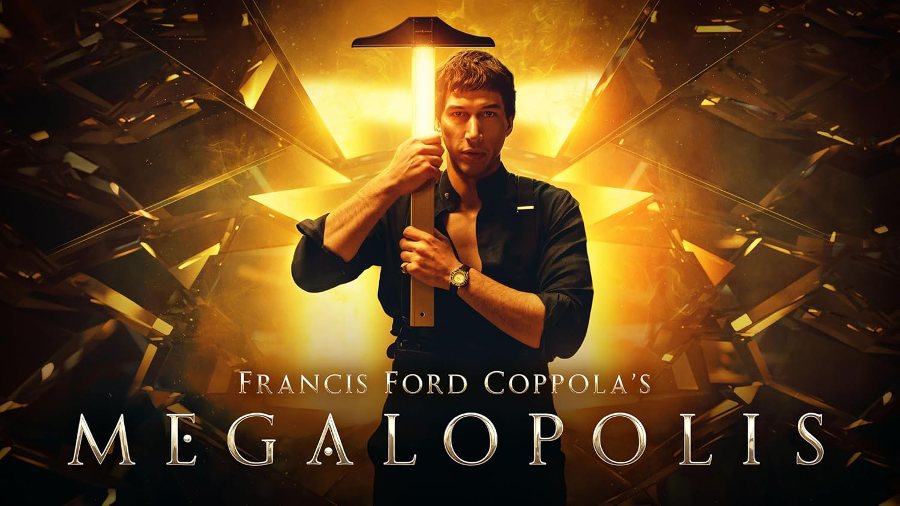
Briefly, the film stars Driver as Caesar Catalina (mashing together two utterly different Roman politicians), a visionary inventor who wants to remake New Rome. And on the face of it, he shouldn’t have much trouble. He has the power to freeze time at will, so he can jump off skyscrapers, then climb right back on the ledge. We never find out where he got this power, but it ought to come in handier than the movie ever lets on.
A Mash-Up of Willie Wonka, Elon Musk, and Donald Trump
More importantly, Caesar has won the Nobel Prize by inventing a new, high-tech, quasi-organic substance that can (bear with me here) grow buildings all on its own, and even restore the shattered heads and brains of gunshot victims. He wants to use this substance to completely remake New Rome into an ecotopian “walkable city” where people get whisked around in high-tech driverless bubbles ….
And the old-line big city machine, embodied by black Democrat Cicero (Esposito), is dead set against Caesar and his vision. Cicero conspires with various wealthy villains and an all-white (!) urban mob to protect New Rome from the threat to “democracy” he thinks Caesar represents. Or something.
Cicero’s motivations are really never made clear. What makes matters more confusing is that he’s meant to be the doting father of Julia (Emmanuel). But he looks 40 years older than she, while her mother (a dead ringer for Ruth Bader Ginsburg) looks more like her great-grandmother. What’s with this casting? And why does Cicero fear Caesar, who’s less like the bloodthirsty Roman demagogue than a mashup of Willie Wonka, Elon Musk, and Donald Trump?
Oh yes, Trump comes into the story in several confusing ways. I think Coppola wanted on some level to check off Hollywood liberal boxes. So the villainous mob waves signs reading “Make New Rome Great Again” and even sports red MAGA hats. These little sour notes remain unconvincing, since Caesar is an optimistic technocrat who just wants to build people nice, shiny new homes — like builder Donald Trump. And who stands in his way? A black big-city liberal. One of the villains is even a crossdresser, which wasn’t on my Bingo card. I think it would horrify Coppola to hear it, but in making Caesar the hero, he inadvertently managed to somehow endorse Donald Trump.
The best part of the movie for me was that Caesar’s office is inside the penthouse of my favorite structure on earth, the Art Deco masterpiece Chrysler Building. That part of the building isn’t open to the public, so this is probably your only chance to take in its glorious, retrofuturist angles.
Not enough for you? It wasn’t for Morticia either. She doesn’t share Gomez’s taste for almost three-hour-long slow-motion train wrecks. And now to punish me, she won’t accompany me to see the long-awaited sequel to Beetlejuice.
So I’ll go stag in an Uber, and chuckle alone in the darkness. Gomez would approve.
John Zmirak is a senior editor at The Stream and author or coauthor of 14 books, including The Politically Incorrect Guide to Immigration and The Politically Incorrect Guide to Catholicism. His newest book is No Second Amendment, No First.