


College Students Fail to Remember the Significance of V-Day, Memorial Day, D-Day, and July 4
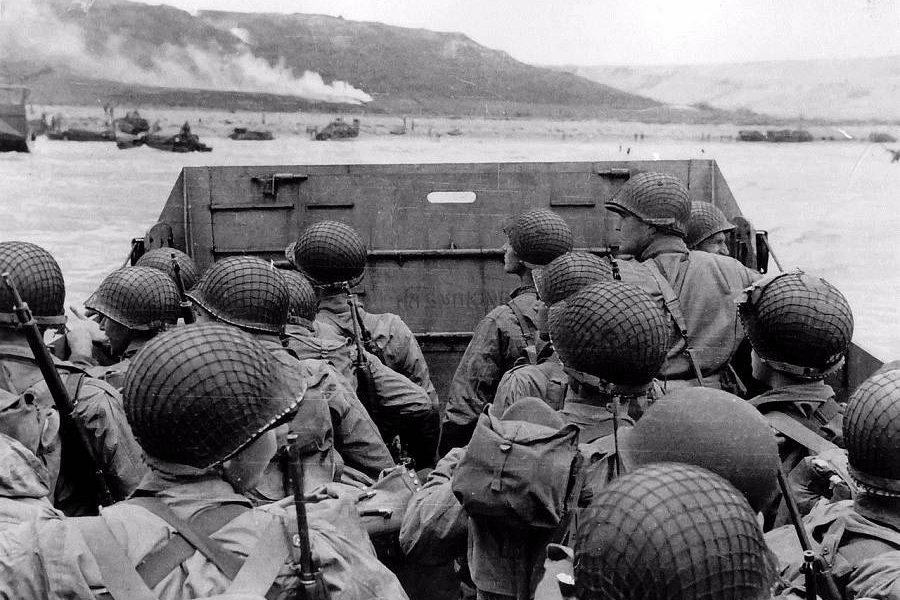
We are in the middle of our national season of remembering. May 8 marked the 80th anniversary of V-Day — the day Nazi Germany surrendered to the Allies, marking the end of World War II in Europe. May 26 was Memorial Day, “a sacred day of remembrance, reverence, and gratitude for the brave patriots who have laid down their lives in service to our great Nation.” Today — June 6 — is the eight-first anniversary of the D-Day invasion that led directly to V-Day eleven months later. And July 4 is coming up.
The theme of all these remembrances is freedom from tyranny.
Object Lessons
A few months ago, my wife and I, along with a group of Wyoming Catholic College students, toured the World War II collection at the National Museum of Military Vehicles in Dubois, Wyoming. We were led by the museum’s founder, Dan Starks, who told us his story.
After moving to Dubois, Starks bought a tank to drive in the town’s annual Fourth of July parade. Then he bought some more tanks, trucks, half-tracks, jeeps and … Anyway, his collection of military vehicles expanded, and public interest in it increased to the point that he built the 160,000-square-foot museum that now includes vehicles from World War II, and the conflicts in Korea, Vietnam, and Desert Storm.
The primary point of the museum, Starks insists, is not the vehicles. It’s the stories of the GIs who drove and died in those vehicles, paying the high cost of freedom.
The tour includes a Higgins boat — the small, plywood landing craft used to shuttle 30 soldiers at a time from their ships to the beach at Normandy. After seeing it, I bought and read Stephen Ambrose’s book, D-Day: June 6, 1944: The Climactic Battle of World War II.
Firsthand Accounts
While the fighting that took place after D-Day was the bloodiest of World War II, that event was the real turning point, when Allies actually won. It was by far the largest amphibious invasion there ever was and likely ever will be. By the end of the first day, 175,000 American, British, Canadian, and French troops had landed in Normandy by sea or air along with 54,000 vehicles. About 4,900 Allied GIs were killed, most in the first waves of landings.
In his book, Ambrose tells the stories of individual soldiers involved in the struggle to take the beaches and then move inland.
The landing began at 6 AM as the tide was rising. The German defenders assumed there would be a dawn attack, but believed the Allies would wait for a high tide — so they were caught off guard, with their senior commanders far from the coast. As Ambrose tells it, one of the veterans later remembered, “We hit the sandbar, dropped the ramp, and then all hell poured loose on us. The soldiers in the boat received a hail of machine-gun bullets. The Army lieutenant was immediately killed, shot through the head.”
That vet’s experience was hardly unusual. The Higgins boats hit underwater mines. Ramps went down in front of Axis machine-gun nests, resulting in the deaths of every soldier aboard. Men stepped out — or bailed out over the gunnels — into water that was well over their heads, losing rifles, radios, ammunition, packs, and often their lives in the process. Many tanks and trucks landed into water so deep that they sank immediately. Meanwhile, Axis machine guns, rifles, mortars, and artillery shells raked the beach.
U.S. Army Sgt. John Ellery of the 16th Regiment got past the beach and led a group to the top of the cliff above it to attack the Germans from behind. He later told Ambrose, “When you talk about combat leadership under fire on the beach at Normandy, I don’t see how the credit can go to anyone other than the company-grade officers and senior NCOs who led the way. It is good to be reminded that there are such men, that there always were and always will be. We sometimes forget, I think, that you can manufacture weapons, and you can purchase ammunition, but you can’t buy valor and you can’t pull heroes off an assembly line.”
Nor can you manufacture the kind of conviction the American, British, and Canadian soldiers and sailors shared with those countries’ citizens. Sgt. Warner Hamlett of the U.S. Army’s 116th Regiment put that conviction well. He was wounded in the leg and back on D-Day while attacking a German pillbox and its guns. He spent two months in a hospital in England, and then was sent back to the front lines. “In all,” he said, “I saw seven months of combat and was wounded twice more. I would do it all over again to stop someone like Hitler.”
Changing Tides
A friend of mine taught literature at a prestigious New England boarding school for 40 years. In the early days, whenever the question of evil arose in a story, he simply pointed to Hitler and students immediately agreed that Hitler was clearly evil.
But as the years went by, his illustration grew less and less convincing. “I would say he wasn’t exactly evil,” students began to say. “It was their culture.” (And how dare you criticize someone else’s culture?) “Hitler was probably trying to do his best.”
Writing in the June/July 2025 edition of First Things, French politician and commentator Éric Zemmour notes:
Western societies have finally reached the ultimate development of the individualism they nurtured. They have become lawless assemblies of nomads who see themselves as having neither ties nor roots, neither past nor history, who claim to be the product solely of their accomplishments and imaginations. Under these conditions no society can survive….
The result will, one way or another, be tyranny all over again. It’s a sobering thought as we stand in the confluence of V-Day, Memorial Day, D-Day, and July Fourth. Is valor still part of our national character? Are there threats so great they must be met, tyrants so evil they must be defeated at any personal and collective cost? In short, do we still believe and, if so, can we still act? Perhaps these can remind us that something has to change.
James Tonkowich is a freelance writer, speaker, and commentator on spirituality, religion, and public life. He is the author of The Liberty Threat: The Attack on Religious Freedom in America Today and Pears, Grapes, and Dates: A Good Life After Mid-Life. He is Instructor Emeritus at Wyoming Catholic College.