


Clarkson’s Farm Offers a New Look at the Distributist Dream
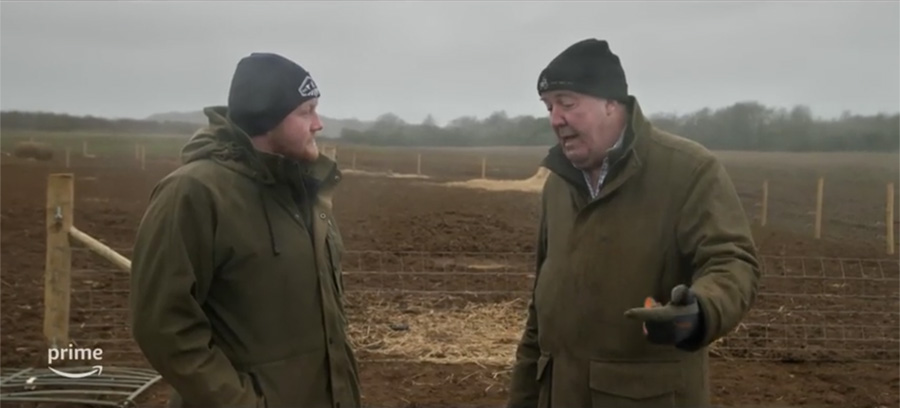
Distributism may be making a comeback, and it’s coming from the most unlikely place: a reality TV show about farming.
For those who aren’t well-versed in the economic discussions that were taking place at the turn of the twentieth century, Distributism was an economic theory meant to represent a middle ground between socialism and capitalism and a direct response to the mass industrialization happening in the West. Among its advocates were Pope Leo XIII (the current pope’s namesake), G.K. Chesterton, Hilaire Belloc, and to some extent J.R.R. Tolkien.
In general, Distributism called for decentralizing capital and localizing economic enterprises. Instead of Big Business or Big Government acting as the main employer of a population, people would work for themselves on a much smaller scale, tilling the fields, working the trades, mastering the crafts, or specializing in a profession. To make this happen, the government would appropriate most of a country’s property and allocate plots of land to individual households. Property rights and commerce would be protected and regulated through local governance, and community and civic culture would primarily take place at the local church, guilds, and tavern.
While this would neither generate the immense wealth of a free market capitalist system nor ensure the fully egalitarian society of a socialist system, a Distributist economy promised a more autonomous, peaceful, natural, and fulfilling way of life.
Never Really Tried
Unfortunately, the idea never really took hold. Some of this had to do with the logistics of implementation, but most of it was due to a lack of imagination. Even though Distributism was the default economic system that preceded the industrial revolutions, modern Westerners even a century ago were long since conditioned to see work in terms of wage slavery and corporate managerialism. Even if governments offered free land and workshops on how to homestead (which was actually tried in England), people wouldn’t know how to do it successfully, nor would many of them really want to do it.
Thus, cites continued to grow, the countryside depopulated, all production was streamlined and automated to the maximum degree, and work became all the more alienating and dehumanizing. Now, people are no longer neighbors or citizens; they are producers and consumers. While living standards and technological innovation should not be taken for granted, today’s globalized capitalist system has induced a widespread malaise in the developed world that might prompt people to reconsider the principles of Distributism.
Fresh Appeal
Oddly enough, this reconsideration is precisely what explains the appeal of the television series Clarkson’s Farm, which has just released its fourth season. The show focuses on British TV personality and writer Jeremy Clarkson, who buys a farm in Oxfordshire and learns to run it. In the process, Clarkson comes to see just how difficult the work is and how marginalized farming communities are in today’s world. The government and global market have come together to reduce British farms to inconsequential boutique outfits that cater to crunchy locavores and wealthy urbanites wanting some pretty countryside to look at while they sip their wine while sitting on the porch of their summer home.
As the show progresses, Clarkson takes an increasingly greater interest not just in farming work, but also in the people who do this work, as well as the kind of life they have. From an unabashed capitalist in liberal England who became a global celebrity by driving fast cars and cracking jokes about Greta Thunberg, he gradually morphs into an Old World conservative who grouses about the local council and poor weather. Instead of testing the new supercar on a road trip through the Swiss Alps, he is filing paperwork to buy a farm-to-plate pub and restaurant and organizing a local farming cooperative.
In so many ways, Clarkson becomes a modern-day Distributist, trading away city life for country life. Although he makes a number of mistakes in his endeavors, he also demonstrates the beauty, virtue, and freedom that come from operating a farm. True, the work can be grueling, the challenges innumerable, and the prospects of financial ruin unavoidable, but this still seems more alluring and adventurous than the typical white-collar or blue-collar job.
Returning to the Roots?
Besides setting an example for others, Clarkson shows that this kind of life is actually possible. For the vast majority of viewers who only know life in cities and suburbs, watching Clarkson drive a tractor and chase after pigs is nothing short of a revelation. There really is life beyond the online retailer, corporate hierarchies, and addictive algorithms of social media. It might not be the idyllic pastoral paradise of Wordsworth’s poems, but it’s far more humanizing and rich than what counts as the good life for most Westerners in the twenty-first century.
Although it may be stretch to predict an exodus of disenchanted millennials and Zoomers to flee to the fields and make their fortunes in the abandoned villages and small towns of England and America, there is good reason to expect at least a good number of them will do so. In The End of the World Is Just Beginning, analyst and prognosticator Peter Zeihan predicts a predicts a deglobalized world order that will force today’s nations to rediscover the virtues of regionalism and localism. Communities would emerge organically, as self-sufficient households operate independent of the needs of the global market or the leviathan state. They would grow their own food, make their own goods, and connect with one another in purposeful fellowship.
Such an outcome would probably be too good to be true, but also too attractive to ignore. Most people recognize that the pendulum of progress needs to swing away from the fakeness of contemporary life toward something more grounded. In any cases, it’s significant that men like Clarkson (and apparently a host of other celebrities) are making the switch, and seem happier for it.
Beyond making for good television, people today might come to realize that it makes for a good life.
Auguste Meyrat is the founding editor of The Everyman, a senior contributor to The Federalist, and has written essays for Newsweek, The American Mind, The American Conservative, Religion and Liberty, Crisis Magazine, and elsewhere. Follow him on X and Substack.