


Catholic Students Protest UK University’s ‘Christian’ Trigger Warning on Canterbury Tales
Anti-Christian red alert ignores antisemitism, cannibalism, poisoning, hanging, beheading, and suicide in other literary works
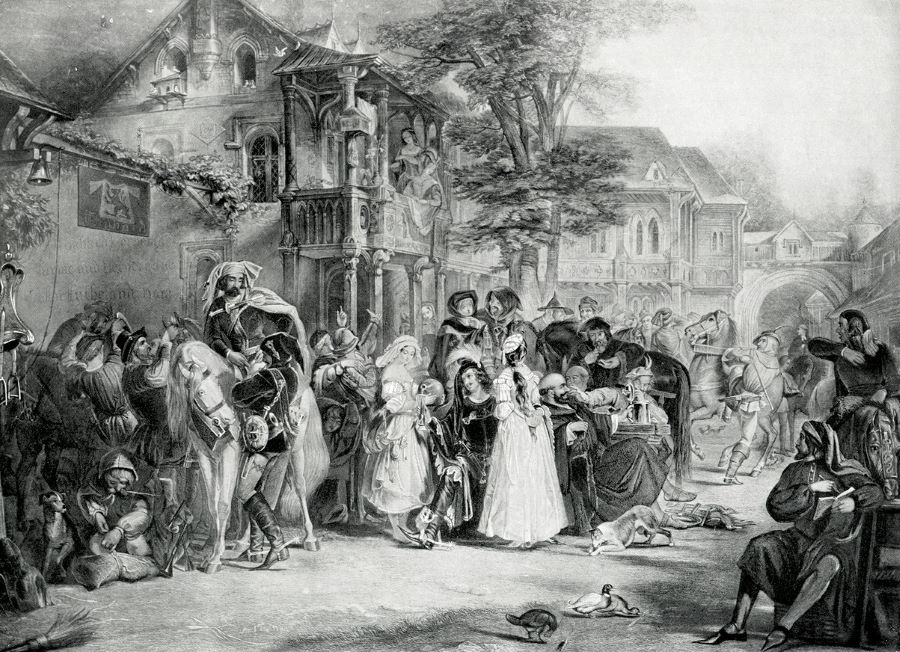
Engraving from 1894 showing the pilgrims and Chaucer from the Canterbury Tales.
Catholic students have joined free-speech advocates across Britain in expressing outrage after a prestigious British university slapped a trigger warning on Geoffrey Chaucer’s The Canterbury Tales due to its “expressions of Christian faith.”
Nottingham University, which named the building housing its Law School after Chaucer, warned of “incidences of violence, mental illness and expressions of Christian faith” in a notice issued to students enrolled in a module titled Chaucer and His Contemporaries, c.1380-c.1420.
The Canterbury Tales is about a group of pilgrims who entertain each other with stories on their way to visit the shrine of Saint Thomas Becket at Canterbury Cathedral.
The Mail on Sunday broke the story October 13 after it used a Freedom of Information request to obtain details of the trigger warning issued to students.
Censoring Christianity
The warning also covers other texts in the literature module, including Sir Gawain and the Green Knight, a late 14th-century chivalric romance replete with the Christian themes of mercy, forgiveness, and escaping sin.
Chaucer’s fellow medieval writers John Gower and Thomas Hoccleve are also placed under the trigger warning, which is believed to have been issued by the course convenor, Dr. Joanna Martin, associate professor in Middle English and Older Scots.
William Langland, who writes about “rich ecclesiastical politics” and “Christian virtue” in the classic poem “The Vision of Piers Plowman” — which has been described as “one of the greatest poems of the English Middle Ages” — has also been subjected to the university’s woke red alert.
In a statement published on social media, Nottingham University’s Catholic Society noted that the trigger warning
sends a deeply concerning message to all students that Christian beliefs — which are central not only to many University students, but also to the intellectual and cultural foundations of English history — are somehow offensive or harmful to others.
To single out Christian perspectives this way is to dismiss the vital role that Christianity has played in shaping this country’s literature, philosophy and society. The implications that Christian values are uniquely problematic is a severe form of discrimination that has no place in academia.
The university’s evangelical student body Christian Union did not cosign the statement when approached by the Catholic Society, and has not issued a statement of its own.
Woke Agendas
Edmund Adamus, Secretary to the Commission of Inquiry into Discrimination Against Christians UK (CIDAC), told The Stream that it’s ironic to see this coming from Nottingham University, given the name of its law school building. It’s also deeply concerning.
“We share growing concerns about higher education becoming increasingly stymied by extreme left-wing woke agendas as the principles of critical thought and academic freedom are lost,” Adamus noted.
“Students are losing out on a genuinely open and rewarding education, especially about great historical figures and their achievements whose lives were steeped in the Christian life and customs of the British Isles. It’s time to stop telling young people to only view Britain’s heritage through the lens of an anti-Christian bias.”
Trigger-Warning Epidemic
In 2022, an investigation by The Times revealed that multiple British universities, including the prestigious Russell Group universities of Warwick, Exeter, and Glasgow, had slapped trigger warnings on more than 1,000 literary works, including those by Chaucer, William Shakespeare, Jane Austen, and Charles Dickens.
In 2017, the University of Glasgow in Scotland admitted it had issued similar warnings to theology students enrolled in the module “Creation to Apocalypse: Introduction to the Bible (Level 1).” The warnings said that a lecture on Jesus and cinema sometimes “contains graphic scenes of the crucifixion, and this is flagged up to students beforehand.”
Students of forensic science at Strathclyde University in Glasgow were given a “verbal warning … at the beginning of some lectures where sensitive images, involving blood patterns, crime scenes and bodies, etc. are in the presentation.”
Archaeology students at Stirling University were issued a “warning in advance of one image in a PowerPoint, which is of a well-preserved archaeological body from an archaeological context” because of the “risk it is found a bit gruesome.”
Oxford University was mocked for issuing trigger warnings to law students in 2016, alerting them to potentially distressing lectures about rape and sexual assault.
Christianity Worse Than Cannibalism?
Writing for the British journal Spiked, columnist Joanna Williams listed the “trauma,” “violent scenes,” and “blood libel” that “abound in Chaucer’s work,” like
the grim pursuit of death in ‘The Pardoner’s Tale’ that leads to one murder by stabbing and two by poisoning.
“The Monk’s Tale” goes one better. It features cannibalism, poisoning, hanging, beheading, suicide and children starving to death. “The Wife of Bath” — who was hit round the head by a former husband until she lost her hearing in one ear — tells of a young “mayde” who was raped by a “lusty bacheler” from King Arthur’s court.
“The fact that rape, child abuse, knife crime or anti-Semitism were not flagged up, while students were warned about ‘expressions of Christianity’, exposes the true purpose that now lies behind trigger warnings,” Williams remarked.
By highlighting Christianity as the supposed problem, Nottingham lecturers are signaling to students that Chaucer’s work is a relic from an unenlightened past—a product of an era where diversity, equity and inclusion did not figure.
University Defends Diversity
Nottingham University spokesperson told The Stream that the school “champions diversity, and its student body is made up of people of all faiths and none.” (The standing policy for most universities in the United Kingdom is not to reveal the names of spokespeople.)
“This content notice does not assume that all our students come from a Christian background, but even those students who are practicing Christians will find aspects of the late-medieval worldview they will encounter in Chaucer and others alienating and strange,” he explained.
“All students may appreciate knowing in advance about some perspectives that will be covered, for example, the anti-Islamic sentiments of some medieval writers.”
Explaining why the trigger warning exclusively targeted Christianity, the spokesperson said: “In relation to why no content warning was offered in relation to the sexual and antisemitic themes in some of Chaucer’s work, while Canterbury Tales do indeed contain both sexual frankness and antisemitism, the content notice relates only to the specific texts studied on the module, not to Chaucer’s works in their entirety.”
University’s Anti-Christian Bias
Nottingham University’s anti-Christian bias has surfaced repeatedly in several reported incidents over the last few years.
In 2020, the school suspended 25-year-old Julia Rynkiewicz and began investigating her fitness to practice after she was appointed as president of Nottingham Students for Life (NSFL) — a pro-life student organization.
The university accused of Rynkiewicz of expressing personal beliefs regarding reproductive sexual health in the public domain (including the press and social media) to the effect that it might create the perception of an impact on patient care.
Rynkiewicz responded by demanding an apology from the university “as a matter of justice.” University authorities agreed to a financial settlement and apologized.
In July 2019, pro-abortion students launched a hate campaign against NSLF seeking to deny the group affiliation in the Nottingham University Students’ Union (NUSU).
After weeks of hostility, NUSU reversed its decision after NSLF threatened legal action.
In August 2021, Nottingham University refused to recognize Fr. David Palmer as chaplain to its Catholic community, raising concerns over his tweets on abortion and euthanasia.
Palmer had criticized US President Joe Biden for promoting the “slaughter of unborn babies” and also commented on proposed changes to assisted euthanasia legislation, noting that then-Health Secretary Matt Hancock was going to allow Britain’s National Health Service to “kill the vulnerable.”
The university later accepted his nomination, allowing Palmer to take up his post after a “revised procedure” involving a trial year was introduced for all chaplaincies.
Dr. Jules Gomes, (BA, BD, MTh, PhD), has a doctorate in biblical studies from the University of Cambridge. Currently a Vatican-accredited journalist based in Rome, he is the author of five books and several academic articles. Gomes lectured at Catholic and Protestant seminaries and universities and was canon theologian and artistic director at Liverpool Cathedral.