


Capitalizing on College: Q and A with Dr. Joshua Brown
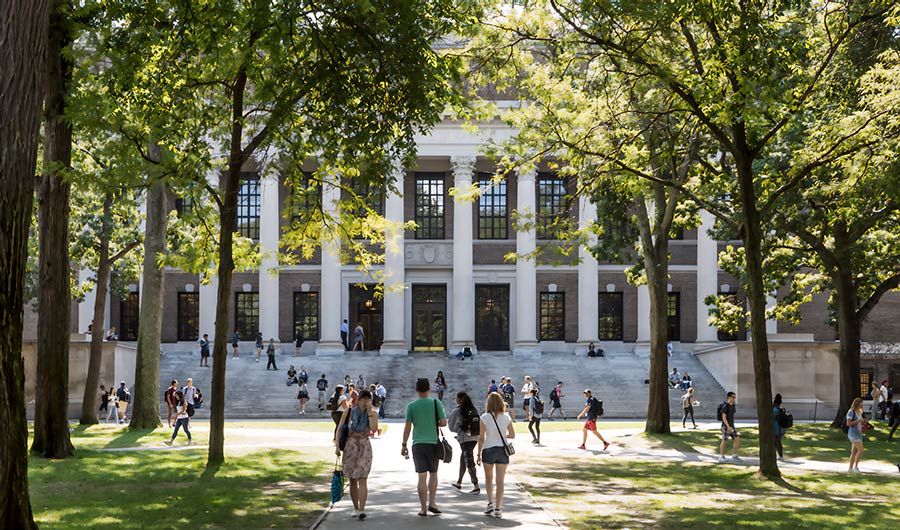
Students and tourists rest in lawn chairs in Harvard Yard, the open old heart of Harvard University campus in Cambridge, Massachusetts.
As a college professor for the past 20 years, it’s hard to pass up a new book with a title like Capitalizing on College: How Higher Education Went from Mission Driven to Margin Obsessed. Author Joshua Brown sets out to explain how colleges are responding to the expanding role of market forces in higher education and their increased dependency on tuition revenue.
Until the end of WWII, students paid or worked to cover the part of their tuition not covered by Uncle Sam (for state schools) or donors (for private schools). That changed with the GI Bill, which created an indirect path for colleges to receive federal funding by recruiting veterans. This then expanded dramatically with the 1958 National Defense Education Act, which created the federal student loan system we see today.
 Most four-year college students use federal loans to fund at least some of their tuition or living expenses.
These developments boosted market incentives for colleges to compete for students. Simply put, for most colleges, the greater the enrollment, the greater the income from federal dollars. Since the 2008 recession, which prompted many states to reduce their education support, state colleges and universities were incentivized to recruit out-of-state or international students because both would pay more. The common thread: increased competition for students, and the tuition dollars they represent.
If you’re wondering about endowments, those can be used to subsidize tuition. But the lion’s share of endowment donations flow to the wealthiest universities, like Harvard and Yale. Many (if not most) colleges have little to no endowment-generated revenue. They live or die by tuition.
Now, consider the fact that the cost of a college education keeps rising. Manpower, facilities, regulatory expectations, you name it: The residential college experience is a cost-intensive service. But if you grow your student body, you can leverage economies of scale, either lowering your per-pupil costs or offering fancier services to beat your competitors in the race to snag even more students.
How are colleges handling these market forces? And how do financial pressures impact the mission of private Christian colleges, both Protestant and Catholic? That’s what Capitalizing on College seeks to address. Recently, Dr. Brown took time to answer a few questions for us.
The Stream: You outline four different strategies that private Christian colleges employ. Briefly, what are they?
Joshua Brown: Each school creates different combinations of endowments and enrollment markets to financially sustain the school and its mission. I found four different approaches and a fifth that was starting to emerge. Briefly they were:
- Traditional — a college that expects students “to come” to the residential campus for a traditional in-person education. Leaders solicit donations from a robust web of alumni to grow the endowment. The money generated from the endowment is used to subsidize the expensive in-person residential model.
- Pioneer — a college that “goes to” the students to deliver an in-person education in places like high schools, military bases, hotels, and shopping malls to those excluded from the traditional on campus model (usually due to life commitments like jobs, children or distance). The money generated from these “periphery” locations is used to build nicer facilities on the main campus for recruiting residential students.
- Network — a college that creates multiple types of educational opportunities beyond its main residential campus (adult education, online, international, transfer, satellite, branch campus, etc.). These many different options function like legs on a table to financially support the main residential campus (tabletop).
- Accelerated — a college that chooses to rapidly scale its online division to generate a substantial amount of money each year — ranging from hundreds of millions to over a billion dollars. The money is used to build nicer facilities on the main residential campus and grow the endowment using money from student loans rather than from donors, essentially making current students the “new philanthropists.”
In my conversations with Christian college leaders, some were working hard to figure out how to create a new approach called “Accelerated Networks” that would generate “superprofits,” which are profits that compound to make additional profits.
TS: Is it particularly challenging to be financially viable with the traditional or pioneer strategies?
JB: It is challenging to keep the Traditional and Pioneer models viable on student tuition revenues alone. What makes it challenging is that leaders must solve one of two problems.
The first is to find enough donors to simultaneously tackle two financial fronts — grow the endowment and overhaul the campus facilities. What happened to the traditional schools in the book is that they successfully raised $200M-$400M over a decade, but all that money went to transforming their physical campus to attract residential students and keep them from going to peer institutions. That money did not go to the endowment; it went to buildings. The fundraising efforts ended up being an either/or, leaving college leaders looking for new income options.
The second is that for this model to work, I believe there needs to be an alternate revenue stream of some type to subsidize the college, similar to the way in which Abeka Press supports Pensacola Christian College or the way the Church of Latter-Day Saints substantially supports its three different BYU campuses. Many Protestant denominations have moved away from financially supporting the Christian colleges they established in years past. Additionally, the rise of “nondenominational” churches nationally has played a role in the lessening of church-related financial support for Christian colleges.
TS: What you call the “accelerated” strategy seems to bring the most numerical success. But what are the downsides of this?
JB: I think the downside of this strategy is best captured in a conversation I had with an administrator who was also a pastor. The university I mention in the book that uses this strategy relied on a giant “engine” to generate its money — a call center army of employees in cubicles tasked with making sales in a high-pressure environment where everyone is monitored via technology. Reflecting on the success of that financial engine, the administrator and pastor told me, “The call centers by their very nature are dehumanizing … I think we forget about the humans in the process … I think we forget what is supposedly a core belief of ours, that we are image-bearers, and no matter what people do, whoever they are, they have value.” An important downside of the numerical success in the accelerated strategy is a tendency to forget core beliefs in the rapid race to the top.
There are other downsides to the strategy mentioned in the book that I could discuss here, but I feel it is important for readers to sit with the words of this Christian college leader who reflected on the tension he faced daily in his own job.
TS: Many parents still aspire for their teens to have a residential Christian college experience. As they consider their options, what questions should they be asking?
JB: Three questions come to mind for parents and teens to consider as they visit Christian colleges:
- Can you focus on the “who” as much as the “where” in your search? Given that mentoring plays an important role in education, is there a person or persons you aspire to learn from? Do research on the faculty just as much as the institution.
- Ask (in writing) if the institutional financial aid awards will change from year to year, or what circumstances would cause financial aid to decrease in years, two, three, or four. As the book explains — and parents should read — some schools front load financial aid to attract, knowing that aid can diminish over time under certain circumstances. Be aware of these circumstances!
- Ask recent alumni what they thought about their experience. I did this when looking at PhD programs and reached out to a handful of people. Some wrote brief responses, and others replied with lengthy, nostalgic responses filled with advice that I put to use. You can ask the alumni office for suggested people to contact or just browse social media outlets and reach out to those you find.
Alex Chediak (Ph.D., U.C. Berkeley) is a professor and the author of Thriving at College (Tyndale House, 2011), a roadmap for how students can best navigate the challenges of their college years. His latest book is Beating the College Debt Trap. Learn more about him at www.alexchediak.com or follow him on Twitter (@chediak).