


British Christians Secure Historic Victory, Setting Legal Precedent for Free Speech
Evangelical mother of two wins six-year court battle to express views biblical concerning transgenderism and gay marriage
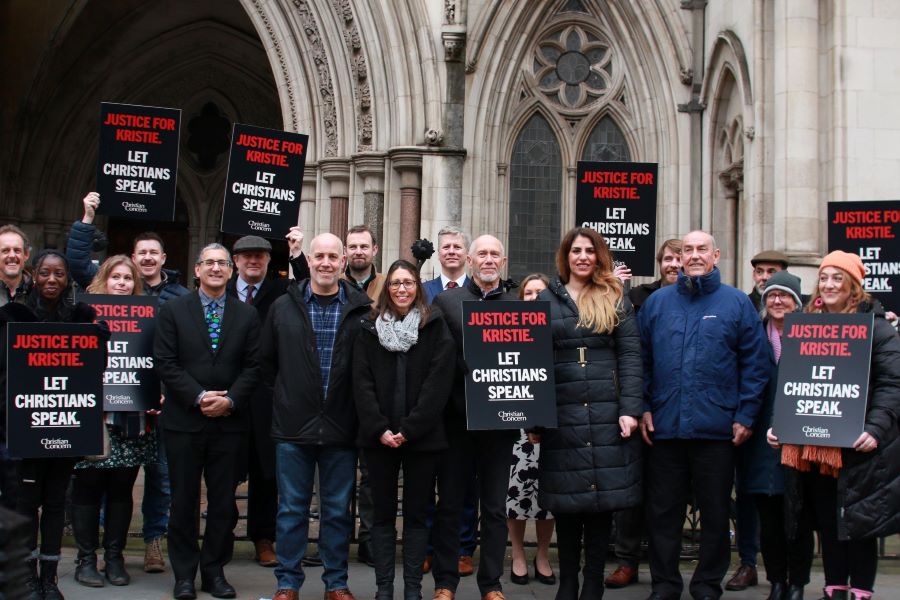
Kristie Higgs (center, with scarf) along with many supporters from Christian Concern at the Court of Appeal in Britain. Higgs celebrated a landmark legal victory there on Feb. 12, 2025.
Christians in Britain are celebrating a momentous victory for free speech after a landmark legal ruling confirmed that British law protects their right to express traditional views on controversial ethical issues like transgenderism and same-sex marriage.
The Court of Appeal on Wednesday upheld the rights of Kristie Higgs, an evangelical Christian who was fired in 2019 by Farmor’s secondary school in Fairford, Gloucestershire, on the basis of a single anonymous complaint which alleged that her Facebook posts were homophobic and transphobic.
In 2018, Higgs — a pastoral administrator and work experience manager at Farmor’s — shared her concerns about policies at her son’s school by reposting Facebook messages about the government’s new sex-education program that was “brainwashing our children” into thinking that “same-sex marriage is exactly the same as traditional marriage, and that gender is a matter of choice, not biology.”
“We say again, this is a vicious form of totalitarianism aimed at suppressing Christianity and removing it from the public arena,” Higgs added in her posts. She also linked her Facebook post to a CitizenGo.Org petition campaigning for “the right of parents to have children educated in line with their religious beliefs.”
School Compares Christian Beliefs to Neo-Nazism
Higgs’s Facebook account was under her maiden name rather than the married name she used for her work at Farmor’s, and contained nothing which suggested any connection with the school.
Higgs also reposted messages from American Christians objecting to materials used in U.S. schools complaining that “kindergarten and first-grade children are being primed for a gender-fluid society.”
Critics alleged that Higgs, a mother of two who had an exemplary record at her job, was a neo-Nazi. In 2019, she was fired for gross misconduct. Farmor’s told Higgs that her private posts could “[bring] the school into disrepute.”
Higgs asserted that her sacking was due to her religious beliefs, her stance against “gender fluidity,” and the concept that people cannot change their biological sex — all of which are protected beliefs under Britain’s Equality Act 2010.
Higgs Loses Appeal
The Bristol Employment Tribunal dismissed Higgs’s plea for justice in 2020, ruling that Farmor’s “did not directly discriminate against the claimant on the ground of religion” and “did not harass the claimant.” The tribunal also refused to reveal the identity of the complainant.
It concluded that Higgs’s dismissal was not related to the Christian beliefs she expressed on Facebook, but rather “the result of a genuine belief on the part of the school that she had committed gross misconduct.”
In 2023, Higgs appealed the verdict to an Employment Appeal Tribunal. Ruling in her favor, the court declared that “the freedom to manifest belief (religious or otherwise) and to express views relating to that belief are essential rights in any democracy, whether or not the belief in question is popular or mainstream and even if its expression may offend.”
Nevertheless, the judge forwarded the case to another tribunal for a fresh decision on whether her dismissal was legal. Higgs’s lawyers described the step as “unnecessary.”
Victory at Last
Last Wednesday, Higgs won a resounding victory when the three judges on the panel ruled that an employer cannot dismiss an employee “merely because they have expressed a religious belief” which may damage their employer’s reputation.
The court noted that Higgs’s posts expressed two beliefs, albeit hyperbolically: (1) that gender is binary and not “fluid” and (2) same-sex marriage cannot be equated with traditional marriage, and therefore it is wrong to teach anything different to children, especially those in primary school.
Further, the posts concerned the pro-LGBTQ lessons being taught at her son’s Church of England primary school.
In a 57-page ruling, Lord Justice Underhill wrote that Higgs’s posts were not grossly offensive but a series of derogatory sneers, noting: “I do not believe that dismissal was even arguably a proportionate sanction for the claimant’s conduct.”
The judge elaborated:
It was no doubt unwise of her to re-post material expressed in (to use the Employment Tribunal’s words) florid and provocative language with which she did not agree, and in circumstances where people were liable to realise her connection with the school. But I cannot accept that that can justify her dismissal, and still less so where she was a long-serving employee against whose actual work there was no complaint of any kind.
Seminal Judgment Sets Precedent for Free Speech
Andrea Williams, chief executive of the Christian Legal Centre, the judicial arm of the advocacy group Christian Concern, which supported Higgs in her battles, described the ruling as “a seminal judgment for Christian freedom and free speech,” that “reexamines and reshapes England’s law on religious discrimination.”
“For the first time in employment law, the judgment has effectively established a legal presumption that any dismissal for an expression or manifestation of Christian faith is illegal,” Williams said. “The outcome of Kristie’s case sets an important legal precedent for many years to come.
“The Court of Appeal has confirmed, loud and clear, that ideological censorship at workplace is illegal, and any employer who tramples upon their employees’ right to freedom of thought, conscience, and religion breaks the law of the land.”
“This ruling is generally recognized to be extremely significant,” explained Tim Dieppe, who leads the public policy division at Christian Concern. “The Equalities and Human Rights Commission intervened in it because of its importance, as did the Free Speech Union, the Association of Christian Teachers, Sex Matters and the Church of England Archbishop’s Council.
“At least one other important freedom of expression case has delayed its hearing until after this judgment came out.”
Joanne Moseley, a senior practice development lawyer, wrote in an op-ed for Schools Week that the ruling sets “a crucial precedent for employee rights and employer responsibilities regarding the expression of controversial views in the workplace.”
Higgs herself waxed exultant when the ruling was released.
“Expressing biblical Christian teaching on gender and sexuality may appear to be offensive to those who hold the opposite views, but as today’s judgment signals, Christians have a right to express their beliefs publicly,” she told the media.
“This is not just about me. Too many Christians have suffered discipline or marginalisation at their work because of their Christian faith.”
Dr. Jules Gomes, (BA, BD, MTh, PhD), has a doctorate in biblical studies from the University of Cambridge. Currently a Vatican-accredited journalist based in Rome, he is the author of five books and several academic articles. Gomes lectured at Catholic and Protestant seminaries and universities and was canon theologian and artistic director at Liverpool Cathedral.