


Ayatollah Who Praised Pope Francis Issues Fatwa Against U.S. President Donald Trump
Iran’s top cleric earlier attacked Pope Benedict for a discourse on the violent spread of Islam
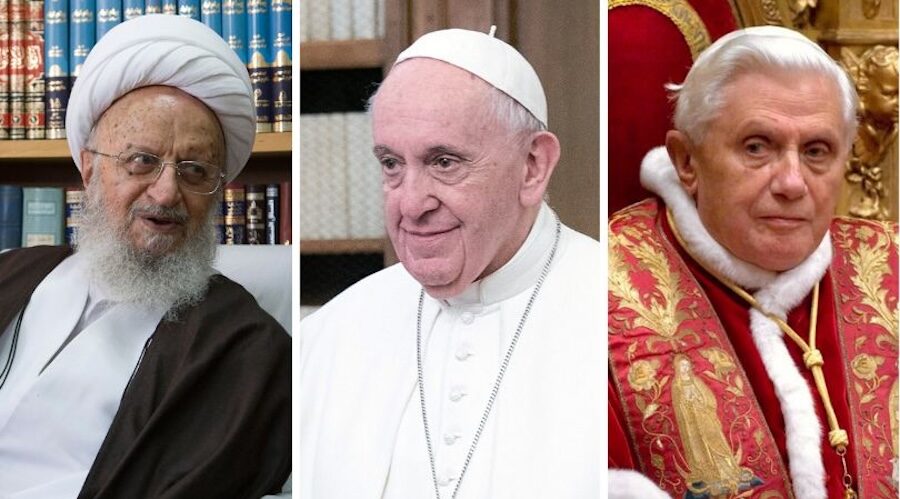
Iran’s highest-ranking Shiite cleric, who has issued a religious edict calling for the assassination of U.S. President Donald Trump, lauded Pope Francis for his refusal to link Islam with terrorism.
On Sunday, Grand Ayatollah Naser Makarem Shirazi released his signed and sealed fatwa in response to an Estefta (formal religious query) declaring Trump and Israeli leaders as Mohareb (an enemy of Allah).
The text of the Estefta and fatwa was published by the Iranian Republic state media and multiple state-controlled Iranian news outlets.
Iranian Expert Explains Fatwa
The Estefta asked the Ayatollah to issue a ruling on how Muslims across the world should respond to threats made by the “U.S. President and the leaders of the Zionist regime” for threatening to assassinate the Supreme Leader Ayatollah Ali Khamenei and other Iranian leaders.
Declaring Trump and Israel’s leaders to be Mohareb (enemy of Allah), Shirazi’s fatwa urged “Muslims across the world to make these enemies regret their words and their wrongdoing,” warning that “any collaboration with or assistance to them is Haram (forbidden).”
The fatwa assures Muslims who cause “harm or hardship” to Trump and Israel’s leaders that they will “be rewarded as Mojaeh (warriors) in the path of Allah, if Allah wills it.”
Khosro Isfahani, a senior research analyst at the National Union for Democracy in Iran, explained that Mohareb is the subject who carries out the act of Moharebeh (or Moharibah), which is widely translated as “enmity against Allah,” or “waging war against Allah.”
The Qur’an 5:33 prescribes “death, crucifixion, cutting off their hands and feet on opposite sides, or exile from the land” as “the penalty for those who wage war against Allah and his Messenger.”
Article 279 of Iran’s Islamic Penal Code punishes Moharebeh with the death penalty.
Grand Ayatollah Hails Pope Francis’s Stance on Islam
In a twist of irony, Shirazi had sent a letter to Pope Francis in August 2016, praising him for his efforts to clarify that Islam is not connected to the violent terrorism perpetrated by jihadist militias like the Sunni-led Islamic State (also known as ISIS or Daesh).
“I am really delighted to have heard your comments during your last trip to Poland in which you stated ‘Islam is not equal to terrorism’ and further dismissed the association of violence and harshness with any and all divinely-sent religions,” the Grand Ayatollah wrote. “Your wise and logical stance regarding Islam in disassociating the religion from the inhumane actions and atrocities of the Takfiri (apostate) groups such as Daesh is truly admirable.”
Francis Equates Islamic Jihad with Catholic Violence
On August 1, 2016, reporters aboard the pope’s plane after a five-day pilgrimage to Poland asked him why he never uses the word “Islam” to describe terrorism or other violence.
“It’s not right to identify Islam with violence. It’s not right and it’s not true,” Francis replied. “I don’t like to talk of Islamic violence because every day, when I go through the newspapers, I see violence. And these are baptized Catholics. If I speak of Islamic violence, then I have to speak of Catholic violence.”
The pope was asked about the murder of Fr. Jaques Hamel, an 86-year-old Catholic priest who was murdered by knife-wielding Islamic State killers during a church service in western France earlier that year.
Francis said he had spoken with imams, adding: “I know how they think, they are looking for peace.” The pope emphasized that ISIS presents itself “with a violent identity card, but that’s not Islam.”
Shirazi “Skillfully Fools Francis”
Responding to Francis’s commendation of Islam, the Grand Ayatollah noted:
As you have also clearly stated, such barbaric acts have nothing to do with divinely sent religions and their various schools of thought. Rather, they originate from the inferior materialistic objectives of some corrupt superpowers who seek nothing but to obtain more illegitimate wealth.
Shirazi said he “strongly condemned the Takfiris’ vicious terrorist attack on the French church, which led to the cruel murder of a priest.” The Ayatollah said that he had written earlier to Francis, stating that “all of the scholars of the Muslim world as well as the vast majority of the Muslim people consider all Takfiri sects to be outside the fold of Islam.”
Islamic scholar Robert Spencer explained to The Stream how “the Shi’ite Shirazi skillfully fooled Pope Francis” by “merely objecting to the actions of Sunni ISIS, and using his objections to ISIS to bamboozle Francis into thinking that he rejected Islamic terrorism.”
“His death fatwa against Trump and Netanyahu shows otherwise,” noted Spencer, who has penned 25 books on Islam and the Middle East. “Shirazi is being consistent with his theology. He believes that ISIS is heretical, but that doesn’t mean he rejects the Qur’an’s death penalty for those who ‘wage war against Allah and his messenger’ (5:33). Yet most Catholic leaders, including Pope Leo, who punctiliously refrained from naming the Islamic perpetrators even as he condemned jihad massacres in Nigeria and Syria, continue to assume, without any actual evidence, that true Islam is peaceful. Shirazi has been among those who have made them comfortable in this delusion, but of course, the chief impetus for their clinging to it is how desperately they wish it were true.”
Grand Ayatollah Attacks Pope Benedict
Ironically, the Grand Ayatollah attacked Pope Benedict XVI in September 2006 for his utterances in Germany, “rebuking and reproaching Islam and the ruling of Islamic Jihad (Holy War), hurting the feelings of all Muslims.”
In a letter sent to the Vatican’s embassy in Tehran, Shirazi challenged Benedict “to participate in a scientific and logical debate in a live broadcast” to discuss if “Islam advocates violence or invites to peace, amity and kindness” and if “Islam spread throughout the world through the force of sword or the extreme logic, reasoning and attraction of Islamic culture.”
Shirazi was responding to Benedict XVI’s famous speech at the University of Regensburg, in which he quoted a 14th-century Byzantine emperor who described Islam as a religion spread through violence.
“It was certainly not the intention of the Holy Father to do an in-depth study of jihad and Muslim thinking in this field and still less so to hurt the feelings of Muslim believers,” the pope’s spokesman, Fr. Federico Lombardi, apologetically remarked.
Isfahani explained that the latest fatwa against Trump is similar to one issued in February 1989 by the Islamic Republic’s first Supreme Leader, Ayatollah Ruhollah Khomeini, calling for the killing of British author Salman Rushdie in reaction to his novel The Satanic Verses.
Khomeini’s death in 1989 did not invalidate the fatwa. In 2022, Iran’s leaders celebrated its partial achievement when Hadi Mattar stabbed Rushdie in an attempt on his life.
Dr. Jules Gomes (BA, BD, MTh, PhD) has a doctorate in biblical studies from the University of Cambridge. Currently a Vatican-accredited journalist based in Rome, he is the author of five books and several academic articles. Gomes lectured at Catholic and Protestant seminaries and universities and was canon theologian and artistic director at Liverpool Cathedral.